Del Rio International Airport Drives Val Verde Economy, Workforce, and Military Training
Del Rio's airport is the only one with commercial service in a 150-mile radius, connecting border-region travelers to Dallas and the world via American Airlines.
Victoria Vargas, Public Relations Director for the City of Del Rio, puts it plainly: "We are the only airport with commercial service in about a 150-mile radius. So, it's very convenient, not only for our city, but for surrounding cities, including those in Mexico, to come to our Airport, then to fly to Dallas with American Airlines to wherever they want in the world." That singular status makes Del Rio International Airport (IATA: DRT, ICAO: KDRT) far more than a local convenience. Sitting two miles northwest of downtown Del Rio, only several miles from the Mexican border, the airport anchors Val Verde County's connectivity to the national air travel network while serving a dual role as a training ground for the U.S. Air Force's largest pilot training base.
A Facility Built for a Border Region
Del Rio International Airport covers 268 acres at an elevation of 1,002 feet above mean sea level, with a single 6,300-foot asphalt runway designated Runway 13/31. Those dimensions are modest by major-metro standards, but they are sufficient for commercial regional jets and the general aviation traffic that moves through this corner of Southwest Texas daily. Federal Aviation Administration data from 2010 recorded 15,357 aircraft operations and 42 based aircraft at the field, figures that reflect the steady rhythm of a working airport serving a geographically isolated population.
The airport functions as both a commercial and general aviation facility, meaning it handles everything from scheduled airline departures to private and training flights. That dual-use character is not incidental; it is baked into the airport's history and its present relationship with Laughlin Air Force Base, which sits on the other side of the city.
Governance: City Ownership, Advisory Oversight
The airport is owned by the City of Del Rio and administered by a seven-member Airport Advisory Board appointed by the Del Rio City Council. The board carries responsibility for the airport's operations and development, providing civilian oversight of a facility that serves both the commercial traveling public and, indirectly, military training missions next door.
That governance structure is the product of a long ownership evolution. Airport Manager Juan Carlos Onofre traces the lineage directly to World War II: "When the war was over, they turned those fields back to the municipalities and counties. This one, in particular, was returned to Val Verde County in 1945. Since then, it was owned and operated by the county, but back in the 1960's, the county turned it over to the city, and now, it's run by the city."
The transition from wartime military asset to county property to city-managed commercial airport mirrors a pattern repeated across the American Southwest, but Del Rio's version carries particular weight given what happened to the military installation next door.
Laughlin Air Force Base: The Neighbor That Never Stopped Flying
Laughlin Air Force Base was commissioned in 1943 as Laughlin Army Air Field, originally built to train B-26 pilots and aircrews for World War II combat missions. Unlike many wartime airfields that faded into farmland or light industrial use after 1945, Laughlin never stood down. Today it is the largest pilot training base in the U.S. Air Force, home to the 47th Flying Training Wing of the Air Education and Training Command.
The scale of activity at Laughlin is difficult to overstate: on weekdays, the base sees more takeoffs and landings than any other airport in the country. That volume of sortie activity creates a natural operational overlap with Del Rio International Airport. USAF students conducting training flights regularly use DRT as part of those exercises, making the civilian airport a functional extension of the military training environment that dominates the local airspace.
That relationship shapes the economic and workforce character of the entire county. A community where the neighboring military installation generates the highest single-day flight volume in the nation is a community with aviation embedded in its identity, its labor market, and its infrastructure planning.
Commercial Service and Regional Connectivity
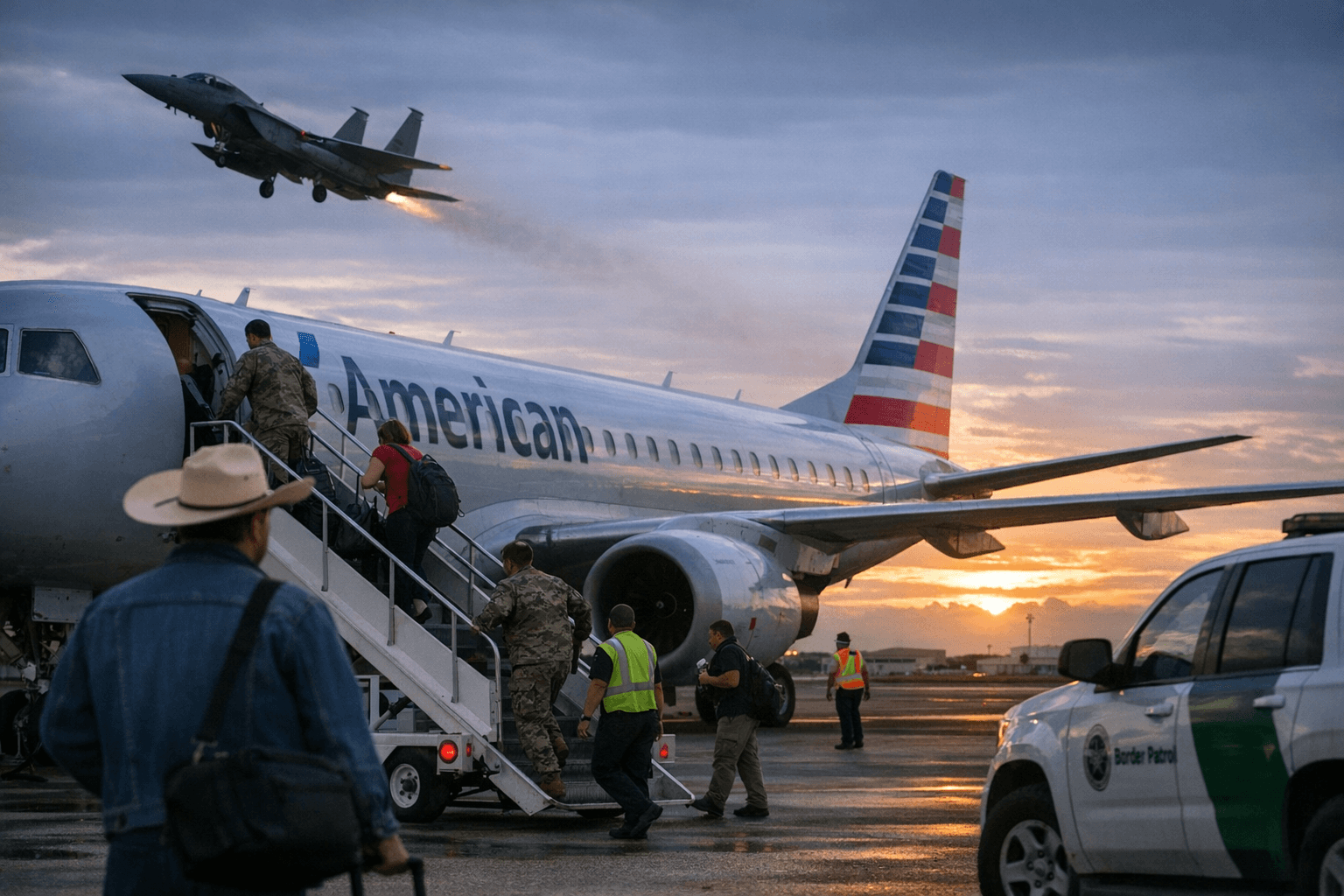
For travelers in Val Verde County and the surrounding region, Del Rio International Airport's commercial service is the gateway to the global air network. The airport's preferred airline partners are American Airlines and Envoy Air, a wholly owned subsidiary of American Airlines that operates regional routes. The connection to Dallas opens onward access to American's international and domestic network.
Vargas's point about cross-border convenience is not rhetorical. Residents of Mexican border communities within driving distance of Del Rio use the airport to access U.S. commercial aviation, making DRT a genuinely binational facility in practical terms even if its formal designation is a U.S. domestic airport.
A Commercial History Built in Stages
The airport's commercial aviation history did not begin with the current terminal. For four or five years starting in 1949, Trans-Texas Airways operated Douglas DC-3 flights connecting Del Rio to El Paso, Houston, San Antonio, and other Texas cities. Those flights, however, used a separate facility: Val Verde County Airport, located east of town. That earlier field closed around 1959 to 1960.
The first commercial airline to operate from the present Del Rio International Airport was Wild Goose Airlines in 1964, flying Piper Aztecs between Eagle Pass and San Antonio. That inaugural service established the current field as a commercial gateway, though consistent scheduled service took decades to stabilize.
More recently, between May and November 2017, Texas Sky Airlines, operated by Contour Aviation, ran a daily British Aerospace Jetstream service between Del Rio International Airport and Dallas/Fort Worth International Airport. That route offered a direct DFW connection before the current American Airlines arrangement took shape through Envoy Air's regional operations.
The Workforce and Education Dimension
Beyond its role as a travel hub and military training auxiliary, Del Rio International Airport sits at the center of a broader effort to develop aviation workforce capacity in Val Verde County. Local aviation education investments have been identified as a key component of expanding the airport's role in the regional economy, building a pipeline of trained personnel suited to the demands of both the civilian airport and the high-tempo training environment at Laughlin AFB. The specific programs, funding sources, institutional partners, and workforce outcomes tied to those investments represent an area of active development for the county.
What DRT Means for Val Verde County
Strip away the aviation jargon and the historical footnotes, and what remains is a straightforward economic reality: a 268-acre airport two miles from downtown Del Rio is doing work that no other facility within 150 miles can do. It connects Val Verde County to the American Airlines network, supports the training missions of the Air Force's busiest pilot production base, and serves a cross-border population that has no comparable alternative. The seven-member Airport Advisory Board and the City of Del Rio manage that responsibility under a governance structure shaped by decisions made in 1945 and the 1960s, now pointed toward a future where aviation workforce development and military training needs are only growing more complex.
This article was produced by Prism’s automated news system from verified source data, official records, and press releases, then run through automated quality and moderation checks before publishing. The system is built and supervised by the people who set the standards it runs under. Read our full AI policy.
Did this article answer your question?