Langtry Landowners, Archaeologists Alarmed by Border Wall Construction Letters
A Langtry family that has owned land near the Rio Grande since the 1940s received a federal letter signaling a border wall could cut through their property, where thousands-year-old rock art still lines the cliffs.

Raymond Skiles Jr., whose family has owned land near Langtry since the 1940s, recently received a letter in the mail. The letter appeared to indicate the federal government's plans to construct a physical border wall directly through his property. For Skiles, the news was not just personal. His land sits at the confluence of some of the most archaeologically significant terrain in all of West Texas.
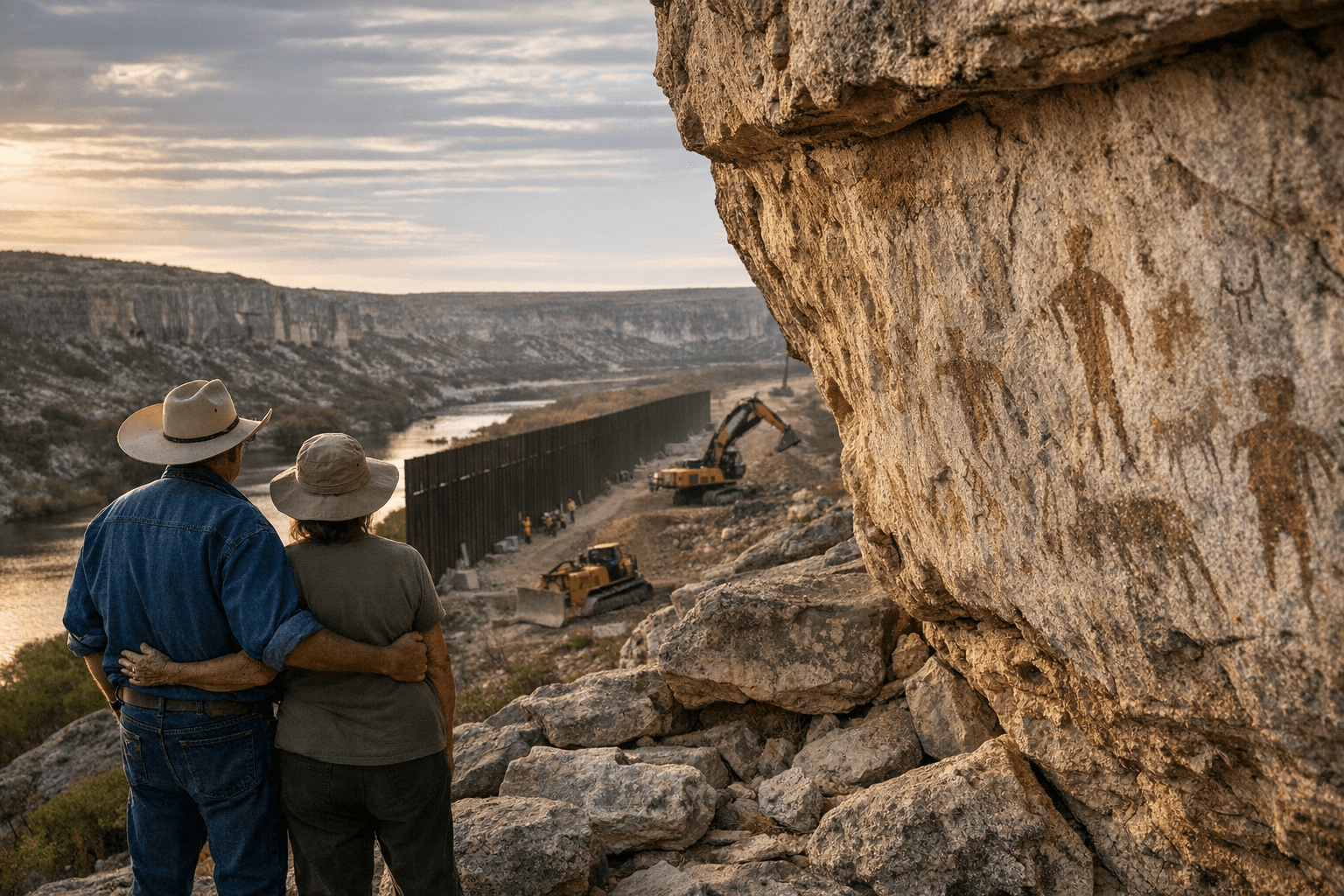
Skiles' property, which sits directly next to the Judge Roy Bean Museum, is historic in several ways. After a trip down to the Rio Grande, Skiles said he would lose access to it should a wall be built. He took reporters to several cliff overhangs just off the river, where humans have lived for thousands of years.
The crown jewel of this area is the rock art that prehistoric societies left behind. Hundreds of vivid paintings exist throughout the lower Pecos River where it meets the Rio Grande. "The oldest of the murals: the Pecos River-style, which are really the most abundant, and I consider the most majestic of all the rock art traditions, were first produced around 5,700 years ago," said Dr. Carolyn Boyd, an archaeologist and founder of Shumla, whose goal is to decode, study, and preserve the art. Some of these sites span hundreds of feet long and 30 feet in height.
Skiles' frustration centers as much on silence as on the prospect of steel bollards. "There's been no communication verbally. No one to pick up the phone and give a call," Skiles said. "The documents don't say you can discuss this or make suggestions for improvement by calling some person."
Many others like Skiles along the Rio Grande, from Big Bend up to Lake Amistad, have received correspondence from the government. With little information publicly available and, in most cases, no direct pathway of communication with CBP, landowners described anger and frustration over a project they say could upend their lives and livelihoods.
Skiles said the concerns span the political spectrum. "I've never seen such a community-wide, native response, you know, anything that unified people as much," Skiles said. "And I'm talking Republicans, extremists, tree huggers." Skiles believes that physical barriers are good deterrents in populated areas, but questions why one is needed in the barren, rugged territory of Val Verde County and the greater Big Bend region.
He pointed to the sheer geography of his own property. "Even if you decided, 'OK, let's put in some barriers' — taking the time to look at the landscape and say, 'Well, look right over there, for a quarter-mile are sheer 100-foot cliffs,'" Skiles said. "Do we really need to put a 35-foot steel wall on top of a 100-foot cliff?"
U.S. Customs and Border Protection stated that for all border wall construction projects, CBP conducts outreach to solicit feedback from landowners and interested stakeholders to seek input on the project's potential impacts to the environment, cultural resources, quality of life and commerce. CBP's goal, the agency said, is to mitigate impacts to environmental resources to the greatest extent possible while still meeting the U.S. Border Patrol's operational requirements. The public outreach period for the Val Verde County project closed in February 2026, though materials including a map of the planned alignment remain available on the CBP website.
While this part of Val Verde County is considered part of the Big Bend region, those who live here feel as though they are getting lost in the shuffle as attention and advocacy concentrate further west toward Presidio and Brewster counties. For the Skiles family and the archaeologists working to protect 5,700-year-old murals along Eagle's Nest Creek, that sense of being overlooked may carry a permanent cost.
This article was produced by Prism’s automated news system from verified source data, official records, and press releases, then run through automated quality and moderation checks before publishing. The system is built and supervised by the people who set the standards it runs under. Read our full AI policy.
Did this article answer your question?