Whitehead Memorial Museum Preserves Val Verde County History Across 2.5-Acre Complex
Judge Roy Bean's actual grave anchors the only full-time public museum in Val Verde County, a 2.5-acre complex of 19 historic buildings in Del Rio.
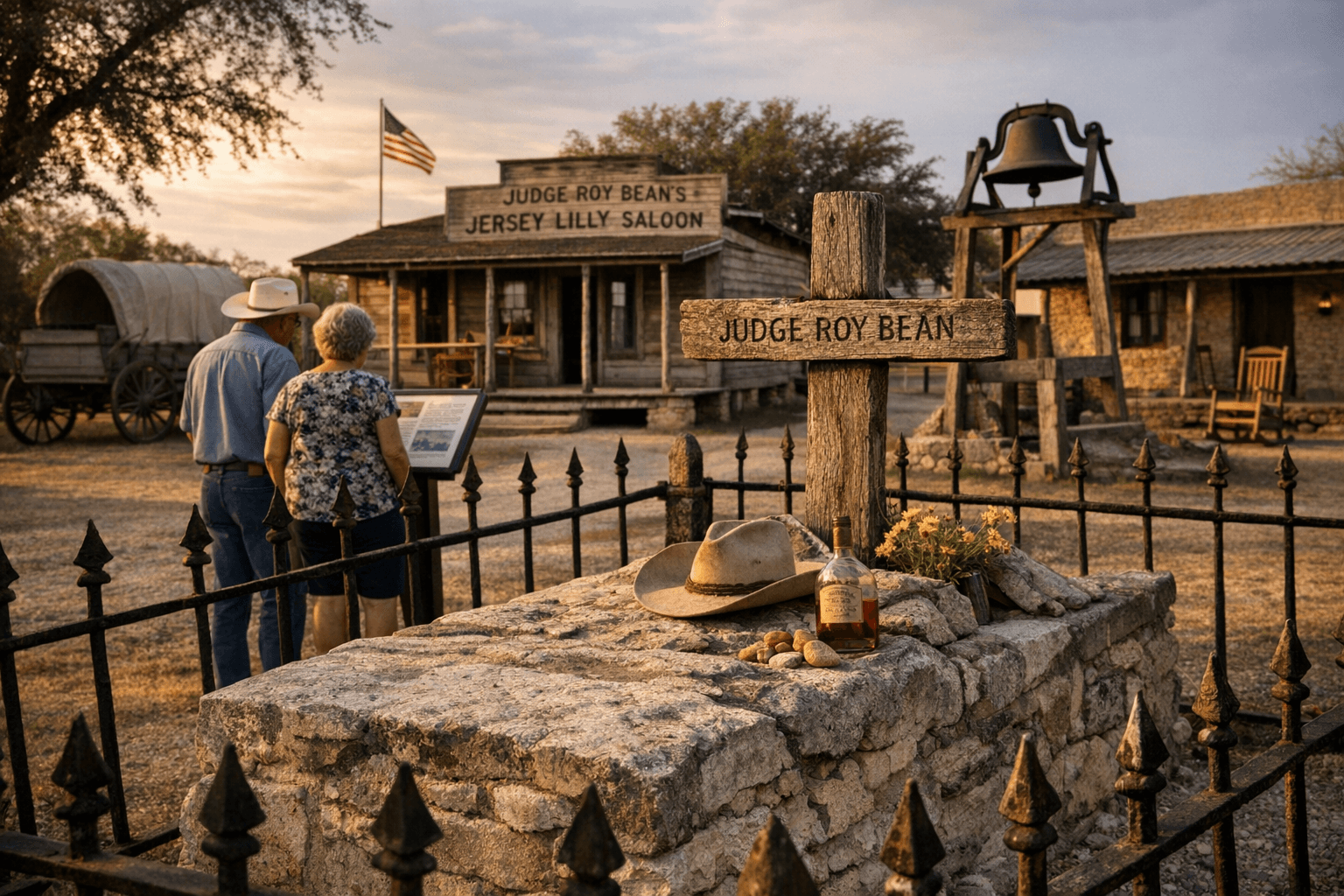
Few Texas museums can claim what sits quietly behind a wrought-iron fence on the grounds of 1308 S. Main St. in Del Rio: the actual graves of Judge Roy Bean, the self-proclaimed "Law West of the Pecos," and his son Sam Bean (1874-1907). Their remains were relocated from Westlawn Cemetery in Del Rio in 1964, after a surviving relative authorized the move to protect the gravesites from vandals and souvenir hunters. That decision placed two of the American Southwest's most storied figures permanently inside the Whitehead Memorial Museum, the only full-time, public museum in Val Verde County.
The museum is no single-room archive. Since the Whitehead ranching family purchased the historic Perry Mercantile Building and donated it to the City of Del Rio and Val Verde County in 1962, the complex has grown into a 2.5-acre campus of 19 restored and replica historic buildings and more than 30 exhibit sites. Founding patron Della Whitehead said it plainly: "The museum belongs to the entire community." More than six decades later, that founding conviction still shapes what visitors find here.
The Building That Launched a Museum
The Perry Mercantile Building is both the oldest structure in the complex and the oldest commercial building in Del Rio. Merchant John Perry constructed the two-story frame around 1870-1871; at the time, it was said to be the largest store between San Antonio and El Paso, a statement that speaks to the commercial reach of this borderland crossroads. The Whitehead family purchased the building from Vernon Perry, the last Perry family member to hold it, and the donation to the city and county set the museum's founding in motion.
Inside, the building preserves living quarters, period artifacts, and military memorabilia that convey the texture of 19th-century commerce along the Rio Grande. It anchors the museum's stated mission: "to preserve historical and tangible artifacts that reflect the early history, diverse cultures, and economics of the region."
In January 1975, the Whitehead family formalized the institution's future by donating the museum in a joint trust to the City of Del Rio and Val Verde County, designating it as a memorial to Mr. and Mrs. Walter E. Whitehead and Mr. and Mrs. Will Whitehead.
Nineteen Buildings, Thirty Exhibit Sites
Walking the 2.5-acre grounds feels less like a conventional museum visit and more like stepping through a compressed frontier village. A chapel, a log cabin, a blacksmith shop, and a barn housing early farming and transportation equipment give physical form to the daily realities of 19th-century settlement. Each structure is either restored or authentically replicated, producing a campus where context accumulates building by building.
A 1905 wood-frame office houses two of the museum's most distinctive exhibits. The first is a dedicated display on the Black Seminole Scouts, a U.S. Army unit with deep roots in the Texas borderlands and a history that intersects directly with this stretch of the Rio Grande. The second chronicles the high-powered border radio stations that broadcast from the region beginning in the 1920s; those transmitters, operating just across the river from Del Rio, reached audiences across North America and represent a chapter of media history unique to the borderlands. Exhibits across the complex also interpret Native American history, ranching, the railroad, and early commerce, threading together the multicultural story of a county shaped by the convergence of Spanish colonial, Indigenous, Anglo-American, and Mexican influences.
Judge Roy Bean and The Jersey Lilly
The museum's replica of "The Jersey Lilly" saloon re-creates the frontier courtroom and drinking establishment that Bean operated in Langtry, Texas, naming it after British actress Lillie Langtry. Furnished with period artifacts, the replica captures the improbable setting where Bean dispensed summary justice on the arid western frontier. It is one of the museum's most recognizable features, and it draws visitors who arrive already familiar with the Bean legend.
Bean died peacefully in his bed on March 16, 1903. His son Sam, born in 1874, was killed in a street fight four years later. The pair had been buried at Westlawn Cemetery in Del Rio until 1964, when their relocation to the museum grounds placed them inside the institution that now interprets their era. A Texas Historical Marker honoring Judge Roy Bean was erected in 1965 on the museum grounds, giving the site formal recognition as a place of historical significance.
Ima Jo Fleetwood Park and the Daughtry Research Center
At the rear of the property, Ima Jo Fleetwood Park extends the museum's offerings beyond its primary exhibit buildings. The park houses the Cadena Nativity collection, a distinct curatorial thread within the complex. It also contains the Daughtry Research Center, which serves genealogists and historians seeking access to archival materials. Researchers planning to use the center should contact the museum in advance to arrange an appointment, as access is typically coordinated with staff.
Why Val Verde County Needs This Institution
Val Verde County was carved from Pecos, Kinney, and Crockett counties in 1885; its name, Spanish for "green valley," was drawn from a Civil War-era battle that marked the region's place in national history. The 2020 Census recorded a county population of 47,586, with Del Rio accounting for 34,673 of those residents. Approximately 80% of the county's population is Hispanic, a proportion that reflects the deep borderland and binational character of a place whose earliest recorded European name, San Felipe del Rio, traces to Spanish explorers said to have offered Mass at the area's springs on St. Philip's Day in 1635.
With no other full-time public museum in the county, the Whitehead Memorial Museum carries singular institutional weight. The artifacts and stories housed here, from early trading post goods and ranching tools to exhibits on the Black Seminole Scouts, have no other permanent home in Val Verde County. The institution functions as an anchor for cultural tourism, complementing Seminole Canyon State Park, where prehistoric rock art illuminates pre-contact lifeways, and Amistad National Recreation Area. Together, these three sites offer a layered picture of the county's past: Seminole Canyon reaches back thousands of years, while the Whitehead complex interprets the post-contact centuries of settlement, commerce, and community formation.
Planning Your Visit
Current hours are Tuesday through Friday from 10:00 a.m. to 6:00 p.m., Saturday from 12:00 p.m. to 6:00 p.m., and Sunday from 1:00 p.m. to 5:00 p.m. The museum is closed on Mondays. Hours may shift for holidays or special events, so confirming before traveling is worthwhile.
- Phone: (830) 774-7568
- Email: info@whiteheadmuseum.org
- Address: 1308 S. Main St., Del Rio, TX 78840
Plan on one to two hours for a thorough walk through the grounds and exhibits. Group tours, school programming, and sleepover programs for students, scouts, and church groups are available; those visits benefit from advance coordination with museum staff. The 2.5-acre footprint is appropriate for families, though visitors with mobility considerations should review exhibit pathways when planning. Researchers seeking archival materials through the Daughtry Research Center should call ahead to arrange appointment-based access.
The museum staff recommends confirming opening times for special exhibits or school-group visits, and those traveling from outside Del Rio should call ahead to verify staffing and exhibit availability. The museum's website also provides current visitor information, including details on programming and special events.
More than six decades after Della Whitehead purchased a neglected two-story mercantile building on South Main Street and set a community institution in motion, the complex she described as belonging to everyone in Del Rio continues to grow. Its 19 buildings hold borderland stories that exist nowhere else in Val Verde County, and its grounds hold the grave of a man whose legend long outlasted the frontier he once policed.
This article was produced by Prism’s automated news system from verified source data, official records, and press releases, then run through automated quality and moderation checks before publishing. The system is built and supervised by the people who set the standards it runs under. Read our full AI policy.
Did this article answer your question?