Fischer Building in Zaleski remains Vinton County’s tallest historic landmark
Zaleski’s Fischer Building still rises above the village, tying Masonic lodge life, storefront commerce and preservation questions to one 1884 landmark.
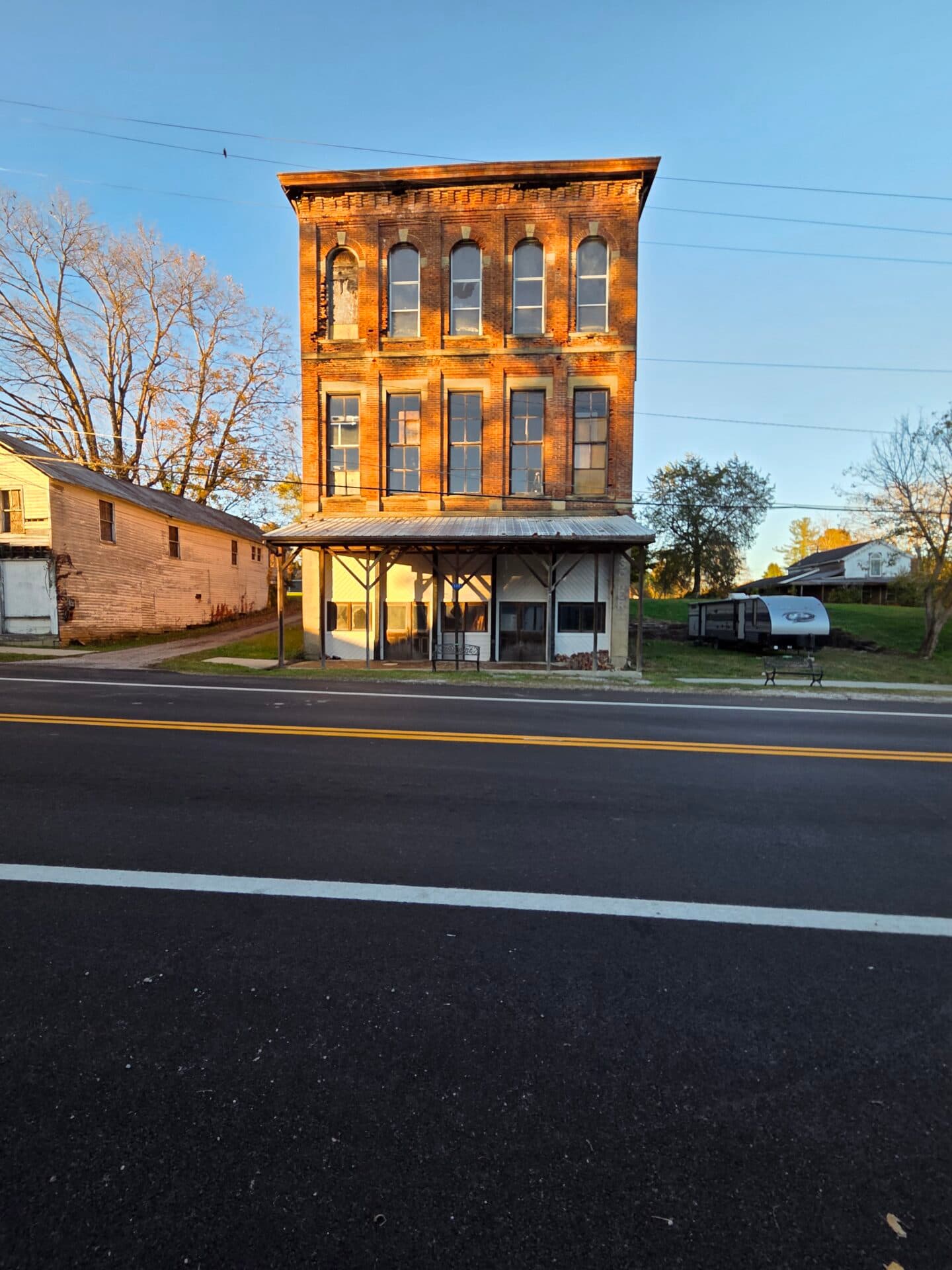
The Fischer Building still defines downtown Zaleski from its perch at 18 Commercial Street, where a three-story frame of stone, brick and Italianate detail has outlasted the boom that built it. It was the tallest building in Vinton County when it went up in 1884, and it remains the county’s tallest historic landmark today, aside from an industrial building at Austin Powder.
A landmark built for a village that once punched above its weight
The building’s scale tells the story before its history does. The National Register nomination describes it as a private, three-story Italianate commercial structure with stone and brick bearing walls, a low hip roof, a sandstone foundation and first floor, and a metal roof. Its footprint measures about 34 feet by 70 feet, the front facade is five bays wide, and the east and west sides are six bays wide, with Masonic symbols carved into the third-floor keystones.
That combination of size and ornament made sense in a village that was growing fast. Zaleski was platted in 1856 and incorporated in 1875, then expanded around iron production, timber and the Marietta & Cincinnati Railroad. A local historical marker places the village’s railroad-era growth in the early 1860s, when large shops were built and helped support the town. In its industrial heyday, Zaleski is described as a booming community of about 1,500 people, a scale that helps explain why a substantial lodge and commercial block could stand at the center of the village.
The building’s recorded names also reflect that layered past. The National Register nomination identifies it as Masonic Lodge No. 472, with Fischer Building, VIN-215-8, as an alternate name and site number. That dual identity matters in Zaleski because the structure was never just a lodge hall or just a storefront; it was both, and it sat in plain view on the village’s main street.
What happened on each floor
The building’s interior use made it a social machine as much as an architectural one. The first floor originally held a store and later served as a restaurant, keeping commerce on the street level where village traffic passed every day. The second floor had a stage and was used for plays, dances, commencements and religious services, turning the building into one of the few places in town where different parts of civic life could share the same roof.
The third floor was reserved for the Masonic Lodge and the Eastern Star Chapter, which anchored the building’s fraternal purpose. That arrangement shows how a small village organized itself in the late 19th and early 20th centuries: business below, community gathering in the middle, lodge work above. In one building, Zaleski housed trade, entertainment, ceremony and fraternal ritual.
That mix is one reason the Fischer Building remains easy to explain to visitors and residents alike. It is not a relic of a single institution; it is a record of how a village made use of one strong structure to meet several needs at once. The National Register nomination judged the property significant at the local level, which fits its history exactly. Its importance is intensely tied to Zaleski and to the people who once filled its rooms.
The preservation challenge is visible from the street
The building’s exterior still carries much of its original logic, even after decades of wear. The sandstone storefront was later covered with wood siding, some windows were bricked or boarded up, and the roofline has corbelled brickwork. The Vinton County CVB notes that the building has suffered vandalism and alterations and is presently unoccupied, while also saying it has been secured to prevent further destructive damage.
That tension is central to any conversation about reuse. The structure has enough integrity to be listed on the National Register, yet enough visible change and vacancy to make stewardship urgent. The nomination was certified by Ohio Historic Preservation Office official Barbara Pave on January 5, 2000, and the National Park Service listed the property on March 9, 2000. Those dates matter because they mark the moment the building’s local value was formally recognized, even as its future remained unresolved.
The listing does not freeze the building in time, but it does establish a case for care. A privately owned landmark in the middle of a small village cannot survive on memory alone, especially when it has already weathered vandalism, patchwork alterations and long stretches without a tenant. The building’s survival to this point is a form of endurance, not a guarantee.
Why the Fischer Building still fits the county’s larger story
Zaleski’s current identity is shaped as much by surrounding forest land as by the old village core. Zaleski State Forest covers 27,822 acres, making it the second-largest state forest in Ohio, and it operates the state’s only state-owned sawmill. That modern landscape keeps the village connected to timber and land use, even as the old industrial center has shrunk.
The Fischer Building sits inside that larger pattern. It reflects the era when Zaleski was a railroad and iron town with enough activity to support multi-story commercial construction, and it still marks the center of the village today. In a place where the built environment can feel sparse, a single structure of this size does more than fill a corner lot. It gives the village a vertical reference point, a reminder of the period when Zaleski’s ambitions were visible in brick, stone and height.
The building’s value now is practical as well as symbolic. As preservation and reuse questions move to the front, the Fischer Building offers a real test case for what small communities can do with landmark properties that are historic, vacant and still structurally commanding. In Zaleski, the answer to what anchors civic pride may already be standing on Commercial Street.
This article was produced by Prism’s automated news system from verified source data, official records, and press releases, then run through automated quality and moderation checks before publishing. The system is built and supervised by the people who set the standards it runs under. Read our full AI policy.
Did this article answer your question?