McArthur preserve turns former mine land into tourism site
A former brick plant site in McArthur now gives Vinton County a place to walk, learn, and tour while mine scars are turned into public land.
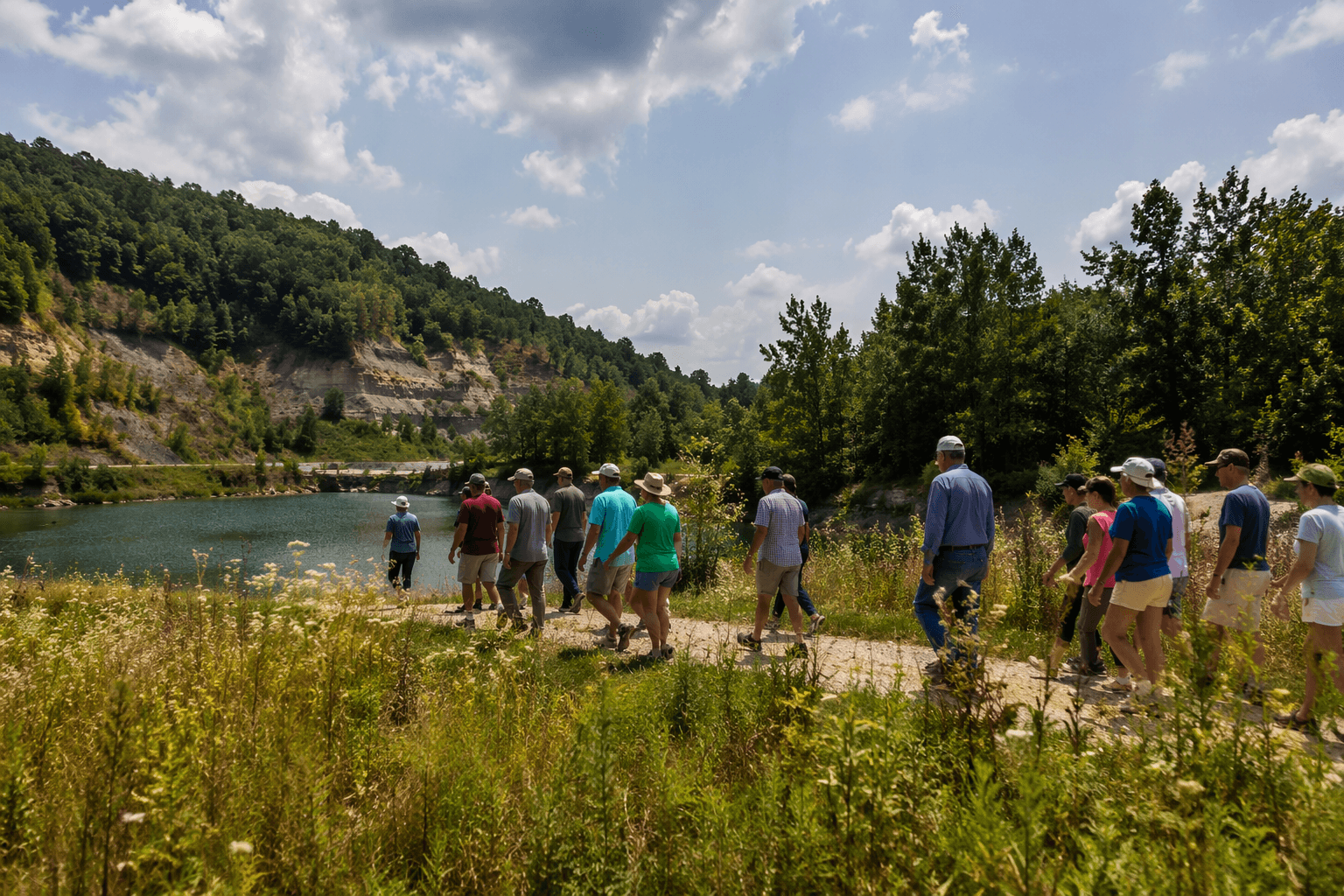
The McArthur Brick Company Historic Preserve turns a former mine-and-brick site into one of the most unusual public stops in Vinton County: a place where locals can walk, read the landscape, and bring visitors to see what industry left behind. On 158 acres in the McArthur area, the preserve now mixes young forest, wetland habitat, and scattered remnants of the brick company that once ranked among the county’s largest employers.
A preserve built on what the land still remembers
What makes the site compelling is that it does not hide its past. The Vinton County Park District says the property still holds remnants of the McArthur Brick Company, and the Ohio Department of Natural Resources says the preserve is meant to protect wetlands, wildlife, rock outcroppings, and historical structures while telling the story of the mining that came before. Interpretive and educational signs are part of that plan, so the site works both as a walking destination and as an outdoor classroom.
That combination matters in McArthur because the land is not a blank slate. The preserve sits on ground affected by erosion tied to pre-SMCRA mining activity, the kind of damage that predates stronger reclamation rules. Rather than strip away the industrial history, the project leaves enough of it visible that a visitor can still see how extraction shaped the site, then see how restoration is changing it.
From brick country to public ground
Vinton County’s industrial timeline at the site stretches back more than a century. Visit Vinton County says the McArthur Brick Company opened in 1905, and the Puritan Brick Plant opened in 1909 and was said to be the largest in this part of the state. Ohio University Libraries’ archive of Puritan Brick Company records confirms that the original buildings were finished in 1909, that Puritan shut down during World War I, and that the plant grounds were later leased to McArthur Brick Company.
That history ended in the early 1960s, when McArthur Brick Company ceased operations. Today, the preserve is being shaped by a different purpose. Instead of feeding a kiln, the land is being stabilized, interpreted, and opened up for public use, with the old industrial footprint still visible enough to anchor the story.
Caleb Appleman, the park district’s acting director, said he and others spent about a year researching pre-ODNR records on coal mines around McArthur and the brick company’s history. He said the former brick plant is now owned by the Vinton County Park District and is planned to become a community park. That local research gives the project a rare kind of credibility: the people steering it are not treating the site like a generic green space, but like a place whose past needs to be understood before it can be used well.
Why the cleanup is about more than scenery
The preservation work is tied to a $2.825 million abandoned mine land and economic revitalization project. ODNR says the funding is reclaiming abandoned mine lands at the 158-acre preserve and addressing erosion problems left by pre-SMCRA mining. It is a reminder that old mine land is not just a historical issue. It is also a practical one, because erosion, unstable ground, and damaged habitat can keep a site from safely serving the public.
ODNR says the preserve project is designed to protect wetlands, wildlife, rock outcroppings, and historic structures, while also supporting tourism. The agency estimates the work will reach about 17,000 community members and bring in 4,000 additional visitors, with around 20 jobs expected. Those numbers give the project a local footprint beyond conservation: the work is meant to create a place people use, not just a parcel that looks better from the road.
The preserve also fits into a larger statewide policy story. ODNR says Ohio’s abandoned mine land programs are aimed at problems left by coal mining before modern reclamation rules, and the state’s first coal-mining regulation, the Strip Coal Mining Act, took effect in 1947. In that context, McArthur is part of a broader effort to repair sites that were built for extraction and left to communities after the jobs were gone.
What visitors can see now
The preserve already offers a landscape that looks and feels different from the abandoned industrial ground that came before. The park district says the site features a young forest and wetland environment with plentiful wildlife. For a visitor, that means the trip is not just about history panels. It is about a visible transition in the land itself, from a working industrial site to a living habitat.
Because the preserve still shows the remains of the brick company across the property, the visit has a built-in before-and-after effect. You can read the signs, look at the landforms, and understand how reclamation is changing a place that once helped build McArthur’s economy. That is especially valuable for families, students, and out-of-town guests who may know Vinton County for recreation but not for the industrial work that preceded it.
How it fits into a weekend in Vinton County
The preserve also works as part of a broader outdoor outing. County minutes say CT Consultants has been developing a connectivity plan between the village of McArthur and the park, including a sidewalk along State Route 93. That kind of access planning matters because a preserved site is only useful if people can actually reach it on foot, by bike, or in combination with other nearby stops.
The project is still being built out in stages. County minutes said roughly $40,000 in site improvements remained before July 2024 as part of the McArthur Brick Co. Historic Preserve and Treebeard’s Retreat Clean Ohio project. In December 2024, the park district said it planned to request $220,000 to complete three miles of trail development at the preserve and $80,000 to surface about four miles of the Moonville Rail Trail. That means the preserve is not standing alone. It is being tied into a longer trail system that can shape how visitors spend a day in the county.
There is also a practical reuse story here. County minutes show the village of Zaleski asked about using bridge trusses stored at the railyard as railings at the park, and both the Moonville Rail Trail Association and the park district supported the idea. That kind of reuse keeps the preserve rooted in local materials and local decision-making, rather than importing a polished but disconnected version of recreation.
The preserve fits naturally beside the Moonville Rail Trail, the county’s wooded hills, and the broader outdoor identity Vinton County promotes. What used to be a place of extraction is becoming a place of access, and in McArthur, that change is visible in the land itself.
This article was produced by Prism’s automated news system from verified source data, official records, and press releases, then run through automated quality and moderation checks before publishing. The system is built and supervised by the people who set the standards it runs under. Read our full AI policy.
Did this article answer your question?