Moonville Tunnel Blends Civil War Era Railroad History With Modern Hiking
Ghost hunters and hikers both claim Moonville Tunnel, but the one-lane cliff road above Raccoon Creek closes in winter ice, and incomplete bridge crossings still block the full 10-mile route.
Moonville Tunnel draws visitors from across Ohio with century-old ghost stories and a spot on the National Register of Historic Places, but the last mile of gravel road to Vinton County's most famous site narrows to a single lane above Raccoon Creek's cliff edge and can shut down entirely under winter ice. The Vinton County Park District sets legal hours at 6 a.m. to 11 p.m. every day of the week, and visiting beyond that window requires a Special Use Permit. What no posted sign fully captures is the condition of the approach itself: that gap between Moonville's growing reputation and its real-world road and trail conditions is the challenge that the Moonville Rail Trail Association and the Park District are still working to close.
A Railroad Built on One Man's Land Deal
The tunnel's existence traces back not to any government plan but to a private transaction in 1856. As the Marietta and Cincinnati Railroad scouted southeastern Ohio for a viable corridor, a landowner named Samuel Coe offered his property to the company at no cost, on a single condition: the line had to cross his land so he could use it to haul coal and clay. The railroad accepted, because the route also reduced the distance to Cincinnati. That agreement carved a rail corridor through terrain that is now Zaleski State Forest and set off a wave of small-town growth along Raccoon Creek. In 1883, the line passed to the Baltimore and Ohio Railroad, but the corridor's industrial purpose remained the same until mining activity declined and the communities it had created began to dissolve.
The Town That Peaked at 100 People
Moonville itself was always small. At its height in the 1870s, a little over 100 people lived there, their homes scattered across hollows and hillsides within a couple of miles of the rail line. Families like the Shirkeys, Kennards, and Fergusons built along the creek; the Coe family ran a lumber and grist mill. A man named Mr. Moon, who operated the town's general store, gave the settlement one of its claimed name origins, though local lore also credits the way a full moon would burn brilliantly above the tunnel entrance on clear nights. The coal mined at Moonville supplied regional furnaces, including the nearby Hope Furnace. As seams thinned and mines closed, the population left. What survives today is a scatter of stone foundations, old brick piles, a small cemetery, and the brick-lined tunnel itself, all accessible from the trail.
The Ghost Story That Outlasted the Railroad
If Moonville had faded quietly, it might be a footnote in a county history book. Instead, the tunnel became the anchor of one of Ohio's most persistent ghost legends. According to the most widely told version, a railroad brakeman was struck and killed by a train near the tunnel, his death decapitating him. His spirit is said to haunt the site, swinging a lantern in the dark corridor for eternity. The legend proved stubborn enough that in 1981, the railroad had to install a dedicated signal at Moonville specifically because so many locomotive engineers were triggering emergency braking after spotting the swinging light in the corridor. Crews received formal instructions to disregard any lantern or flashlight signal and rely only on the installed marker. That the railroad responded to a ghost story with operational infrastructure is the detail that has locked Moonville into Ohio folklore for more than a century, and it is the single sharpest share hook in Vinton County tourism.
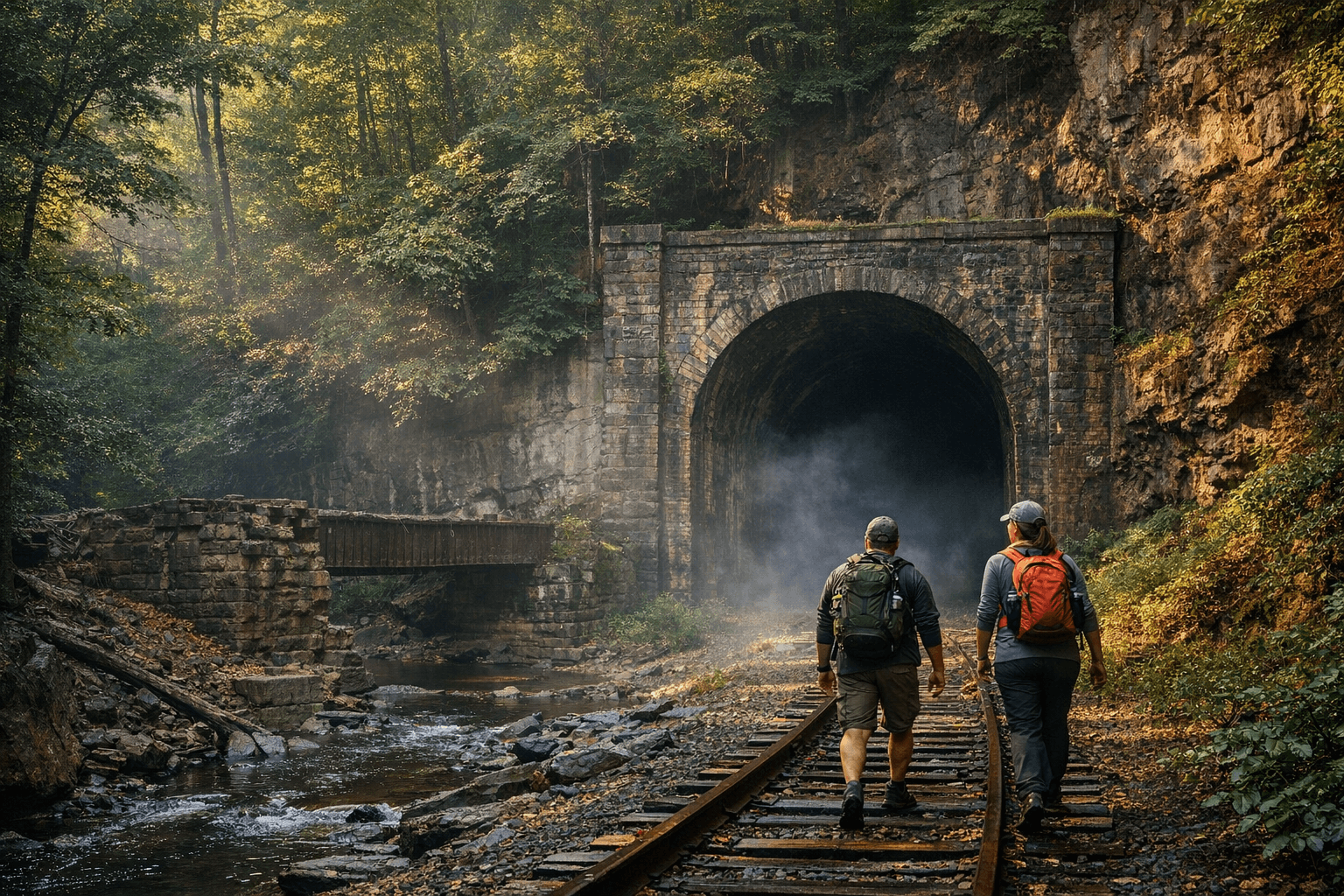
The east portal of the tunnel still carries a heavily vandalized plaque recording a repair in 1903. Despite decades of graffiti, the masonry structure carries enough significance that it earned a listing on the National Park Service's National Register of Historic Places, a designation that both honors the site and places a preservation obligation on every visitor who passes through.
How to Get There and Where to Park
The designated trailhead for Moonville Tunnel sits off Hope-Moonville Road, also designated County Road 18, with the parking area located at approximately 39.308286, -82.324418. The main road from the McArthur area is paved to a point, but the final mile transitions to dirt and gravel that narrows to a single lane in sections, running alongside cliff edges above Raccoon Creek. In winter, ice and snow on that final stretch can make it impassable for standard passenger vehicles. Travelers who arrive expecting a maintained park road will find something closer to a primitive forest track.
Five trailheads serve the full corridor: Zaleski on the western end, Mineral on the eastern end in Athens County, Hope Schoolhouse off Wheelabout Road (located opposite the dam at Lake Hope State Park), the Moonville Tunnel trailhead on Hope-Moonville Road, and King Hollow Tunnel. The Moonville Tunnel trailhead is the practical starting point for visitors whose primary goal is the tunnel and ghost-town site. From that lot, the tunnel is approximately 0.2 miles on the maintained path.
Questions about current trail conditions or permit requirements can be directed to the Vinton County Park District at 740-596-7013.
The Trail: Surfaces, Wetlands, and Two Tunnels Worth Seeing
The Moonville Rail Trail covers roughly 10 miles of former railroad grade from Zaleski to Mineral. The trail is open to hikers, equestrians, and bicyclists; motor vehicles are prohibited throughout. Surface quality varies considerably by section. Near the maintained trailheads, the path is gravel and compacted dirt. In less-developed stretches, the surface shifts to grass-covered ballast that can rattle cyclists and soften badly after rain. The corridor holds water on both sides through much of its length, creating a wetland zone home to diverse flora and fauna. Those same low-lying areas mean some stream crossings flood seasonally and soft spots appear without warning, particularly in spring.
Two tunnels define the route. Moonville Tunnel is a brick-and-masonry structure whose west face looks directly toward Raccoon Creek, where old stone abutments from the original railroad trestle remain visible on both banks. King's Hollow Tunnel, 2.7 miles to the east in Athens County, is structurally unusual: it was built around 1855 and is lined with timber rather than masonry, one of few surviving examples of its kind in the region. Visitors approaching it on foot typically pick up the sharp smell of creosote before the structure comes into view. The out-and-back hike between Moonville and King Tunnel covers 5.4 miles total and is the recommended day-hike option for those wanting more than a quick look at the masonry portal.
Birders use the wetland corridor regularly, as do equestrians on sections open to horses.
Rules Every Visitor Needs to Know
Trail hours are 6 a.m. to 11 p.m., seven days a week. Visiting after 11 p.m. for any reason, including paranormal investigation, requires a Special Use Permit issued through the Vinton County Park District. Paranormal investigators arriving during standard hours need no permit; organized ghost hunts running past 11 p.m. do. The same permit process applies to guided tours, photography sessions that restrict public access, weddings, and other organized activities.
At all hours: pets must be on leashes; open fires, camping, spray painting, littering, and motor vehicles are prohibited. Do not climb on tunnel masonry. Vandalism has already claimed portions of the historic plaques, and no artifact, stone, or structural element may be removed from the site. The Moonville Rail Trail Association and the Park District ask visitors to carry out all trash, stay on marked trail surfaces where they exist, and report maintenance issues directly to the Park District.
Guided History, Local Investment, and What's Still Unfinished
Moonville Rail Trail Historian Rich Dahn leads guided hikes that move through the ghost-town site, past foundations and brick scatters, into the cemetery, and up to the tunnel. These programs, offered through Vinton County's Convention and Visitors Bureau and local organizers, reframe the site as an industrial and social history resource rather than just a paranormal destination. That reframing matters for a county trying to build a durable outdoor-tourism economy around sites like Zaleski State Forest and Lake Hope State Park.
The Moonville Rail Trail Association, a 501(c)3 nonprofit founded in April 2001, holds monthly meetings at 6:30 p.m. on the third Tuesday of each month at Hope Schoolhouse on Wheelabout Road. The Vinton County Park District, established in 2021, governs trail operations. Together, they have secured roughly 10 miles of former railroad bed for public use through Clean Ohio Conservation Fund grants and volunteer labor.
The corridor's long-term passability depends on bridge restoration. When the railroad was dismantled, most trestles were removed, and incomplete crossings still interrupt the full route. That work is ongoing, funded through a mix of grants and partnership investment. Until it is complete, the 10-mile trail is best treated as a series of distinct segments rather than a single continuous route, with the Moonville Tunnel trailhead offering the most reliable and rewarding access point for first-time visitors.
This article was produced by Prism’s automated news system from verified source data, official records, and press releases, then run through automated quality and moderation checks before publishing. The system is built and supervised by the people who set the standards it runs under. Read our full AI policy.
Did this article answer your question?