Moonville Tunnel preserves Vinton County’s railroad and ghost-town past
Moonville Tunnel is the rare Vinton County stop where a brick-lined railroad relic, a haunted legend and an active trail meet in one hike.
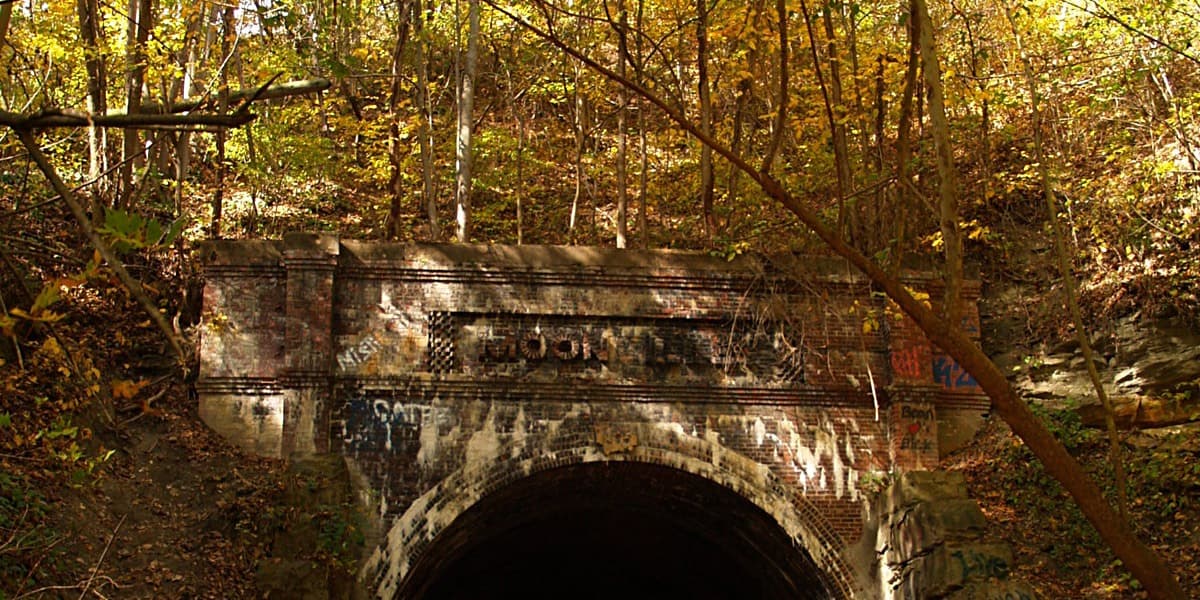
Moonville Tunnel gives Vinton County a single stop that ties together rail history, coal country and the ghost-town era. The brick-lined tunnel sits near Zaleski State Forest on the Moonville Rail Trail right-of-way, and the Ohio Department of Natural Resources counts it among Ohio’s best-known haunted landmarks. For a summer outing, it offers more than a story about the past: it is part of a living recreation corridor with trailheads, nearby forest land and a route that still draws hikers, riders and other muscle-powered users.
A railroad town that rose and disappeared
Moonville began in 1856, when Samuel Coe granted the Marietta and Cincinnati Railroad permission to cross his property. Coe wanted the line to help him move coal and clay from his land, and the railroad wanted a better route between Marietta and Cincinnati. The settlement grew up around that rail line and mainly housed miners and railroad workers, reaching a peak population of about 100 residents in the 1800s.
The decline came as coal mining faded in the early 1900s. ODNR says the last family left Moonville in 1947, leaving only the tunnel, the old schoolhouse foundation and the cemetery as visible traces of the community. That thin scatter of remains is part of what makes the site so striking: the place did not vanish into a museum case, it simply narrowed to a few pieces of infrastructure and a landscape that still carries the imprint of the railroad era.
Moonville’s reputation has also picked up a second life in local folklore. ODNR describes it as one of Ohio’s best-known haunted landmarks, and believers still tell stories of railroad workers waving lanterns in the abandoned tunnel. That legend gives the site a draw beyond history buffs, but the real appeal is that the story is anchored in a documented railroad community that once sat along a working line.
How the tunnel fits into today’s trail system
Moonville Tunnel is not just an isolated relic. It is part of the Moonville Rail Trail, a roughly 10-mile flat, linear route operated by the Vinton County Park District and maintained by the Moonville Rail Trail Association. The trail moves through some of the county’s most recognizable outdoor geography, including Zaleski State Forest, the communities of Zaleski and Mineral, and the wetland areas around Lake Hope State Park.
The trail’s access points give visitors several ways in. Trailheads include Zaleski, Mineral, Hope Schoolhouse, Moonville Tunnel and King Hollow Tunnel. That makes the corridor easy to fold into a half-day outing or a longer county loop, especially for families pairing a walk with a stop in nearby communities. Because the route is built on an abandoned rail bed, the terrain is generally straightforward, which helps explain why the trail is used by hikers, equestrians and other non-motorized users.

The trail itself is also a preservation effort. The Moonville Rail Trail Association was established in 2001 to develop and maintain the trail while preserving local history and the environment, with tourism and economic development folded into that mission. That matters in Vinton County, where a historic site only stays relevant if people can actually reach it, use it and understand how it fits into the wider landscape.
What to know before you go
The trail is open daily from 6 a.m. to 11 p.m. and the operator explicitly welcomes paranormal investigators, which makes Moonville one of the few historic trail destinations in Ohio where ghost lore is not pushed to the margins. Small events such as weddings and photography sessions are allowed, but guided hikes, public events and visits after 11 p.m. require special use permits.
Several restrictions are straightforward and worth keeping in mind before heading out:
- Motor vehicles are prohibited.
- Camping is prohibited.
- Fires are prohibited.
- Spray painting is prohibited.
- Littering is prohibited.
Those rules help protect both the trail surface and the historic setting around the tunnel. They also reflect the reality that Moonville is a shared corridor, not a roadside overlook. If you want the easiest visit, plan it for daylight or early evening, bring water and sturdy shoes, and treat the tunnel area as part of an active trail rather than a standalone attraction.
Why the Moonville corridor keeps expanding
Moonville is becoming easier to visit because the broader trail network keeps growing. ODNR says the Ingham’s Station project opened 12.2 new miles of trail, added seven bridges and closed eight abandoned mine entries for safety. That is a meaningful amount of infrastructure for a rural county, especially in a corridor where old mining sites and former rail beds intersect.
The numbers also point to demand. ODNR’s project description says about 10,000 day-use visitors frequent small sections of the trail each year. For a place like Moonville, that helps explain why preservation and recreation are now linked: the county is not only protecting a remnant of its past, it is investing in a route people already use.
That investment includes larger planning work as well. Vinton County has an approved $2,825,000 tourism-enhancement project tied to the Moonville corridor, involving the county Convention and Visitors Bureau, the park district, the Moonville Rail Trail Association, Tetra Tech and Downstream Strategies. County minutes also show engineering work on Moonville Tunnel preservation, including drainage improvements and reconstruction of deteriorating sandstone wingwalls. Those are the kinds of fixes that matter on the ground, because they shape whether the tunnel can keep standing as both a landmark and a trail destination.
The best way to experience it now
A visit works best when it combines the tunnel with the rest of the corridor. Start from one of the named trailheads, then build in time for Zaleski State Forest, the trail sections around Mineral or the Lake Hope State Park wetland areas. The tunnel’s location about 100 yards from the access point makes it one of the easiest landmarks to reach on the route, and the surrounding landscape adds context to the story of coal transport, rail construction and later abandonment.
Moonville Tunnel still matters because it is not frozen in one era. It is a surviving railroad structure, a ghost-town remnant, a trail landmark and a piece of county identity all at once. In Vinton County, that combination is rare, and it is exactly why the tunnel continues to draw people who want both the story and the place itself.
This article was produced by Prism’s automated news system from verified source data, official records, and press releases, then run through automated quality and moderation checks before publishing. The system is built and supervised by the people who set the standards it runs under. Read our full AI policy.
Did this article answer your question?