Vinton County marks three stops on John Hunt Morgan Heritage Trail
Three Vinton County markers trace Morgan’s 1863 sweep through Wilkesville, Vinton Station, and Creola, turning a Civil War chase into a driveable local heritage route.
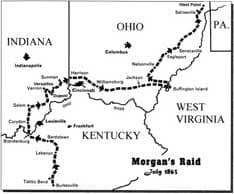
Morgan’s Raid cut through Vinton County in July 1863, and the signs along the road still point to the fear, confusion, and local improvisation that followed. The John Hunt Morgan Heritage Trail now lets you follow that passage across familiar county places, from Wilkesville to McArthur and Creola, on a route built to show how one cavalry raid briefly pulled Vinton County into a war many residents knew only from afar.
A county-sized chapter in a larger Confederate sweep
John Hunt Morgan launched the raid while Gettysburg and Vicksburg were raging, hoping to pull Union attention away from eastern Tennessee. The movement stretched through Indiana and Ohio and became the longest sustained cavalry raid of the Civil War, covering about 1,000 miles. In Vinton County, that broad campaign narrows into a handful of named places where the general’s men passed, camped, and moved on under pressure from Union pursuers.
The trail itself gives visitors a practical way to understand the route. The Vinton County Convention and Visitors Bureau describes the John Hunt Morgan Heritage Trail of Ohio as 557 miles long, with interpretive and directional signs guiding travelers without the need for a map. Ohio History Connection places the route at 561 miles and says it was created with the Ohio Department of Transportation and local communities to commemorate Ohio’s role in the July 1863 events. However the mileage is counted, the point is the same: the trail turns scattered Civil War sites into a connected drive.
Start in Wilkesville, where the raid first pressed into the county
Wilkesville is the first clear Vinton County stop on the trail, and the historical marker there anchors the opening moment of Morgan’s passage. The marker says Morgan and his men arrived just before dark on July 17, 1863, and met very little resistance from the local home guard. That detail matters because it shows how quickly a fast-moving cavalry column could unsettle a small community, even without a major battle.
For a modern visit, Wilkesville works as the county’s entry point into the story. It is the place to start if you want to trace the raid in sequence, because it establishes the speed of Morgan’s movement and the limited ability of local defenders to stop it. The marker also helps explain why the raid left so much folklore behind: in many places, the passing of armed men was brief, but the memory lasted far longer.
Creola and the Cornelius Karns House: a night of shelter and scarcity
Creola gives the most intimate local scene on the trail. The marker there says Morgan led his depleted force around McArthur to avoid Union troops guarding the town, then camped at Creola on the morning of July 22, 1863. It also names the Cornelius Karns House, where Mrs. Karns cooked for the men in a huge iron kettle.
That image is one reason Creola stands out on the route. It places Morgan’s men not just on a road but inside a household, where the raid touched ordinary domestic life and left behind a story residents could repeat for generations. The fact that the force was described as depleted also signals the strain of the campaign by late July, when the men were moving fast, short on supplies, and still trying to stay ahead of Union forces.
Creola is the stop that most clearly shows how a national military event met local labor, local shelter, and local memory. The road here is not just a corridor for troops. It is a place where a home became part of the historical record.
Vinton Station and the chase after Buffington Island
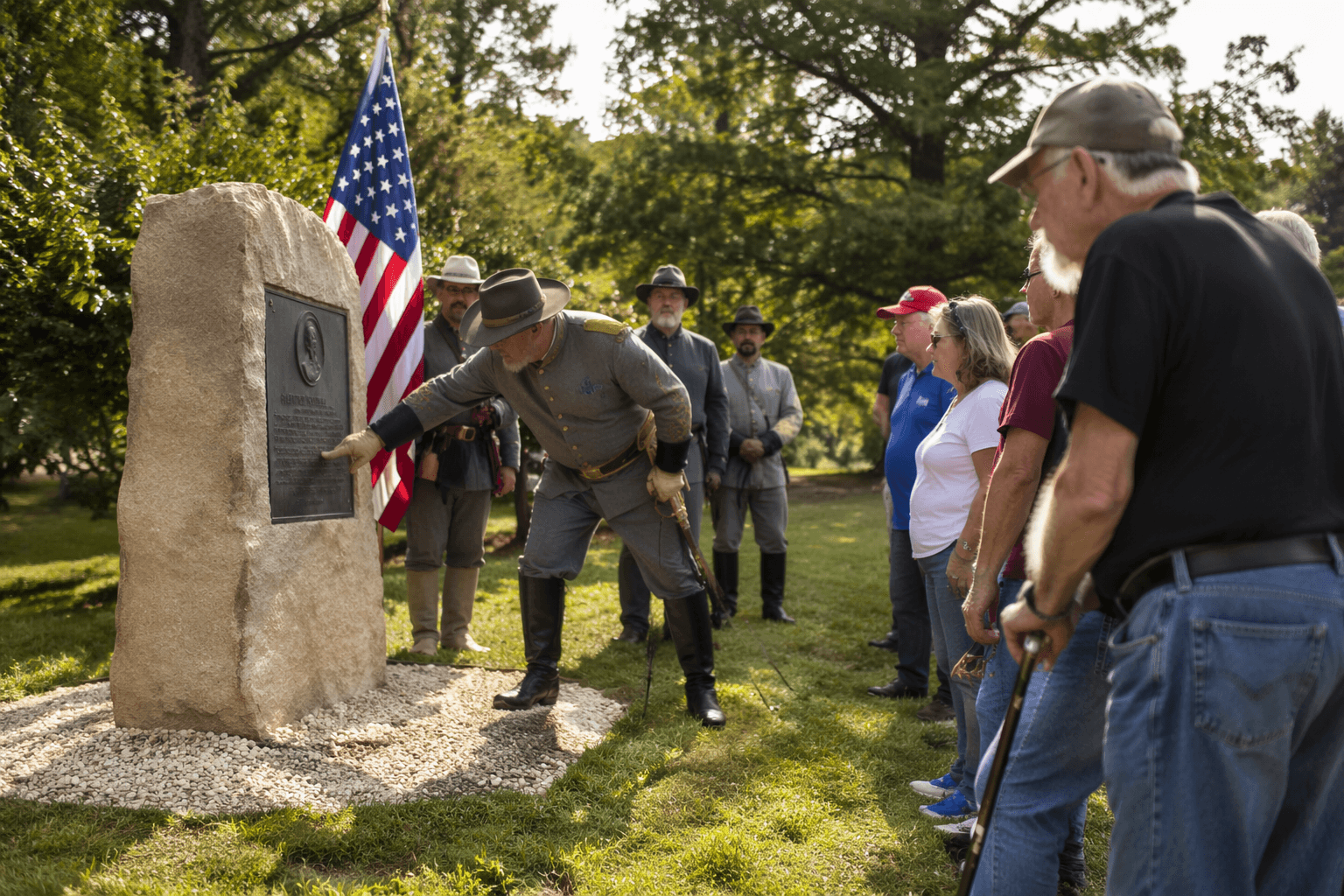
Vinton Station marks another phase of the retreat. The trail page explains that Morgan and his cavalry moved cross-country after losing baggage and artillery at Buffington Island, trying to shake Union pursuers and avoid revealing their position. That shift from mounted raid to evasive flight gives the stop its meaning: Vinton Station was part of the desperate attempt to keep the column intact after the campaign turned against Morgan.
Buffington Island is the broader battlefield behind that movement, and it is central to understanding why the Vinton County stops matter. The National Park Service says Morgan’s force was attacked there on July 19, 1863, and about 400 men escaped during the night by following a narrow woods path. Ohio History Connection says the fight involved about 3,000 Union troops routing about 1,800 Confederate cavalry and artillery, with between 800 and 1,000 of Morgan’s men captured and about 300 escaping across the Ohio River. The same site identifies Buffington Island Battlefield as the only significant Civil War battle in Ohio.
Those numbers help explain the urgency on the roads that passed through Vinton County. Once the column broke at Buffington Island, the trail became a flight path. Vinton Station is one of the places where that larger collapse can still be read in the landscape.
Why the raid mattered far beyond the county line
Morgan’s raid left a measurable trail of disruption. The National Park Service says it captured and paroled about 6,000 Union soldiers and militia, destroyed 34 bridges, disrupted railroads at more than 60 places, and diverted tens of thousands of troops from other duties. That scale helps explain why a brief passage through Vinton County became part of a nationally known Civil War route.
The end of the chase also deepens the story. Morgan was later captured near West Point, imprisoned at the Ohio State Penitentiary, and escaped in November 1863. Vinton County Convention and Visitors Bureau notes that this was the only successful escape from that prison in the 19th century. For readers following the trail, that detail widens the arc from local roads to a dramatic ending far from Vinton County, then back again to the markers that preserve the county’s role in the campaign.
How to follow the Vinton County stops today
A visit to the trail works best as a drive with pauses, not a quick pass-through. Begin in Wilkesville to mark the raid’s arrival on July 17, then move toward McArthur and Creola to see how Morgan skirted Union troops and stayed at the Cornelius Karns House on the morning of July 22. Vinton Station fills in the retreat after Buffington Island, when baggage and artillery were gone and speed mattered more than baggage trains or ceremony.
The route is designed for exactly this kind of reading. Interpretive signs and directional markers make it possible to follow Morgan’s movements as a sequence of places rather than as a distant textbook event. In Vinton County, that sequence turns three historical markers into a compact heritage trail: a county story tied to one of the Civil War’s most recognizable cavalry rides, preserved where the roads still run through it.
This article was produced by Prism’s automated news system from verified source data, official records, and press releases, then run through automated quality and moderation checks before publishing. The system is built and supervised by the people who set the standards it runs under. Read our full AI policy.
Did this article answer your question?