Vinton County’s four covered bridges, a guide to historic crossings
Start in McArthur and trace a loop past Bay, Cox, Mount Olive and Arbaugh, the only Vinton County covered bridge still open to vehicles.
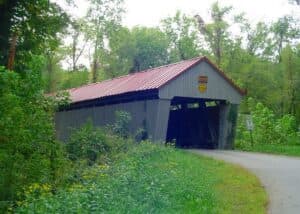
Four covered bridges still mark Vinton County's back roads, and only one still carries vehicles. Start in McArthur at the Vinton County Fairgrounds, then work outward to Brushy Fork Creek, Middle Fork Salt Creek and Big Raccoon Creek for a compact route that fits a weekend and tells the county's full bridge story.
A weekend loop that actually works
The easiest way to see all four survivors is to begin at the Vinton County Fairgrounds in McArthur, where Bay Covered Bridge now sits beside a pond at the Junior Fairgrounds. From there, the route naturally turns into a short county drive: stop at Cox Covered Bridge for its picnic area, continue to Mount Olive Road Covered Bridge over Middle Fork Salt Creek, and finish at Arbaugh Bridge, also known as the Eakin Mill Covered Bridge.
That sequence gives you the broadest spread of bridge settings in one pass. Bay is a relocated fairground span, Cox is a compact roadside bridge that was moved just enough to save it, Mount Olive sits as a pedestrian crossing over the creek that once needed a bypass, and Arbaugh remains in service.
Why the bridges were covered in the first place
The roofs were not decorative. Covered bridges were built that way to protect wood, the main building material in the early and mid-1800s, and the cover helped wooden trusses and flooring last nearly five times longer when rain and snow would otherwise rot them. The design also suited horses, which shied from high places, because the enclosed sides kept them from seeing what lay below.
They are working examples of rural engineering, built for timber, weather and livestock on county roads that had to last with limited material and labor. In Vinton County, where more than 60 covered bridges once dotted the landscape, the four survivors are the visible remainder of that transportation system.
Arbaugh Bridge, the county's only vehicle crossing
Arbaugh Bridge is the oldest surviving covered bridge in Vinton County. Records differ on its construction date: one places it in 1871, while another identifies it as the Eakin Mill Covered Bridge and gives the date as 1870 over Big Raccoon Creek; both point to the same span as the county's oldest survivor.
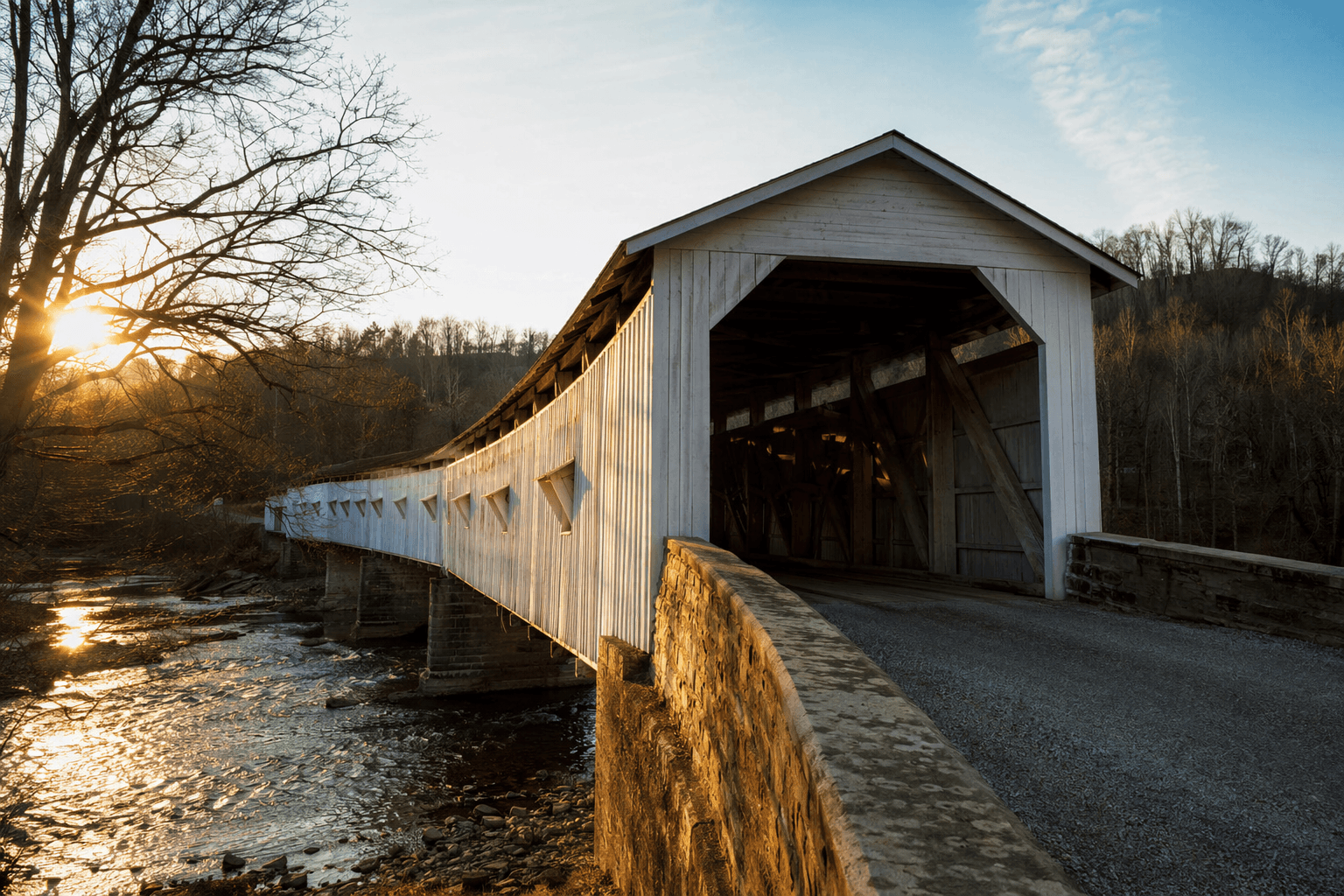
The bridge was closed to traffic for 30 years, then reopened after a grant-funded improvement project.
Bay Covered Bridge at the fairgrounds
Bay Covered Bridge was built in 1876 over Little Raccoon Creek and moved to the Vinton County Fairgrounds in 1967, though some bridge records place the relocation in 1966. The move was tied to the creation of Lake Rupert, and today the 63-foot Multiple Kingpost bridge spans a pond at the Junior Fairgrounds in McArthur.
That setting makes Bay the easiest stop for a family walk or a quick photo. Park at the fairgrounds, follow the path to the pond and look at the bridge the way many visitors do now, not as a traffic crossing but as a preserved landmark set into an active local venue.
Cox Bridge and the careful work of moving a bridge
Cox Covered Bridge was built in 1884 over Brushy Fork Creek and is now open only to pedestrians. It is one of the shortest covered bridges in the county, measuring about 40 to 42 feet, and it includes a picnic area that makes it an easy roadside stop.
The bridge was moved about 10 feet north to make way for a new bridge, and one record dates that move to late August 1992. Workers from the Vinton County Engineer's office used jacking, greased plywood, steel cables and front loaders to set it onto new concrete foundations. The bridge later received a makeover in 2004 through a Make a Difference Day grant from the Vinton County Convention and Visitors Bureau.
Mount Olive Road Covered Bridge and the road that changed around it
Mount Olive Road Covered Bridge was built in 1875 by Civil War veteran George Washington Pilcher. It spans Middle Fork Salt Creek, is open to pedestrians only and is identified as a Queenpost truss bridge.
A bridge record lists it as rehabilitated in 1963 and bypassed in 2000.
The bridge Vinton County lost
Ponn Humpback Covered Bridge, also known as the Humpback Bridge, was once the county's longest covered bridge and one of its most visited. One record dates its construction to 1874. In 2013, arson destroyed the bridge, leaving only sandstone abutments behind.
Ponn was listed on the National Register of Historic Places, as is Mount Olive Road Covered Bridge. The National Register is the federal list of historic places worthy of preservation, and in Vinton County it gives formal recognition to bridges that already carry local meaning.
Who kept them standing
Covered-bridge preservation in Ohio has long depended on county government, especially county commissioners and the surveyor or engineer, who historically shaped design, construction and maintenance. In Vinton County, that local control shows up in grant-funded repairs, bridge relocation, and the decision to keep the surviving spans accessible even when they no longer carry regular traffic.
A 1972 Ohio Historical Society pamphlet counted five remaining covered bridges in Vinton County. Four survive today.
This article was produced by Prism’s automated news system from verified source data, official records, and press releases, then run through automated quality and moderation checks before publishing. The system is built and supervised by the people who set the standards it runs under. Read our full AI policy.
Did this article answer your question?