Vinton County’s surviving schoolhouses reveal a changing rural era
Three surviving schoolhouses in Vinton County show how rural learning, travel, and community life shifted from neighborhood classrooms to a countywide district.
Surviving schoolhouses in Vinton County do more than preserve old walls. They map the move from neighborhood schooling, where a one-room building could anchor an entire community, to a countywide system built around consolidation, transportation and larger enrollments.
From local school to county system
The shift was part of a statewide policy change, not just a local one. An Ohio rural-school bulletin from 1920 addresses one-room schools, supervision, centralization, consolidation, community activities and extension work, showing that officials were already debating how rural children should be educated and how far they should travel to get there. In Vinton County, that larger trend eventually produced a district with a much wider footprint than the township schools that came before it.
The modern Vinton County Local School District was formed in 1967 by merging the Allensville, Hamden, McArthur, Wilton and Zaleski districts. It now spans 12 townships and 416 square miles, and Vinton County High School is the county’s only high school. That scale is the clearest sign of how far the county has moved from the era when a child could walk or ride a short distance to a schoolhouse that also doubled as a meeting place, a social center and a marker of neighborhood identity.
For parents and students today, the surviving buildings show what was gained and what was lost. Consolidation brought larger districts and more centralized staffing, but it also ended the daily routine of small school communities that revolved around a single classroom, a single teacher and a small circle of families tied to the same roads and hills.
Swan Township School #1 still carries the old school rhythm
Swan Township School #1 in Creola gives the county’s best preserved example of that older system. The Vinton County Convention & Visitors Bureau says Swan School was active from 1921 until 1955 and served as both a school and a community building. Today it stands at 26025 OH-93, and it opens as a visitor center on special occasions, keeping the site in public view rather than letting it fade into private memory.

The building’s south end carries a huge schoolhouse quilt block painted by former students and friends, now part of Vinton County’s Quilt Trail. That detail matters because it links the schoolhouse to a broader county tradition of marking place through craft and memory, not just architecture. A reunion is held there each year on the first Sunday of June, which means the building still functions as a gathering point long after the last class ended.
The CVB’s recollections from former students name teachers including Mr. Felton, Miss Scott and Mrs. Pettit. Those names matter because they show how personal one-room and small rural schools were: one teacher could define the experience of an entire generation of children, and a teacher’s reputation often traveled as far as the school’s boundaries.
Hope Schoolhouse connects education to Moonville’s rise and decline
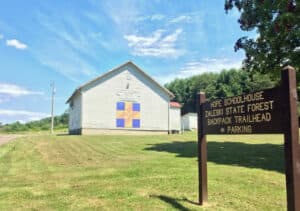
Hope Schoolhouse tells an even broader story because it is tied to a community that disappeared around it. In 1883, the school district bought a half-acre lot and built a new schoolhouse there. The Ohio Department of Natural Resources says the school later had one of the largest libraries in Vinton County during the 1920s and 1930s, a sign that even remote rural schools could become important centers of reading and learning.
The schoolhouse also reflects how fragile those communities could be. A fire destroyed the old Hope Schoolhouse in 1931, and it was rebuilt in 1932. It closed in 1941 as the iron ore industry declined and enrollment fell, a reminder that local schools depended not only on children but on the economic life of the surrounding area. The Vinton County Convention & Visitors Bureau identifies the original school as a one-room school for the town of Moonville before that community was deserted.
Today the site has a second life. It was renovated in 1998 as the Hope Schoolhouse Interpretive Center, which now features exhibits and programs about area history and serves as a special event site. It sits within Zaleski State Forest near Lake Hope State Park, placing it inside a landscape where school history, ghost-town memory and outdoor recreation now overlap. That setting gives visitors a direct view of how education, industry and settlement once moved together in the county.
Moonville shows how little can remain
Moonville makes the stakes of preservation easy to see. The Ohio Department of Natural Resources says the last family left in 1947, and today only the old schoolhouse foundation, a train tunnel and the community cemetery remain. Zaleski State Forest also contains the Moonville Rail Trail and the historic Moonville Tunnel, and the forest operates the only state-owned sawmill in Ohio.
That mix of remnants and landmarks explains why schoolhouses matter in Vinton County history. The buildings are not isolated curiosities. They are among the few physical traces of places where children once learned, families gathered and local life centered on a small patch of ground.
Dunkle Schoolhouse shows how reuse can save a structure
Dunkle Schoolhouse adds one more layer to that story. The Vinton County Convention & Visitors Bureau says it was built in 1885, closed in 1935, later used as a home and restored in 2006 as a cabin. Its path from school to residence to restored structure shows how rural buildings survive when communities adapt them instead of losing them entirely.
That kind of reuse is part of what makes Vinton County’s surviving schoolhouses valuable today. Swan Schoolhouse still brings people together each June. Hope Schoolhouse now interprets the history of Moonville and the surrounding forest. Dunkle Schoolhouse shows how a former classroom can become a cabin and remain part of the county’s built landscape.
Taken together, these buildings show the county’s educational evolution in concrete form. They mark the era when schools were scattered through the townships, when a single room could hold a grade or an entire neighborhood, and when community life was woven into the school calendar as tightly as it was into the school day.
This article was produced by Prism’s automated news system from verified source data, official records, and press releases, then run through automated quality and moderation checks before publishing. The system is built and supervised by the people who set the standards it runs under. Read our full AI policy.
Did this article answer your question?