Historic Yates Mill preserves Wake County’s last operable gristmill
Yates Mill is Wake County’s last operable gristmill, with free weekend tours, trails, and a 174-acre park that turns local history into an easy family outing.

Historic Yates Mill County Park gives Wake County something increasingly rare: a low-cost outing that is both outdoorsy and deeply local. Set on 174 acres in the central-southwestern part of the county, the park’s centerpiece is the last operable water-powered gristmill in Wake County, a working reminder of the rural economy that once shaped this place before subdivisions, shopping centers and office parks spread across the map.
A last working link to Wake County’s rural past
Wake County says more than 70 water mills once operated in the county, which makes Yates Mill less of an isolated landmark than the survivor of an entire lost landscape. The mill’s story reaches back to the earliest settlement era: Samuel Pearson is thought to have first acquired land in the area around 1750, and the earliest known document tied to the site dates to 1756. The mill itself is generally dated to around 1756 to 1760, placing it among the county’s oldest surviving built resources.
That timeline matters because the site shows how people once organized daily life around water power, agriculture and shared labor. Before the county’s modern growth, families brought grain to mills like this one to be ground into meal and flour, and the mill became a practical meeting point as much as a machine. Wake County’s history notes make clear that Yates Mill sits in the county’s earliest settlement story, not just its preservation story.
From abandoned equipment to a restored landmark
The mill’s modern survival is a preservation story with unusually strong local roots. Wake County says the mill was placed on the National Register of Historic Places in 1974, while other preserved-history sources place the listing in 1971, so published records differ on the year. What does not differ is the larger fact: the site gained formal historic protection decades ago and remained important enough to justify a full restoration effort.
Wake County says the mill was restored to working order through a grassroots community effort by 2005. The equipment inside is original and was left after the Lea family stopped milling in the mid-1950s, giving the restoration an uncommon level of authenticity. Yates Mill Associates, a nonprofit formed in 1989 by local history buffs, says it took the lead on restoring, preserving and operating the mill, and that a coalition of about 35 people helped push the effort forward.
The park opened to the public in May 2006 and now operates through a partnership among Wake County Parks, Recreation and Open Space, NC State University and Yates Mill Associates. That arrangement has helped turn a once-vulnerable structure into a civic asset that is maintained, interpreted and regularly used.
What a visit actually includes
The attraction is more than the mill itself. Historic Yates Mill County Park includes a 20-acre mill pond, three walking trails, gardens and picnic areas, so a visit can be as much about a quiet walk as about the history lesson. The setting also makes the site useful for families who want an easy half-day plan without paying for admission.

- Free mill tours, offered on weekends from March through November.
- Costumed guides who demonstrate how corn is ground into cornmeal.
- A 20-acre mill pond and trail system for walking before or after the tour.
- Gardens and picnic areas that make the park work as a full outing, not just a stop-in destination.
What visitors get on the ground:
Yates Mill Associates says the mill is the only fully restored and operational automatic mill in North Carolina and one of just a few historic automated water mills in the United States. That makes the site especially valuable for Wake County families and school groups, because the machinery is not simply displayed, it works. Seeing the wheel and gears in motion gives the place an immediacy that static exhibits cannot match.
Why it still matters to Wake County now
The park’s relevance is reflected in its traffic. Wake County says Historic Yates Mill County Park draws more than 100,000 visitors a year, a substantial number for a historic site rooted in county history rather than a major downtown attraction. That level of visitation suggests the park fills a real need in a fast-growing county: a place where residents can spend time outdoors without leaving behind the story of how Wake County came to be.
The county has also made the site more accessible. It provides visual schedules, sensory supports and noise-reducing headphones for visitors who are blind, partially sighted, deaf or on the autism spectrum. Those tools matter because they widen access to a place that depends on sound, movement and close observation.
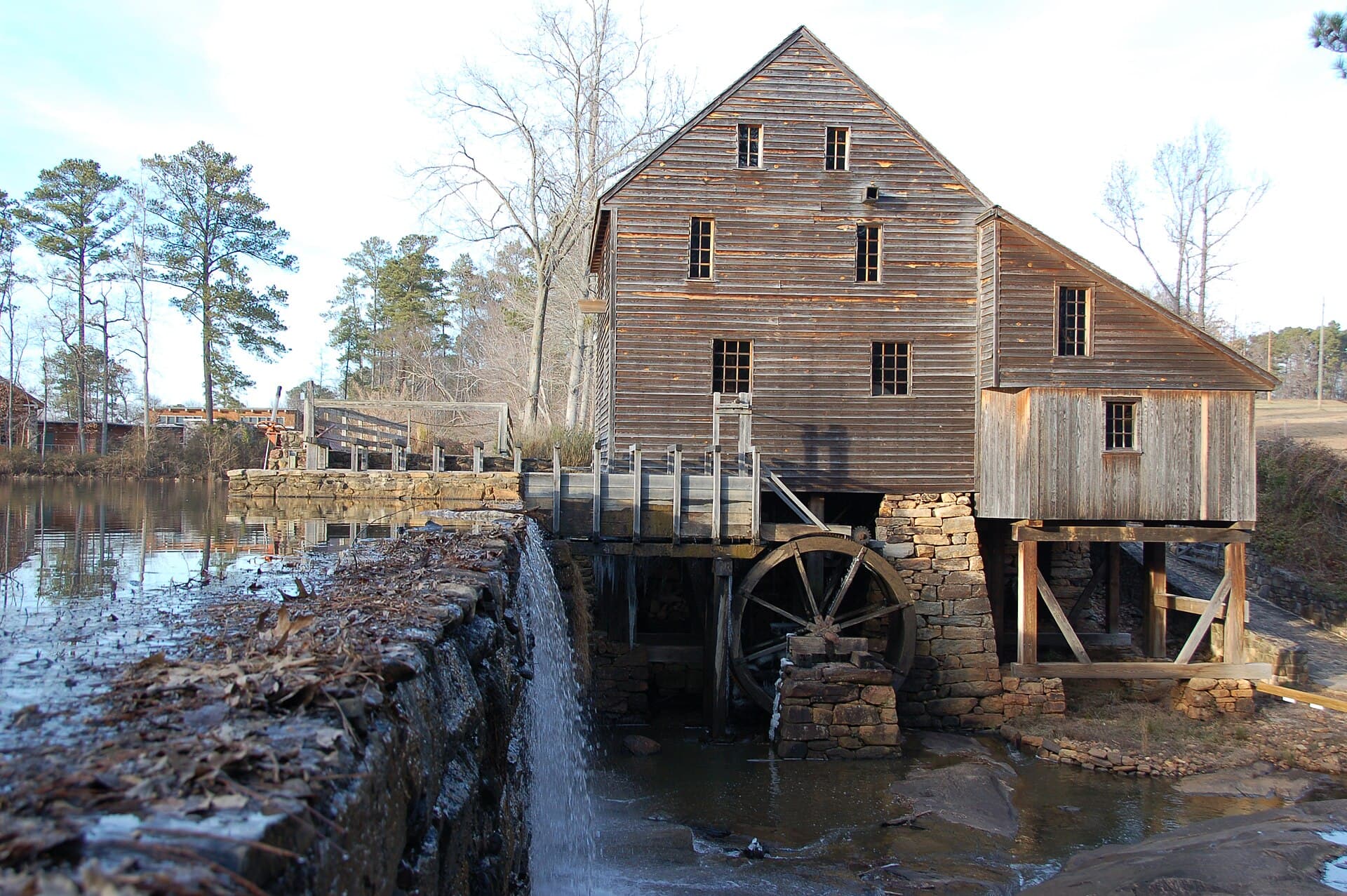
The site remains an active preservation project as well as a completed one. NC State News reported in July 2025 that the water wheel was being rebuilt and that a new wheel was expected in the fall. NC State also opened the Yates Mill Aquatic Conservation Laboratory at the park in June 2024, adding a modern research and conservation role to a place already defined by history and public use.
How to think about the visit
Historic Yates Mill works because it combines three things that are getting harder to find in one place: a tangible piece of early Wake County history, a real outdoor setting, and a price point that keeps the outing approachable. The mill tells the story of the county before its growth boom, the trails and pond extend the visit beyond a brief tour, and the preservation work shows that the site is still being actively maintained rather than left as a relic.
For anyone looking for a Wake County weekend option that is low-cost, local and genuinely distinctive, Yates Mill is one of the clearest answers.
This article was produced by Prism’s automated news system from verified source data, official records, and press releases, then run through automated quality and moderation checks before publishing. The system is built and supervised by the people who set the standards it runs under. Read our full AI policy.
Did this article answer your question?