ONE Wake Pushes Raleigh for $200 Million Bond, 100 Acres for Affordable Housing
A faith coalition handed Raleigh leaders a specific ultimatum: a $200 million housing bond and 100 acres of public land for affordable development.
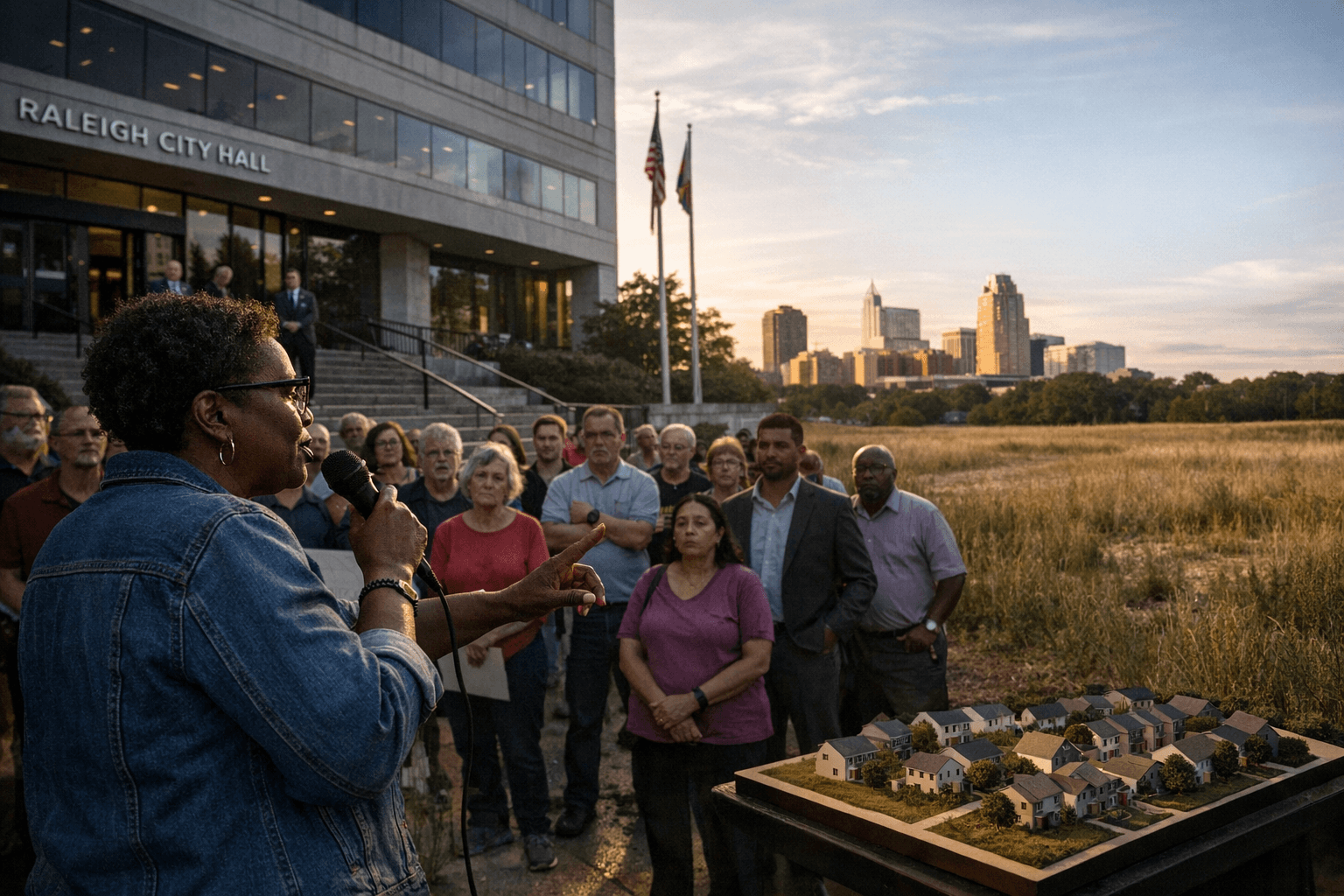
A faith-based coalition called ONE Wake assembled in Raleigh on Saturday and handed city and county leaders a precise ultimatum: commit $200 million in bond financing and 100 acres of public land to affordable housing, or watch lower-income residents get priced out of Wake County altogether.
The April 11 gathering brought together faith leaders, community advocates, and residents watching housing costs climb as the Triangle's economic boom reshapes neighborhoods across Raleigh and the broader county. ONE Wake organizers framed the demands as both a moral obligation and a practical policy intervention, arguing that market forces alone cannot build affordable housing at the speed or scale the region requires.
The coalition's two asks are deliberately specific. The $200 million bond would fund new affordable housing construction, preserve existing subsidized units, expand rental assistance, and create supportive housing for vulnerable residents. A bond of that magnitude would almost certainly require a public referendum before it could move forward, meaning Wake County voters would ultimately decide whether to authorize the borrowing. The second demand, a formal commitment of 100 acres of publicly controlled land, is designed to eliminate land acquisition costs as a financial barrier to development. Advocates say that land structured through community land trusts could lock in affordability permanently, rather than for a fixed federal compliance window.
Neither the Raleigh City Council nor the Wake County Board of Commissioners has publicly responded to the specific dollar figure or acreage target. Both bodies have acknowledged housing affordability as a priority in recent years, but ONE Wake's assembly escalates that conversation into concrete, measurable commitments that officials can no longer address in general terms. Bond proposals in North Carolina municipalities typically require staff analysis, commission review, and extended public comment before reaching a ballot, a process that could stretch deep into 2026 budget and election cycles.
The push comes as Wake County absorbs sustained population growth that has driven up rents and home prices, particularly near downtown Raleigh and along expanding transit corridors. Without deliberate public investment at scale, advocates argue, the displacement of low- and moderate-income households will outpace any voluntary or market-driven response.
The $200 million figure is expected to become a flashpoint in upcoming Raleigh City Council and Wake County Commission sessions, and a defining issue in local budget deliberations through the rest of the year.
This article was produced by Prism’s automated news system from verified source data, official records, and press releases, then run through automated quality and moderation checks before publishing. The system is built and supervised by the people who set the standards it runs under. Read our full AI policy.
Did this article answer your question?