Wake County Sheriff's Office Partners With Horses to Support Deputy Mental Health
Sgt. Mark Szajnberg says deputies face 700+ critical incidents in their career; a Wendell farm with 13 horses is now part of the department's response.
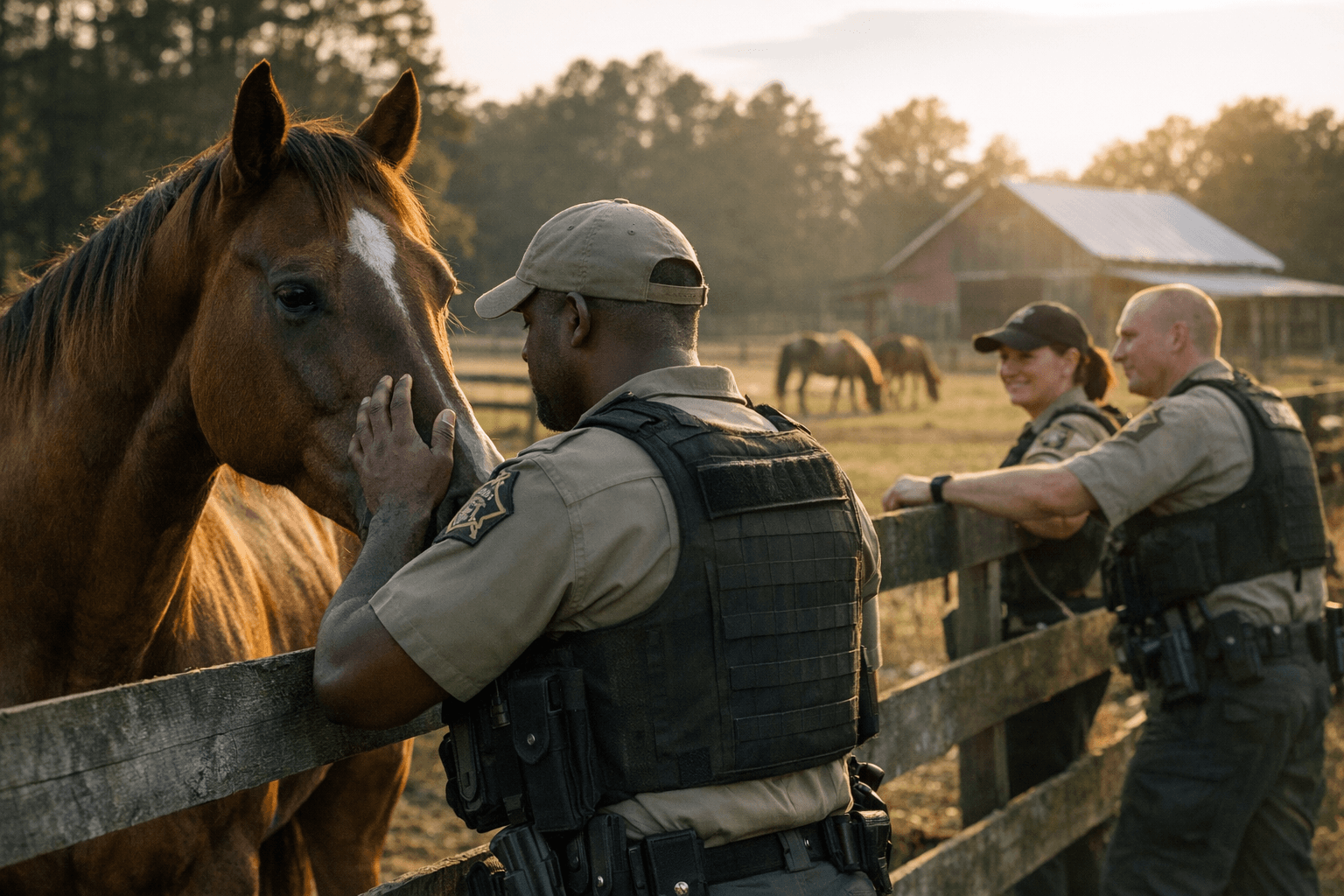
Wake County Sheriff's Sgt. Mark Szajnberg puts the emotional math of policing bluntly: a law enforcement officer experiences more than 700 critical incidents over a career, while the average person sees two to three in a lifetime.
That disparity is at the center of a new partnership between the Wake County Sheriff's Office and Helping Horse Therapeutic Programs, a certified 501(c)(3) nonprofit located at 5104 Riley Hill Rd in Wendell that has worked with individuals with special needs since its founding in 1989. The organization recently opened its First Responders and Veterans track to Wake County deputies and their families, offering equine-assisted activities and mindfulness training as a tool for managing the psychological weight of the job.
Deputies attend the farm off-duty, individually or alongside their families. The individual track runs eight hours, during which participants meet Helping Horse's herd of 13 horses, select a partner animal, and work through grounding and horsemanship tasks designed to reduce anxiety and build coping skills.
Jackie Shapaker, the program's First Responders and Veterans coordinator, said the horses take an active role in the process. "Deputies' jobs are highly stressful," she said. "We offer mindfulness and grounding techniques before they're with the horses and while they're with the horses." She described the animals as "incredibly intelligent" and said they "demand us to be mindful in the present moment." When a deputy's attention wanders, she said, the response is immediate: "The horse kind of steps away."
Szajnberg said the partnership addresses a training blind spot that has long existed in law enforcement. "We train our officers how to handle a crisis, how to go into a crisis but not that good of a job of teaching them how to process it afterwards," he said. "This gives them an opportunity to slow down, reset themselves and talk about what their thought process is."
The stakes behind that blind spot are significant. According to the National Alliance on Mental Illness, nearly 25 percent of police officers have experienced suicidal ideation at some point in their lives, and for every officer killed in the line of duty, approximately 2.5 officers die by suicide. A CNA analysis of public safety officer suicide data found depression was a contributing factor in 34 percent of those cases.
Helping Horse has served as Wake County's premier therapeutic riding program for more than 35 years, building its First Responders and Veterans track on a foundation of work with children and adults with physical and emotional disabilities. The nonprofit is mostly volunteer-operated; its executive director, who joined the organization in 2008 and assumed the leadership role in 2017, now oversees both program tracks.
Research into the model is still maturing. A 2024 peer-reviewed pilot study by Charles Nelson, Kimberly Dossett, and Deanna L. Walker examined equine-assisted therapy as an adjunct PTSD treatment for first responders across an eight-week, 90-minute weekly program, finding early outcomes promising but calling for larger-scale studies. Police1 amplified the approach during First Responder Wellness Week in March 2026, publishing a call to action that described the therapy as delivering proven benefits for veterans and first responders through shared peer experiences in a natural setting.
Other North Carolina nonprofits, including Peace Reins and Western North Carolina-based Heart of Horse Sense, founded in 2014, run comparable equine programs for first responders and veterans. The Wake County program's direct institutional backing from the sheriff's office, and its design to include deputies' families, positions deputy wellness as a formal departmental priority rather than something left to individual initiative.
This article was produced by Prism’s automated news system from verified source data, official records, and press releases, then run through automated quality and moderation checks before publishing. The system is built and supervised by the people who set the standards it runs under. Read our full AI policy.
Did this article answer your question?