Wake County teen faces sexual exploitation charges in AI image case
A Knightdale teen was charged after allegedly using AI to create explicit images of Wake County girls. North Carolina law and Wake school rules are still catching up.
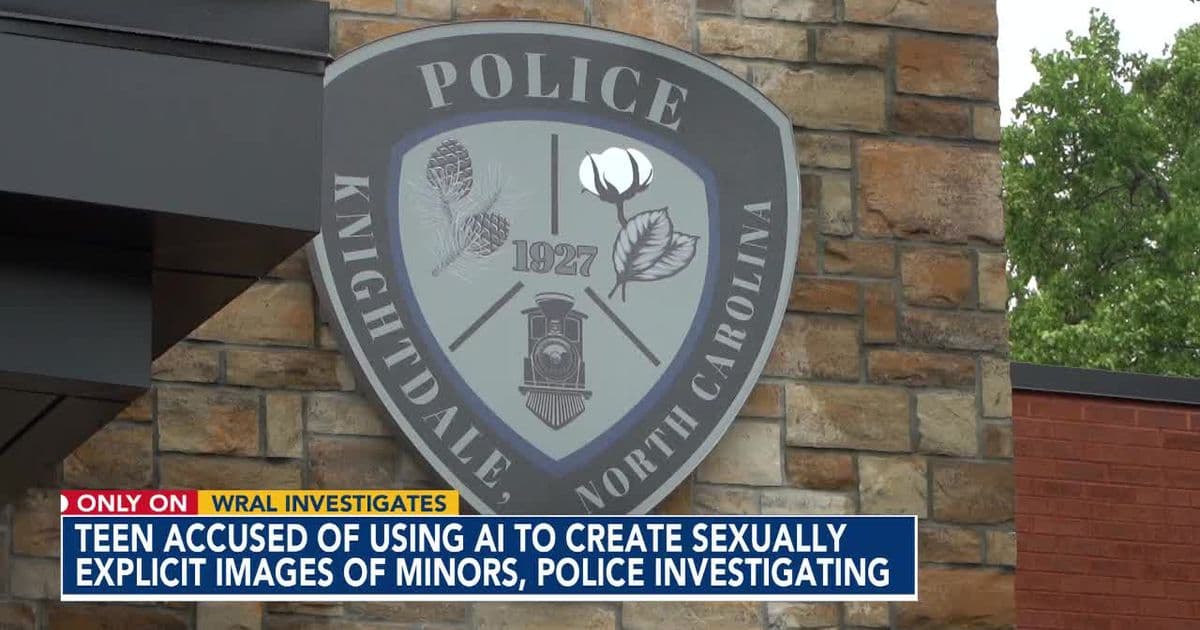
A Wake County teen faced multiple sexual exploitation charges after using artificial intelligence to create sexually explicit images of teenage girls, and Knightdale police identified the images as involving Wake County girls. The teen’s name was not released because of his age. The case was posted at 10:09:46 p.m. July 23 and updated at 10:33:56 p.m. that night.
North Carolina lawmakers had already started tightening the law around synthetic sexual imagery. House Bill 805, “Prevent Sexual Exploitation/Women and Minors,” became Session Law 2025-84 after Gov. Josh Stein’s July 3, 2025 veto was overridden by the General Assembly on July 29, 2025, and it took effect that day for the 2025-2026 school year. House Bill 375 would have created a new chapter on “Artificial Intelligence and Synthetic Media” to regulate deepfakes and deceptive ads, while Senate Bill 828 would have prohibited the creation, possession and dissemination of visual representations made to look as if a minor were engaged in sexual activity.
A May 12, 2026 UNC School of Government post covered prosecuting AI images under amended sexual exploitation laws, and the FBI linked a Charlotte child sexual abuse material case to the “unsettling reach” of AI-generated imagery. By July 2026, ENOUGH ABUSE counted 45 states that had enacted laws criminalizing AI-generated or computer-edited child sexual abuse material, while 5 states and Washington, D.C., had not.
In June 2026, a draft Wake policy discouraged teachers from using AI detectors because of reliability concerns. Earlier, the Wake County Public School System had moved from banning student AI use to teaching it in classrooms during the 2023-24 school year. State leaders also held AI safety presentations at Dillard Drive Middle School for about 2,000 middle school students across Wake and Durham schools.
For parents, the immediate response is to report sexualized AI images of a child to the National Center for Missing and Exploited Children’s CyberTipline at 1-800-THE-LOST, or 1-800-843-5678. If a child may be in immediate danger, call 911. The FBI directs parents and caregivers to the same reporting route in its guidance, and NCMEC maintains resources and support for victims dealing with explicit images online.
In August 2025, Attorney General Jeff Jackson took actions to protect children from deepfake pornography and AI chatbots that engage in inappropriate conduct with underage users, and in November he led a bipartisan coalition of 36 attorneys general opposing efforts to block states from enforcing their own AI protections.
This article was produced by Prism’s automated news system from verified source data, official records, and press releases, then run through automated quality and moderation checks before publishing. The system is built and supervised by the people who set the standards it runs under. Read our full AI policy.
Did this article answer your question?