Arizona Law Now Allows Merchants to Round Cash Transactions to Nearest Nickel
Arizona's new penny-rounding law is now in effect, and Yuma shoppers paying cash could see their totals nudge up or down by a few cents at the register.
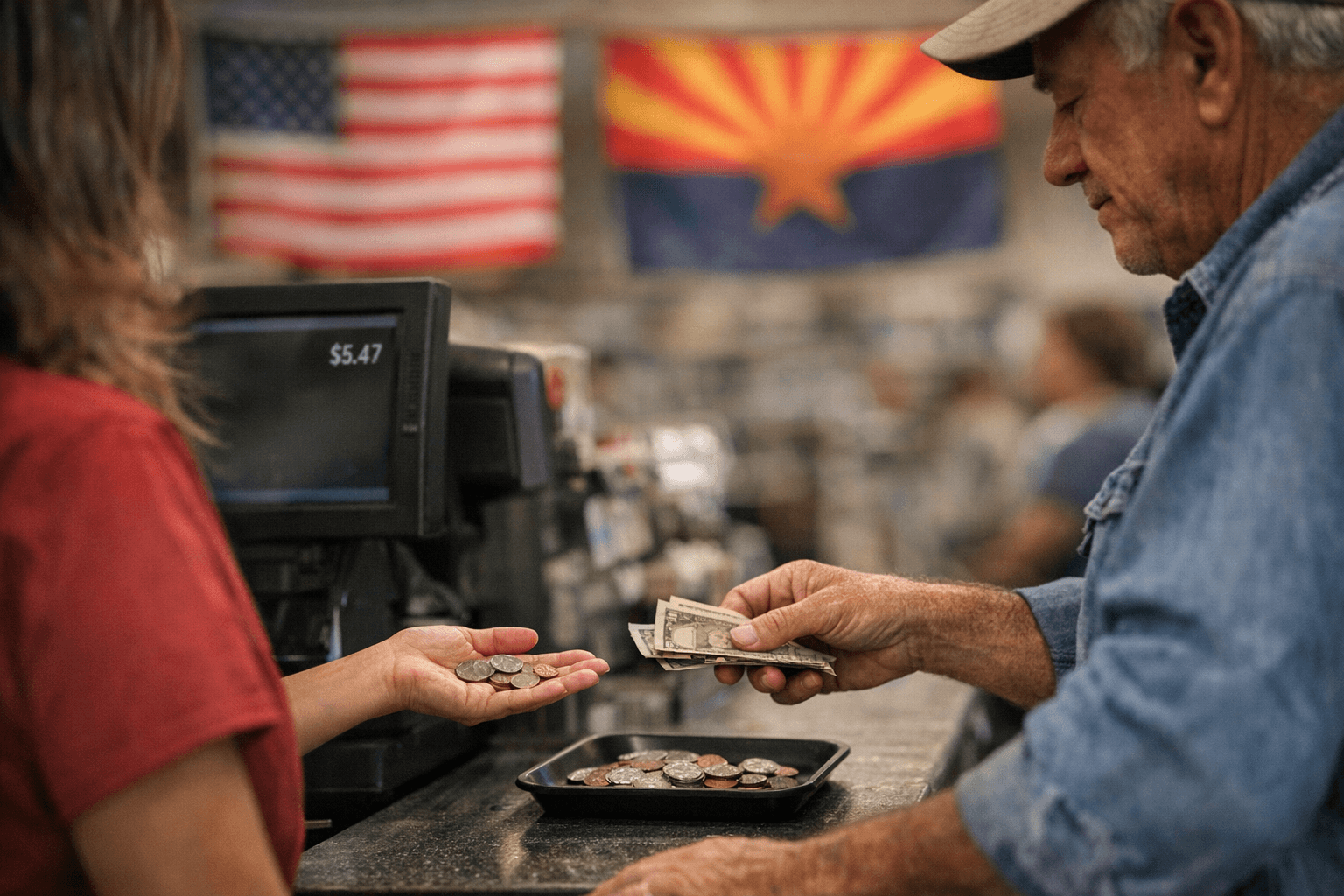
Gov. Katie Hobbs signed House Bill 2938, mandating that businesses round to the nearest five cents if pennies are not available to complete a transaction. The law carries an emergency clause, meaning it took effect immediately on her signature, and Yuma cash shoppers are already subject to its rules.
Rep. Teresa Martinez, a Republican from Casa Grande and the bill's sponsor, told a House committee in February that she started keeping track of which businesses gave change in pennies and which kept those extra few cents. "It needs to be uniform, all across the state of Arizona," she said. The inconsistency she flagged was on full display before the law passed: as KAWC reported, Martinez noted that McDonald's restaurants "will keep the penny for itself," while cash shoppers at Fry's get the benefit of having the final bill lowered.
The bill passed through the state legislature with near-unanimous support, drawing just a single opposing vote in each chamber.
The mechanics are straightforward. Retailers that accept cash but do not have pennies available or do not use them at the point of sale must round the final cash transaction total, after taxes and fees, to the nearest five-cent increment. Totals ending in 1, 2, 6, or 7 round down to the nearest nickel; those ending in 3, 4, 8, or 9 round up. A purchase of $10.02 becomes $10.00; a purchase of $10.03 becomes $10.05. The requirement, known as "Swedish rounding," applies only to cash transactions and does not affect credit, debit, EBT, or other non-cash payments. Retailers subject to the rule must post a visible notice at the point of sale stating: "Cash transactions are rounded to the nearest five-cent increment pursuant to state law." Enforcement is handled by the Arizona Department of Agriculture's Weights and Measures Services Division.
Pennies are not outlawed. Merchants remain free to accept them and give them as change if they choose. The law only governs transactions where pennies are unavailable or not used.
The trigger for all of this was the federal government's decision last November to stop producing pennies for circulation. The measure directly addresses the U.S. Mint's cessation of penny production. According to the United States Mint, it costs 3.69 cents to produce a one-cent coin, a figure that made continued minting a money-losing proposition.
Reaction among Yuma residents was mixed, though skeptics were in the minority. Nancy Ripp was direct in her opposition: "I don't like that. Stores need to adjust accordingly." But Nicole Millis, a local business owner, welcomed the change. "I personally hate going to the bank when we run out of pennies. It's just not the biggest convenience at all to be honest with you, but yeah, I will be rounding up. When I'm out of pennies, I'm out of pennies, so I'm pretty happy about this."
Marlo Foss framed the law as simple logic: "It costs more money to mint one, than it is worth so." Yuma resident Candice Foss pointed to the psychology behind price tags ending in .99 as reason enough to move on. "I think it's fine. I mean it really was misleading anyway, it really was $10, but they just made it $9.99 to catch your eye or $79.99 to catch your eye, so let's just get rid of it."
Legislation allowing rounding to cope with the penny shortage awaits approval in Florida, Oregon, Tennessee, Virginia and Washington; Indiana adopted a similar rounding provision earlier in March. Arizona, with its emergency clause and immediate implementation, moved faster than most.
This article was produced by Prism’s automated news system from verified source data, official records, and press releases, then run through automated quality and moderation checks before publishing. The system is built and supervised by the people who set the standards it runs under. Read our full AI policy.
Did this article answer your question?