Army Apache Helicopter Tests New Proximity Rounds Against Drones in Yuma
An AH-64 Apache fired a new proximity-fuzed 30mm round at drones over Yuma Proving Ground last December, detonating near targets without needing a direct hit.
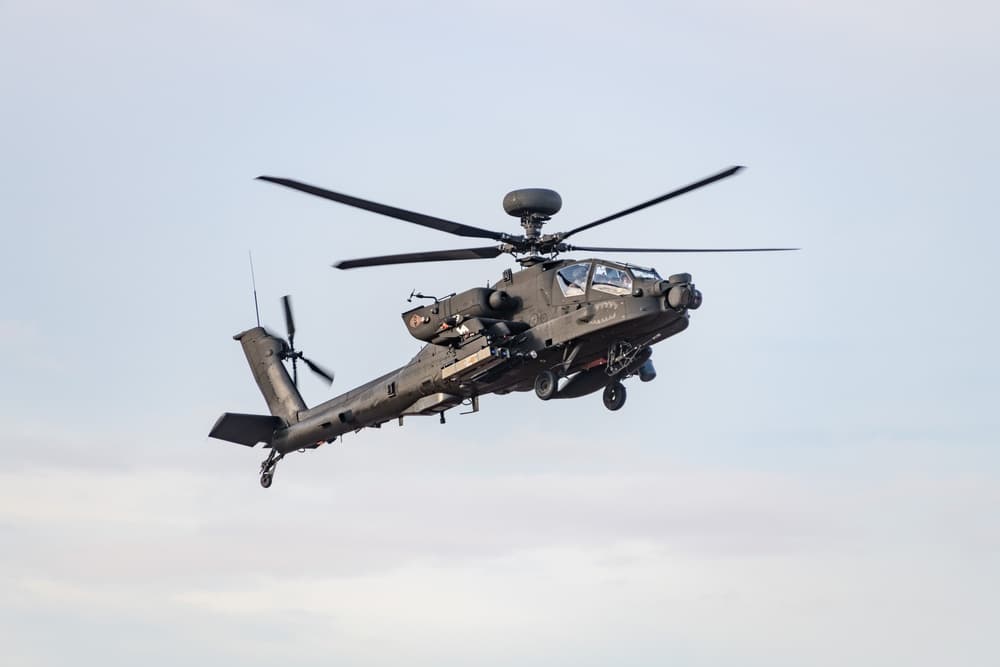
An AH-64 Apache attack helicopter fired roughly 1,200 rounds of a new proximity-fuzed 30mm cartridge against drone targets at Yuma Proving Ground last December, marking what the Army described as the first successful live-fire air-to-air test of the XM1225 Aviation Proximity Explosive, or APEX, round from the aircraft.
The XM1225 is a 30×113mm programmable proximity-fuzed cartridge fired from the Apache's M230 chain gun. Unlike the legacy M789 High Explosive Dual Purpose round it was compared against, the APEX detonates before reaching its target, throwing a fragmentation pattern outward to destroy a drone without requiring a direct hit. The Army designed the round to counter unmanned aerial systems, exposed personnel, and small boats, and says it requires no modifications to the M230 or the Apache's fire-control system.
Test officer Walter McCormick, speaking about the Yuma trials, described the concept plainly. "The APEX round was developed to be a frag round that would prox in front of the UAS and make a frag pattern that would take out a UAS," McCormick said.
The test campaign ran across two subtests, engaging several unmanned aerial systems at both close and long ranges as well as ground targets. One objective was a direct performance comparison between the XM1225 and the M789 under identical field conditions; a secondary objective collected data on mixed ammunition loads combining both rounds against the same target sets. The Army considered the results highly successful, saying the XM1225 met all accuracy requirements and demonstrated what an Army release called "precision, versatility, and lethality."
Scoring that performance required a dense instrumentation network: Black Hawk helicopters provided overhead observation, while Kineto tracking mounts, telemetry systems, high-speed cameras, still photography, and ground-based sensors collected data from multiple angles simultaneously.
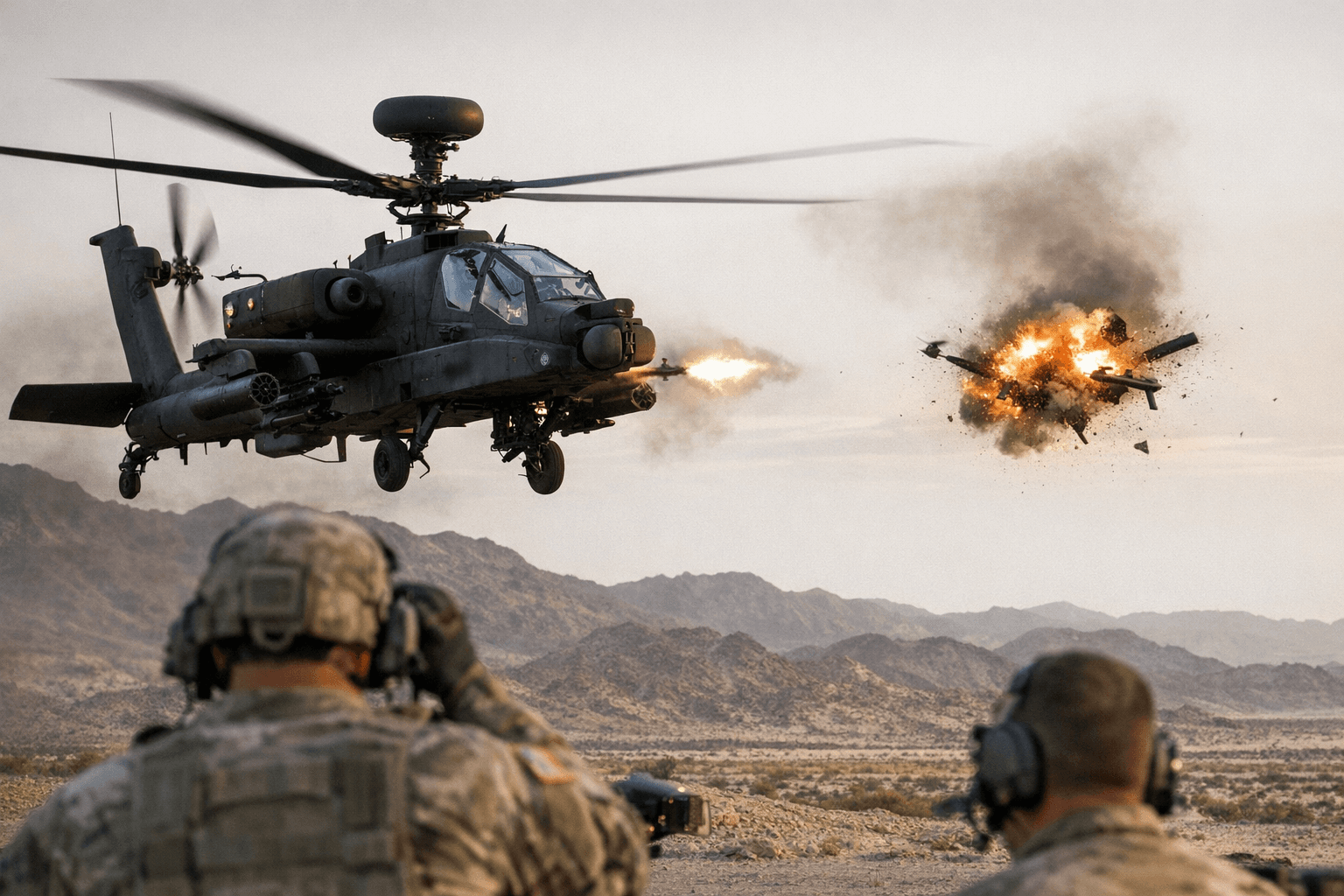
Yuma Proving Ground, with nearly 2,000 square miles of restricted airspace and year-round clear skies, gave testers the room and visibility the exercise demanded, McCormick noted. The facility, operated as the Yuma Test Center, hosted the December 2025 trial alongside support from several Army organizations: Product Manager Medium Caliber Ammunition at Picatinny Arsenal in New Jersey, Project Manager Apache, the Army Evaluation Center, the DEVCOM Aviation and Missile Center, the DEVCOM Armaments Center, and the Redstone Test Center.
The Army's press release, issued February 12, 2026, did not disclose the types of drones used as targets or the number destroyed during the engagement. Official imagery released with the statement showed the XM1225 detonating in front of a steel plate and a close-up of the round itself, but included no footage of the Apache firing the weapon.
Whether the XM1225 moves toward procurement and what timeline the Army envisions for fielding it across Apache units remains publicly unanswered. The Yuma results, however, give the service a documented baseline for a counter-drone capability that requires no hardware changes to one of its most widely deployed attack helicopters.
This article was produced by Prism’s automated news system from verified source data, official records, and press releases, then run through automated quality and moderation checks before publishing. The system is built and supervised by the people who set the standards it runs under. Read our full AI policy.
Did this article answer your question?