Yuma County jail booking linked to sexual abuse, attempted assault arrest
Alejandro Lopez-Escamilla’s May 28 booking carried a federal SCAAP tag, highlighting how Yuma County recoups only a narrow slice of jail costs tied to immigration-related detentions.
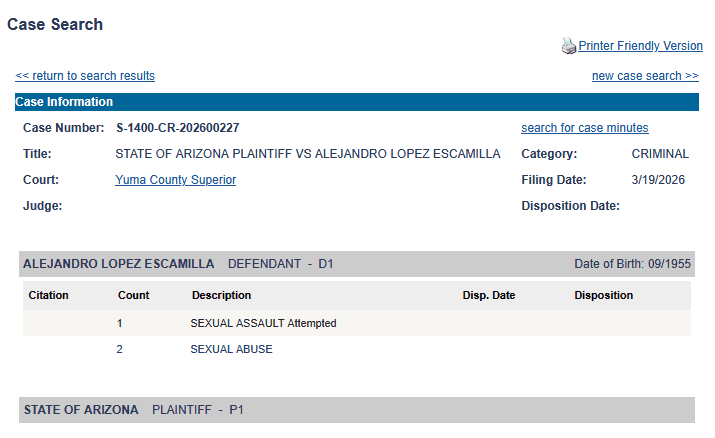
Alejandro Lopez-Escamilla’s May 28 booking at the Yuma County Detention Center carried more than a criminal charge sheet. The record was tagged SCAAP, a federal reimbursement label tied to the cost of holding certain undocumented inmates, and it puts a county finance issue at the center of a sexual abuse and attempted sexual assault arrest.
Jail records show Lopez-Escamilla was booked at 10:37 a.m. on May 28 by the Yuma County Sheriff’s Office on charges of sexual abuse and sexual assault, listed in some records as attempted sexual assault. Under Arizona law, sexual abuse is generally a class 5 felony, or a class 3 felony if the victim is under 15, while sexual assault is a class 2 felony.

The SCAAP tag matters because it points to a federal program that does not pay for the full cost of incarceration. The State Criminal Alien Assistance Program is run by the U.S. Department of Justice Bureau of Justice Assistance with U.S. Immigration and Customs Enforcement involved, and it reimburses correctional officer salary and training costs for qualifying inmates who have at least one felony conviction or two misdemeanor convictions and are held for at least four consecutive days. For FY25, the application window covers incarcerations from July 1, 2023, through June 30, 2024, with federal deadlines of June 23, 2026, for Grants.gov and June 30, 2026, for JustGrants.
For Yuma County, that reimbursement sits inside a jail system that is large, busy and expensive to run. The Yuma County Detention Center is a maximum-security facility with a rated capacity of 756 inmates, and detention staff processed 10,476 inmates in and out of the jail in 2025. That volume underscores why even a federal reimbursement program leaves a wide gap between what Washington sends and what county taxpayers pay to keep the jail operating day to day.
The broader public records picture matters too. Arizona’s eAccess system makes many superior-court case documents available for criminal cases filed on or after July 1, 2010, but the portals warn that records may be incomplete and should be verified with the clerk’s office. For Yuma County residents, the SCAAP tag on a single booking is a reminder that immigration-related incarceration funding is partial, tightly limited, and unlikely to cover the full cost of detention locally.
This article was produced by Prism’s automated news system from verified source data, official records, and press releases, then run through automated quality and moderation checks before publishing. The system is built and supervised by the people who set the standards it runs under. Read our full AI policy.
Did this article answer your question?


