Yuma Farmers Race Against Unseasonable March Heat to Save Harvests
Melon harvests in Yuma ran up to two weeks early as record March heat pushed crops ahead of schedule and depressed markets already strained by oversupply.

Before sunrise each morning this week, farmworkers across the Wellton corridor were already cutting lettuce in the dark, racing a thermometer that had no business reading what it did in March. Temperatures across the Yuma region climbed into the 90s and pushed toward triple digits weeks earlier than growers typically expect, compressing harvest windows, bunching crops together, and sending markets into oversupply.
Multiple days of record-breaking heat this month forced harvests across the region to run more than a week ahead of schedule. For melons, the displacement was even sharper. "Melons, they look to be ten days to two weeks ahead of schedule, as well. The weather's been nice, so they're growing," said Mike Pasquinelli, president of the Yuma Fresh Vegetable Association. That acceleration, stacked across multiple crops ripening simultaneously, created a glut that growers had no good option to absorb. "Right now, the market's are kind of depressed because we have an over-supply situation between everything bunching up, so we'll see," Pasquinelli said. Profit margins, he acknowledged, were taking a hit.
At Desert Premium Farms in Yuma, co-owner John Boelts described the math of each compromised acre in blunt terms: "In each acre there is about sixty-plus thousand servings per individual, so an individual salad." With that kind of volume at stake, every hour of delay between field and cooler carried a real cost. "Once we cut a lettuce, it's important to get it in the cool chain quickly," Boelts said. His crews faced a 35 to 45-minute drive from their fields into town, meaning the packaging and palletizing sequence had to be executed without slack. "They need to get a cut, palletized in your cart, palletized and on a truck headed to Yuma fairly quickly," he said.
Heat does more than accelerate maturity. It makes lettuce bitter and strips the deep green color that consumers expect. Boelts, a fifth-generation American farmer and the second generation of his family to work Yuma County soil, called this year's conditions simply outside the norm. "You know the weather has been unusual this year, but the heat does impact our crops," he said.
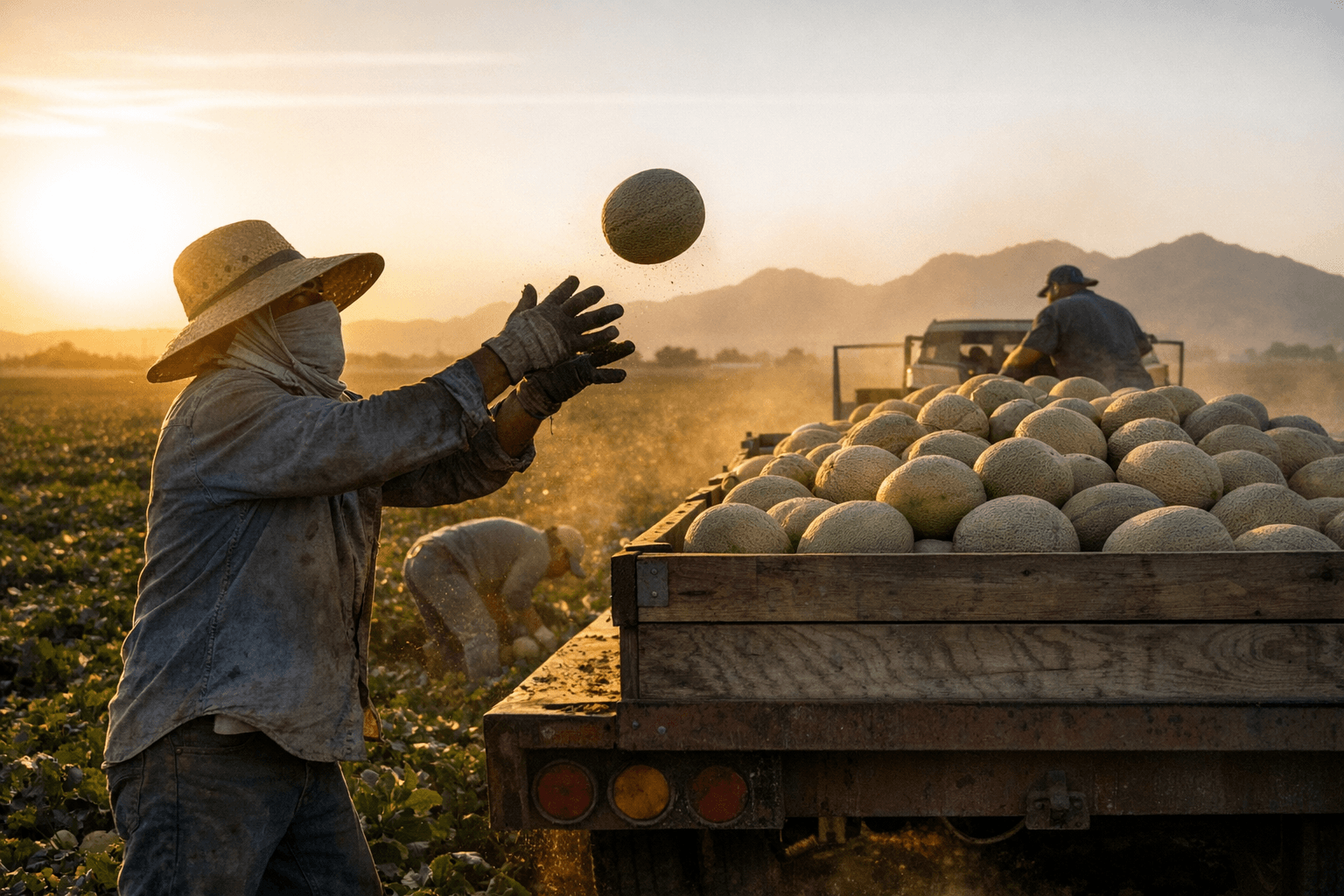
To manage the heat, crews shifted their start times to 4 a.m. As temperatures continued rising, operations were moving toward nighttime harvesting altogether. The changes came against an already unusual backdrop: last fall, the Yuma area received nearly three times its normal rainfall, setting up a growing season that has veered from expectation at nearly every turn.
For Pasquinelli, the core problem remained unchanged even as growers adapted: the harvest window is fixed, and the heat does not negotiate. "Well, we do as best as we can," he said. "We only have a certain finite window where we can harvest the vegetables and they be good for market." The summer crops now developing ahead of schedule meant that pressure was unlikely to ease soon. "It has been a volatile up-and-down with quality and supply," he said.
Yuma's fields feed dinner tables across the United States and Canada, which means the disruption radiating outward from the county's growing districts this March extended well beyond any single farm's ledger.
This article was produced by Prism’s automated news system from verified source data, official records, and press releases, then run through automated quality and moderation checks before publishing. The system is built and supervised by the people who set the standards it runs under. Read our full AI policy.
Did this article answer your question?