Yuma road report details multiple street closures, utility projects
Closures on 28th Street, Avenue 4E and 20th Street are tightening traffic across Yuma as sewer, water and lighting projects reshape commutes and business access.
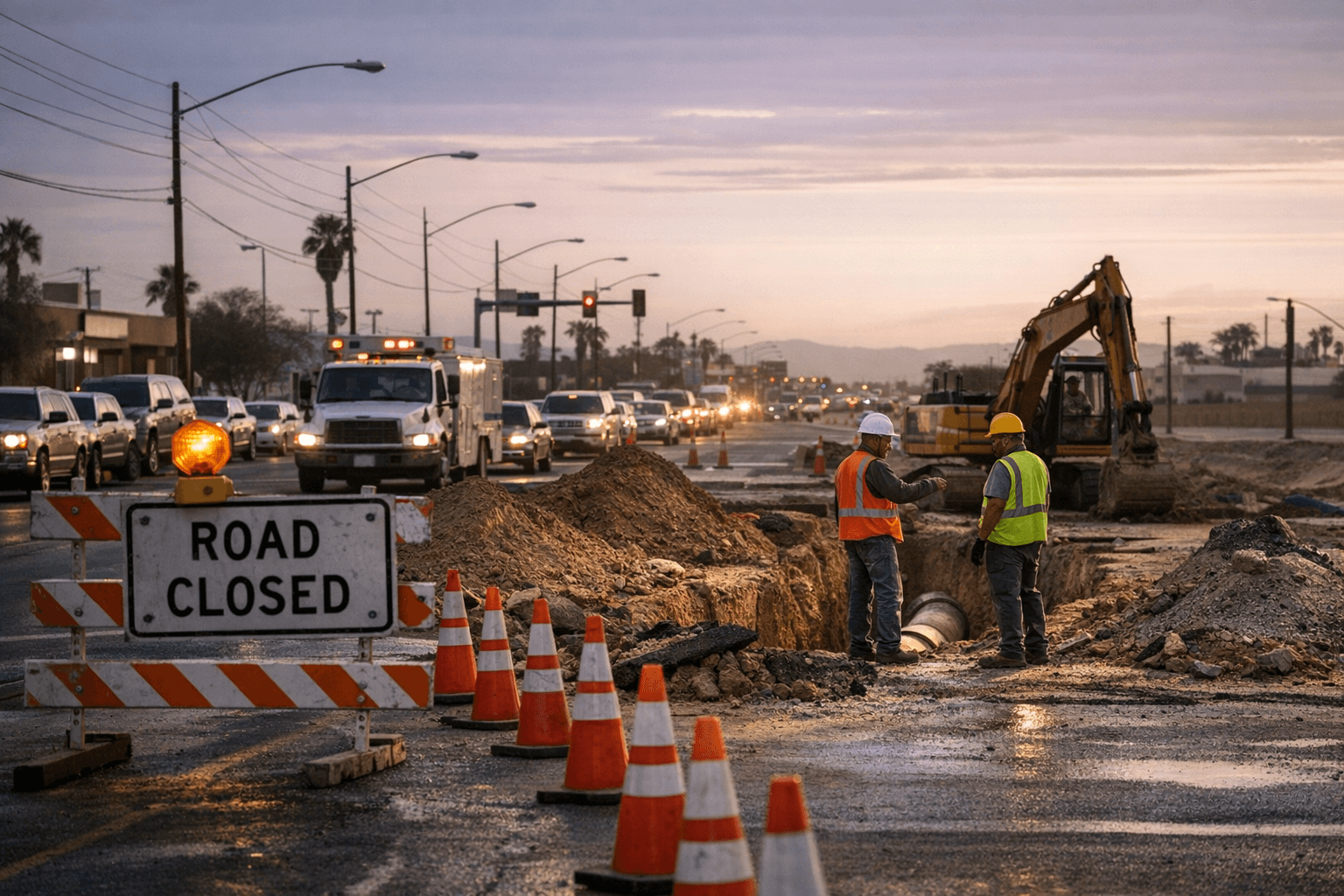
The biggest disruptions are lining up on Yuma’s key corridors
Traffic is getting pinched in several parts of Yuma at once as crews work through lighting upgrades, sewer replacement and a major underground utility rebuild. The sharpest pressure points are 28th Street, Avenue 4E at 32nd Street, and the 20th Street and 20th Place corridor, where closures and detours are already changing how people get to work, reach stores and move freight across town.
The City of Yuma’s road work lineup also shows a steady layer of maintenance work underneath the larger projects, including citywide striping, patching in two subdivisions and sidewalk repair in Las Brisas. Taken together, the report reads like a map of where drivers, delivery routes and business frontage will feel the most friction over the spring.
28th Street remains one of the most sensitive corridors
One of the most immediate slowdowns is on 28th Street, where roadway lighting work is underway after completed signal and intersection upgrades. The closure pattern matters because it affects movement in both directions, with westbound traffic restricted from Avenue C to 45th Drive and eastbound traffic restricted east of Avenue C to 33rd Drive.
That setup creates a narrow corridor of inconvenience around Avenue C, a place where cross-town trips can quickly become stop-and-go. Even when the work is tied to a safety upgrade, it can still disrupt store access, short errands and the daily rhythm of commuters who depend on 28th Street as a connector between neighborhoods and commercial areas.
Avenue 4E and 32nd Street is a direct business access issue
The sewer replacement project at Avenue 4E and 32nd Street is one of the clearest examples of infrastructure work colliding with customer access. The roadway is closed in both directions, but the city says business access is being maintained through alternate routes.
That distinction matters for nearby operators that depend on drive-up traffic, deliveries and regular customer flow. A closure that fully blocks through movement can still leave a business open, but it often changes how people find it, how long they stay on route and whether a delivery truck or service vehicle can reach the front door without extra maneuvering.
The project is part of the city’s broader effort to replace aging sewer infrastructure, and the short-term inconvenience is the tradeoff for avoiding bigger failures later. For anyone headed through that area, the practical rule is simple: expect to detour and allow extra time, even if the business you need is still open.
The 4th, 5th and 6th street work is a slower-moving squeeze
Another sewer line replacement project is closing stretches of 4th, 5th and 6th streets between 3rd Avenue and 4th Avenue. Unlike a brief patch job, this is the kind of corridor work that creates a persistent drag on nearby travel because it sits inside a dense grid where short turns and local access matter.
The city expects that work to continue into early May, which means the impact is not just a single-day interruption but a multi-week adjustment for people who live, work or operate small businesses in the block pattern around it. Even minor delays in a central neighborhood grid can ripple outward by pushing drivers onto parallel streets that were not built to absorb the extra volume.
For storefronts and service providers in that zone, the concern is less about dramatic shutdowns and more about friction. Each extra turn and each temporary barrier can be enough to alter whether a customer stops in or keeps going.
20th Street and 20th Place is the largest long-duration project on the list
The most extensive project in the report is the underground utility and pavement work on 20th Street and 20th Place between 8th Avenue and 4th Avenue. Crews are installing new water, storm and sewer infrastructure while also adding sidewalks, ramps and valley gutters, which makes this far more than a resurfacing job.
Because it involves multiple kinds of utility and pedestrian upgrades, the project includes several closures and is not expected to finish until late June. That extended timeline gives it the broadest potential impact on travel patterns, especially for anyone who uses the corridor as a regular connector between east-west routes or depends on predictable access for deliveries.
This is the kind of project that tends to matter quietly at first and loudly later. The visible work may look like lane closures and trenching, but the real effect is the cumulative disruption to drive times, curb access and the ease of getting from one side of the grid to the other without a detour.
Neighborhood maintenance will still shape short trips
Alongside the major construction zones, the city is also scheduling maintenance work for the week of April 13 through April 19. That includes patching in Hillside Manor and Santa Maria subdivisions, sidewalk repair in Las Brisas and citywide striping on several roads.
These jobs may not create the same scale of disruption as the big sewer and utility projects, but they still affect the trips people make every day. Patch work can bring brief lane shifts and rough pavement, sidewalk repair can change how pedestrians approach intersections, and striping can tighten or alter the way a driver reads a road at night or in heavy traffic.
The striping work is especially important because it is aimed at improving roadway safety and visibility. It also started March 23, which means that even the most routine-looking maintenance on the list is part of a broader push to keep Yuma’s streets legible as traffic patterns shift around the larger closures.
What matters most for commuters and small businesses
The pattern across the report is clear: Yuma is dealing with several layers of infrastructure work at the same time, and the city’s most traveled corridors are the ones carrying the burden. 28th Street affects cross-town movement, Avenue 4E and 32nd Street hits business access directly, the 4th through 6th street work slows neighborhood-grid travel, and the 20th Street project brings the longest and most complex disruption.
For commuters, that means the spring driving routine is likely to change more than once depending on the route. For small businesses, it means customer access, delivery timing and visibility may all shift at the same time, especially near active closures and detours.
The upside is that each project is tied to core systems Yuma depends on every day: lighting, sewer, water, storm drainage, sidewalks and pavement. The city is rebuilding the pieces that keep the streets functioning, even if the short-term result is a tougher drive across town.
This article was produced by Prism’s automated news system from verified source data, official records, and press releases, then run through automated quality and moderation checks before publishing. The system is built and supervised by the people who set the standards it runs under. Read our full AI policy.
Did this article answer your question?