1-Carat Rapaport Price Index Drops 1.3 Percent in January
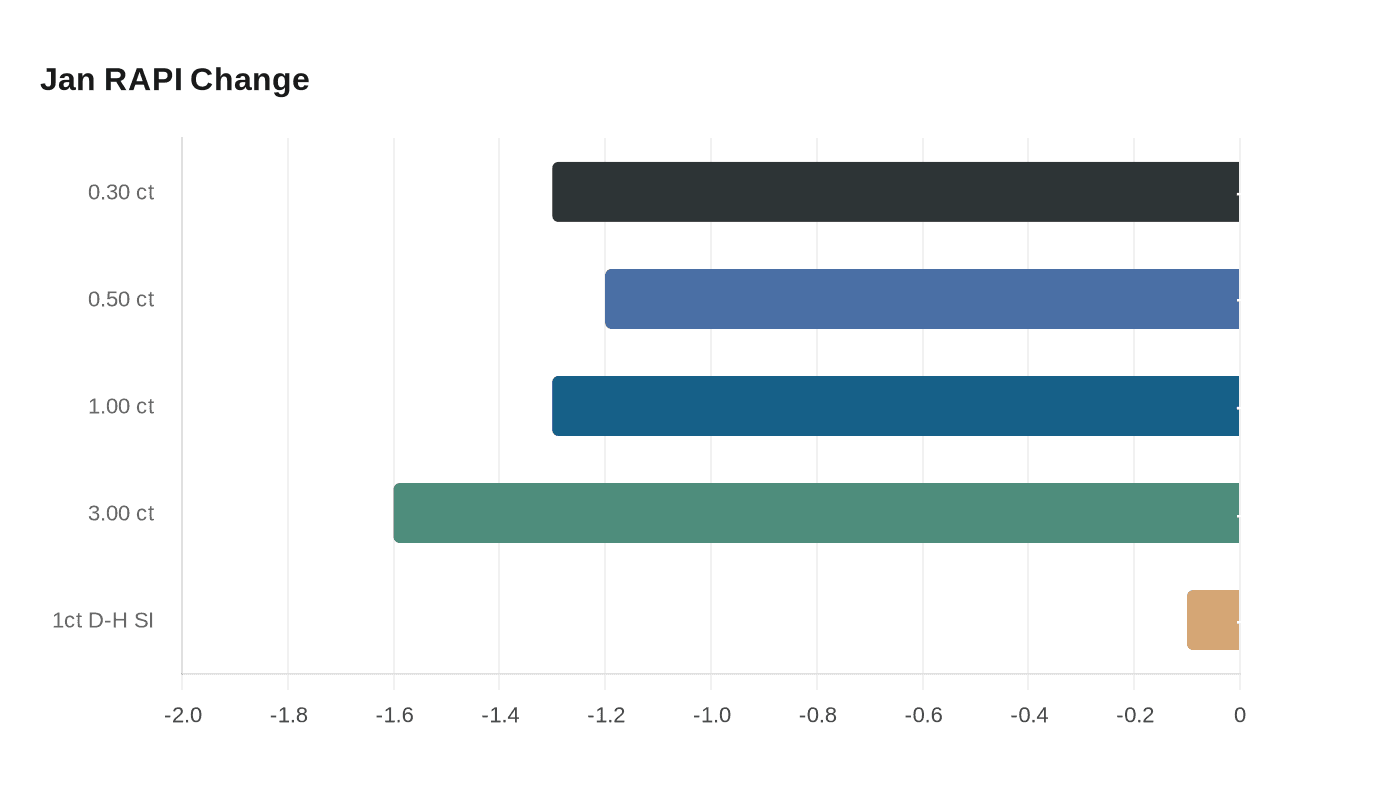
Rapaport's 1-carat RAPI fell 1.3% in January as small-goods declines eased; 0.50-carat RAPI dropped 1.2% while 3-carat prices slid 1.6%.

Rapaport reported that its RapNet Diamond Index (RAPI) for 1-carat goods fell 1.3% in January 2026, a moderation after two months of steeper declines for small sizes. The RAPI - which tracks round, D to H, IF to VS2 diamonds - showed 0.30- and 1-carat goods both down 1.3% for the month, while the 0.50-carat RAPI decreased 1.2%.
The index recorded mixed performance by size class. Prices for 3-carat diamonds slid 1.6%, reversing a recent period of stability. Rapaport highlighted a narrow subset—round, 1-carat, D to H, SI diamonds—that saw prices fall 0.1% for the month after suffering a 24.1% slump across 2025, underscoring how volatility last year continues to shape polished markets.
Market mechanics, Rapaport said, help explain the pattern. "Diamond-price drops became more moderate in January, especially in the small goods that had seen sharp declines in recent months." The release linked that earlier weakness to last year’s influx of lower-value rough from Angola and Russia, and to a January move in the supply chain: "De Beers reduced rough prices at its January sight, causing concern that lower-cost goods would flood the market."
Regional demand and buyer behavior were uneven. Rapaport noted that "US prices were stronger than those in India," while India’s jewelry market dipped because of high gold prices and China "remained weak." At the same time, European orders for 5-carat-plus diamonds were good, and jewelers showed demand for rounds and long fancies of 1.50 carats and larger, indicating where liquidity is concentrated.
Trade and sentiment added further texture. Rapaport said "buyers remained cautious due to price uncertainty and the impact of tariffs and geopolitical tensions," but that the "US-India trade deal in early February lifted sentiment." On social channels Rapaport reported that "US dealers were mainly positive about the season and were waiting for the results of memo conversions. Retailers managed inventory carefully, resulting in last-minute orders." The firm also flagged that "demand focused on 1.20-carat and larger diamonds, especially long fancies," and that "synthetics continued to gain market share in fashion jewelry."
Taken together, the January numbers show a market still sorting winners from losers: diamonds over 1.20 carats and large, long-fancy stones are providing price support, while polished under 1 carat struggles with overhang from cheaper rough and shifting retail appetite. Rapaport summed the landscape this way: "The market continued to bifurcate, though the divisions were less pronounced than last year." Expect selective demand for larger goods to remain the principal stabilizer of prices in the near term.
Know something we missed? Have a correction or additional information?
Submit a Tip