4 key takeaways on U.S. birthrate decline and policy risks
A CDC 2024 paradox: total births rose while the general fertility rate hit a historic low; four takeaways explain data, who’s affected, why it matters, and what reporters must verify.

1. CDC paradox and conflicting numbers
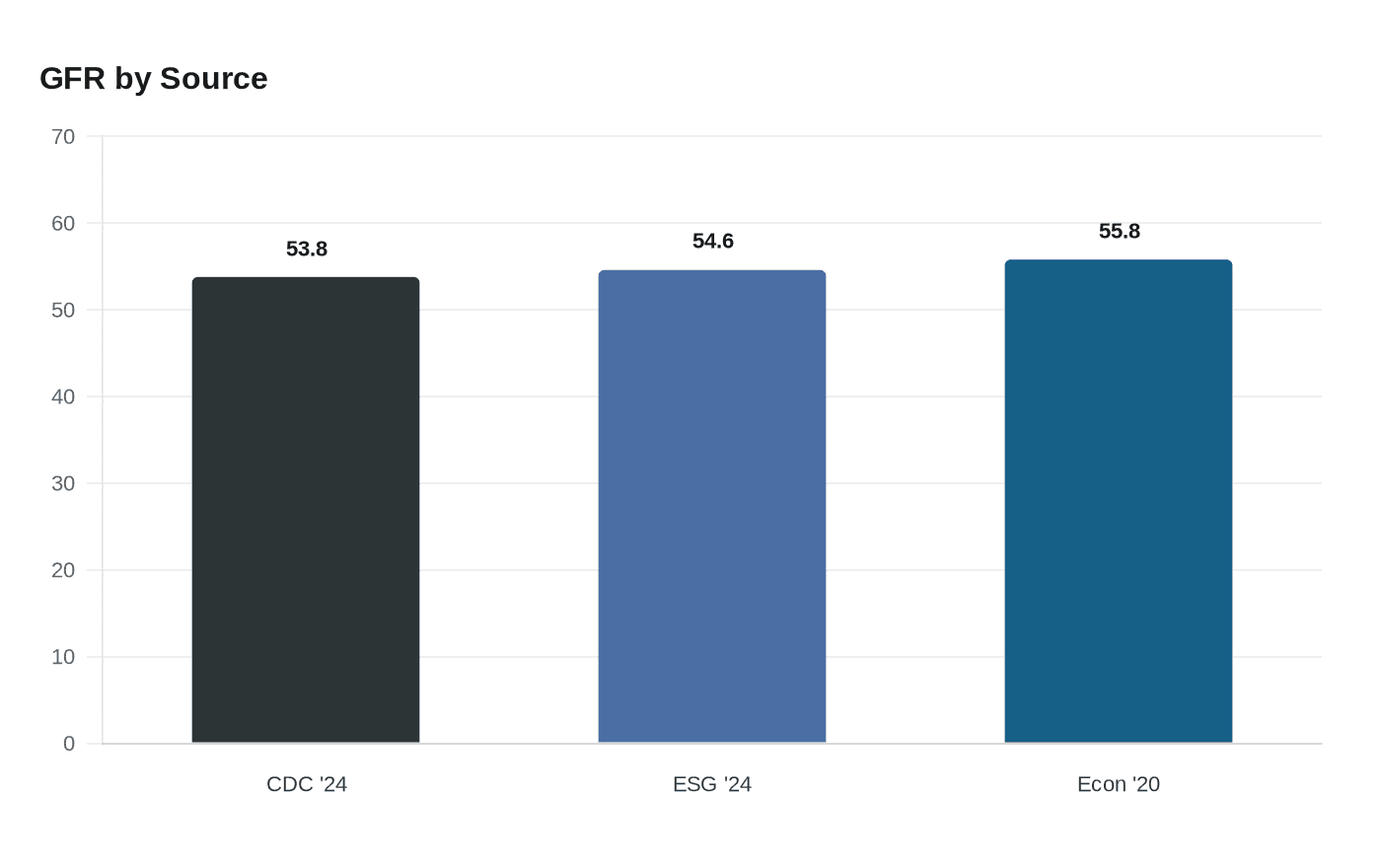
In July the CDC released data on U.S. births for 2024 showing a paradox: the number of births increased from 2023 to 2024 while the general fertility rate (GFR) “dropped 1% to a historic low of 53.8 births per 1,000 women aged 15 to 44 years, fewer than 1.6 births per woman,” according to the original report. That 53.8 GFR is recorded alongside other recent figures in the source bundle, Economic Strategy Group reports a 2024 GFR of 54.6 and Econofact records 55.8 for 2020, so the numbers need reconciliation before publication. Reporters should confirm the CDC natality release (exact release date and dataset), verify whether the cited “historic low” refers to GFR or total fertility, and note the source retrieval error for Healio: “[Healio]: We were unable to process your request. Please try again later. If you continue to have this issue please contact customerservice@slackinc.com.”
2. Age and demographic patterns: who is driving the drop
The decline is broad but uneven by age: birth rates dropped for women aged 15–34, were unchanged for those aged 35–39, and rose 2% for women aged 40–44 (original report). The New York Times reporting by Sabrina Tavernise highlights that “the biggest drops were among the youngest women” and presents the striking demographic shift that “half of all 30-year-old women are childless now,” adding the line “31 is the new 21.” Econofact documents declines across racial and socioeconomic lines, white, Black and Hispanic women (with the largest declines among Hispanic women), women with and without college degrees, and both married and unmarried women, and notes the teen birth rate has been falling steadily since the mid‑1990s. These mixed age trends (younger women down, older women stable or up) shape short-term cohort dynamics even as long-term fertility stays below replacement.

3. Competing explanations for why births fell
Sources preserve several nonexclusive hypotheses. An OBGYN graphic quote (OBGYN0925King_Graphic_01) captures one voice: “No one really knows. My personal belief is that women have found true autonomy, and many (women and men) are choosing not to have children, a perfectly valid choice. Likely, they would be less likely to make this choice in a world of economic equity, prosperity and one that valued quality of life through meaningful parental leave, etc. But even in Scandinavia where they seemingly have gotten this “right,” we see a similar decline, indicating that parenthood is not a priority for all persons.” Econofact emphasizes cohort and preference shifts, changing aspirations, parenting norms and expanded opportunities for women that predate 2007, and flags the Great Recession as a potential inflection point after which births did not rebound. The New York Times excerpt also notes immigration as a component of population change, parenthetically asserting that “immigration… has fallen under the Trump administration,” which compounds natural population change. Reporters should present these as hypotheses and attribute them precisely rather than asserting a single cause.
- Obtain the primary CDC 2024 natality release and confirm the GFR and total births, and why births could rise while GFR falls.
- Reconcile the three recent GFR/birth‑rate figures in the bundle (53.8; 54.6; 55.8) and ensure consistent terminology (GFR vs. “birth rate”).
- Verify the identity, title and affiliation for the quoted “King” and the source of the OBGYN graphic (OBGYN0925King_Graphic_01).
- Retrieve Sabrina Tavernise’s full New York Times piece (page header shows “Friday, February 27, 2026”) for methodology behind “half of all 30‑year‑old women are childless now.”
- Confirm Economic Strategy Group methodology for natural increase figures and the CBO citation, and get full Mayo Clinic Proceedings text referenced in PMC metadata.
4. Economic, policy consequences and verification checklist
Analysts warn of large fiscal and labor-market consequences if low fertility and falling immigration persist. The Aspen Economic Strategy Group warns that “lower birth rates are slowing natural population growth,” reporting natural increase fell from 0.6 percent in 2006 to 0.2 percent in 2025, and citing the Congressional Budget Office forecast that “by 2030, natural population growth in the US will turn negative (that is, deaths will begin to outnumber births).” The group emphasizes that an older, smaller population “will present strong headwinds to the country’s economic dynamism and to public finances – particularly the fiscal health of states and communities losing population.” Medical literature cited in the bundle also points to policy responses, Tannus and Dahan (J Med Econ. 2019) argue for state‑mandated fertility coverage, while a Mayo Clinic Perspectives piece (PMCID: PMC11537490; PMID: 39489566) frames long-term implications and provides contact details for follow-up: Vesna D. Garovic, MD, PhD, Mayo Clinic, garovic.vesna@mayo.edu, Twitter: @GarovicVesna. Before publishing, confirm key items listed here:
These four takeaways bundle the factual claims, exact quotations and numeric discrepancies preserved in the source material so reporters can verify, contextualize and responsibly report the public‑health, economic and equity implications of the U.S. birthrate decline.
This article was produced by Prism’s automated news system from verified source data, official records, and press releases, then run through automated quality and moderation checks before publishing. The system is built and supervised by the people who set the standards it runs under. Read our full AI policy.
Did this article answer your question?