7.7 earthquake off Japan triggers tsunami warnings along Pacific coast
Sirens and loudspeakers drove coastal evacuations in Ofunato as Japan warned of 3-meter waves after a powerful offshore quake.
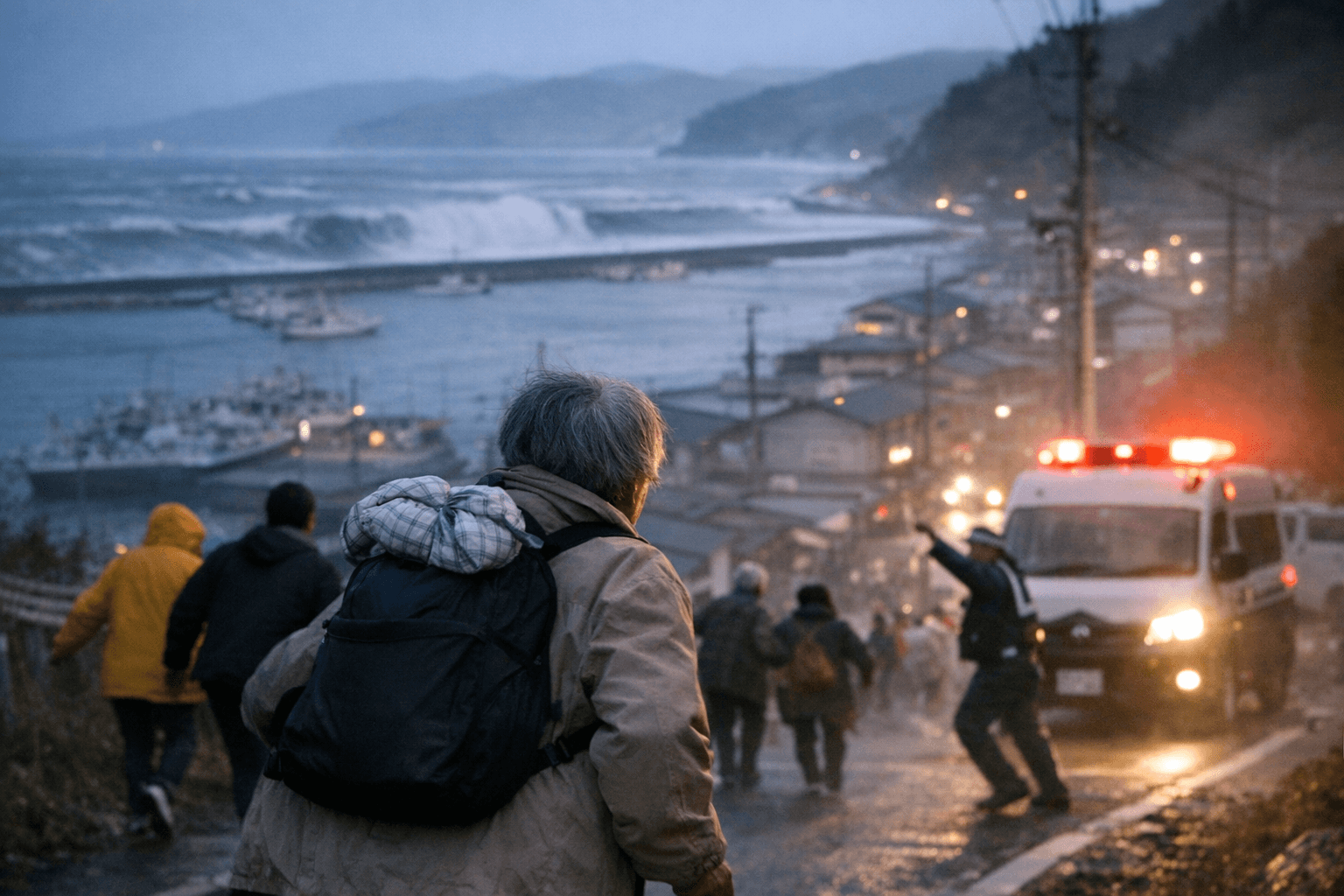
Sirens split the air in Ofunato as loudspeakers told coastal residents to move away from the shoreline, and Japan’s Pacific coast moved quickly into evacuation mode after a powerful offshore earthquake struck near the Sanriku coast. The quake hit off Japan’s northeastern coast at about 4:53 p.m. local time, with preliminary magnitudes ranging from 7.4 to 7.7, sending fresh anxiety through communities that still measure danger against the memory of 2011.
The Japan Meteorological Agency said tsunami waves as high as 3 meters, or about 10 feet, were possible and issued warnings or advisories for parts of Iwate, Aomori and Hokkaido. Its system bases warning levels on estimated tsunami heights and arrival times, and a 3-meter forecast falls into the urgent evacuation category. Officials urged residents not to wait at the water’s edge to see what might arrive.
Early reports suggested the feared impact did not immediately materialize at the scale some had feared. NHK reported a tsunami of about 80 centimeters at Kuji port on the northeast coast, with smaller waves observed in other coastal areas. Chief Cabinet Secretary Minoru Kihara said there were no immediate reports of damage or injuries in the early hours after the quake.
The shockwaves were felt beyond the northeast, with reports of shaking reaching Tokyo, underscoring how widely the quake was felt across Honshu. The offshore Sanriku-Iwate region remains one of the most closely watched stretches of Japan’s coast because it sits near the source of the 2011 Tohoku earthquake and tsunami, a magnitude 9.0 disaster that killed around 18,500 people and triggered the Fukushima nuclear meltdown.
That history is why the response moved so fast. In towns such as Ofunato, Miyako and Kuji, the warning itself became the first test: sirens, public announcements and immediate movement away from the sea. Japan’s preparedness culture is built for precisely that moment, when there is little time to debate and only minutes to clear the coastline before the next wave arrives.
This article was produced by Prism’s automated news system from verified source data, official records, and press releases, then run through automated quality and moderation checks before publishing. The system is built and supervised by the people who set the standards it runs under. Read our full AI policy.
Did this article answer your question?