8-Year-Old California Boy Wins NASA Contest to Design Artemis II Mascot
Lucas Ye, an 8-year-old from Mountain View, California, beat 2,600 global entries to send his plush mascot "Rise" to the Moon aboard Artemis II.
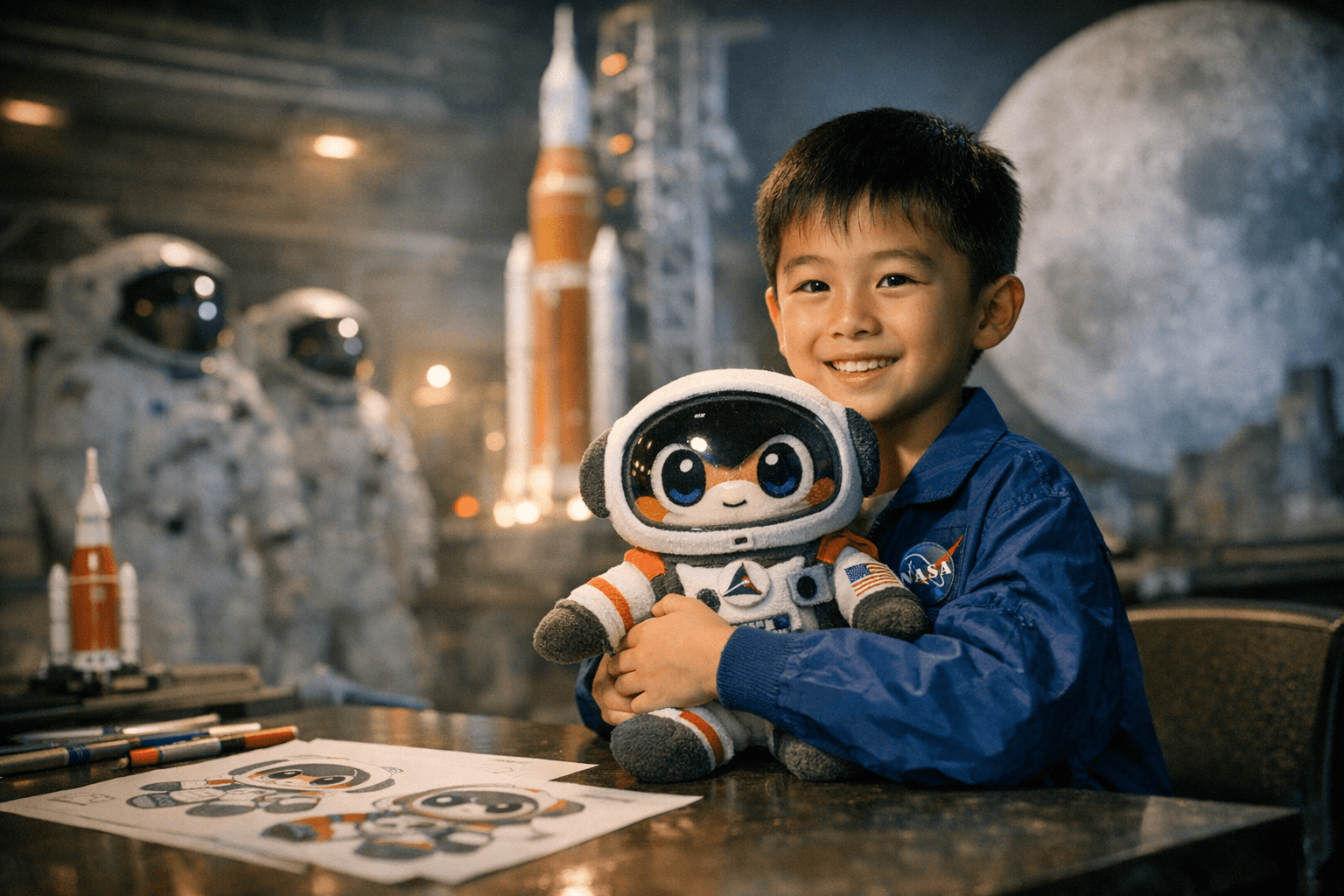
Lucas Ye was eight years old and in second grade when his design beat more than 2,600 entries from students across 50 countries to become the official mascot of Artemis II. The white moon plushie he created, named "Rise," launched aboard the spacecraft on April 1, 2026, becoming a small but historically resonant piece of one of NASA's most consequential missions in decades.
The design draws its concept from one of the most celebrated images in space history: the 1968 "Earthrise" photograph taken by Apollo 8 astronaut Bill Anders, which captured Earth appearing above the lunar surface. Lucas rendered that idea as a plush toy wearing a cap printed with Earth, the brim of the hat tracing the galaxy and rockets. "It was called Earthrise," the Mountain View, California boy explained, "and the Earth on top of the plushie's head was representing Earthrise."
The NASA Moon Mascot competition, sponsored by Freelancer, a freelancing marketplace company, was open to students of all ages worldwide. The Artemis II crew reviewed the full submission pool and narrowed the field to 25 finalists in August 2025, before selecting five top contenders. Among those was Anzhelika Iudakova of Finland, whose entry was titled "Big Steps of Little Octopus," and Daniela Colina of Peru, who submitted "Corey the Explorer." Rise ultimately won the crew's vote.
On March 27, 2026, Rise was officially unveiled at a ceremony at Kennedy Space Center in Cape Canaveral, Florida. Mission Specialist Christina Koch introduced the mascot on behalf of the crew: "This little guy, Rise, really resonated with us, because the theme is actually the Earthrise photo taken on Apollo 8, which is inspirational to all of us. It is a mission that sort of mirrors our own, and we've incorporated it into our mission patch and also into our ethos and values as a crew, so, welcome aboard, Rise."
On Artemis II, Rise serves as the Zero Gravity Indicator, a small plushie placed in the cabin that floats freely once the craft reaches microgravity, signaling to the crew that they have entered zero-g. The tradition dates to 1961, when Soviet cosmonaut Yuri Gagarin brought a small doll aboard the Vostok I capsule for the same purpose. Since then, ZGIs have included R2-D2, an Albert Einstein doll, Baby Yoda on SpaceX's Crew-1, and most recently Snoopy on the uncrewed Artemis I mission in 2022.
Artemis II lifted off at 6:35 p.m. EDT on April 1, 2026, from Launch Complex 39B at Kennedy Space Center. The four-person crew consists of NASA Commander Reid Wiseman, Mission Specialists Victor Glover and Christina Koch, and Canadian Space Agency astronaut Jeremy Hansen. Their 10-day free-return trajectory takes the spacecraft around the Moon and back, marking the first crewed lunar flyby in more than 50 years and the first human mission beyond low-Earth orbit since Apollo 17 in 1972.
Lucas and his family attended the launch in person at Kennedy Space Center. In a Good Morning America interview, he called the experience "really cool" and reflected on how far his idea had traveled: "I feel very lucky. A little idea can turn out into a big thing." He also said he hopes to one day watch an Artemis mission that lands astronauts on the Moon, a goal that Artemis II, building on the uncrewed Artemis I test in 2022, moves meaningfully closer to achieving.
This article was produced by Prism’s automated news system from verified source data, official records, and press releases, then run through automated quality and moderation checks before publishing. The system is built and supervised by the people who set the standards it runs under. Read our full AI policy.
Did this article answer your question?


