Abiy Ahmed’s Prosperity Party wins overwhelming majority in Ethiopia election
Abiy Ahmed’s party captured 438 parliamentary seats, but the landslide came in an election that did not vote in Tigray and parts of Amhara.

Abiy Ahmed’s Prosperity Party has won 438 seats in Ethiopia’s 547-seat lower house, a margin that gives it a commanding majority and sets up another five-year term for the prime minister. Yet the scale of the victory tells only part of the story: the election was held without voting in Tigray and in parts of Amhara, where conflict and insecurity kept large numbers of citizens from the polls.
The National Election Board of Ethiopia said the final results were verified and approved by its Executive Council before being announced in Addis Ababa, in a ceremony attended by President Taye Atske Selassie, party representatives, civic groups, ambassadors and media. The results were also broadcast on Facebook, a reminder that the vote was both highly visible and tightly bounded by the conditions on the ground. With 274 seats needed for control of the chamber, the Prosperity Party cleared the threshold comfortably and won roughly 90 percent of the seats for which results were announced.
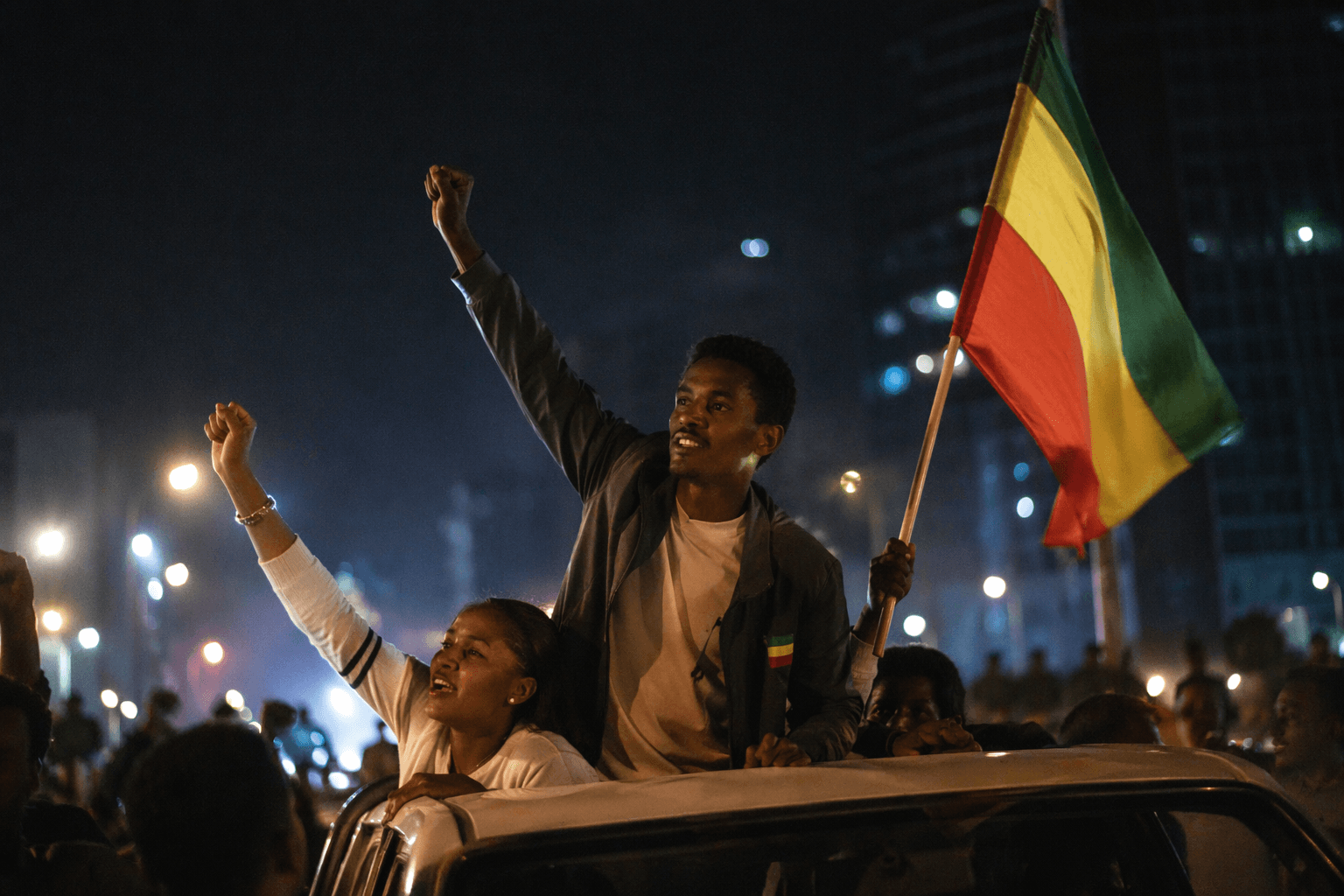
That overwhelming result does not settle the deeper question of Ethiopia’s democratic trajectory. More than 50 million people were registered to vote, more than 10,900 candidates ran and 42 political parties took part, but the contest unfolded amid what the Intergovernmental Authority on Development described as an election marked by major institutional, administrative and technological reforms as well as serious security problems. Observer missions from IGAD and the African Union said the vote took place alongside Ethiopia’s national dialogue and reform process, while also noting that elections were not held in Tigray and some parts of Amhara because of security concerns.
The absence of voting in those regions undercuts claims that the landslide reflects a fully national mandate. In Amhara, at least eight of 138 constituencies did not vote, while in Tigray the government did not organize an election after a two-year civil war and continuing political turmoil. In Oromiya, fighting between government forces and the Oromo Liberation Army has killed hundreds over the past few years, and in Amhara the Fano militia has seized territory since 2023. Opposition parties accuse the federal government of arresting leaders and using legal barriers to weaken competition, allegations the government denies.
The result also reflects Abiy’s broader consolidation of power since he came to office in 2018 after mass protests against the EPRDF coalition. He created the Prosperity Party the next year, replacing the old governing structure with a more centralized one, and the new parliament is expected to convene in October to reelect him for another five-year term. In 2021, the party won 410 of 436 contested seats; this time, the numbers are even larger, but so are the questions about how much of Ethiopia’s political landscape was actually allowed to compete.
This article was produced by Prism’s automated news system from verified source data, official records, and press releases, then run through automated quality and moderation checks before publishing. The system is built and supervised by the people who set the standards it runs under. Read our full AI policy.
Know something we missed? Have a correction or additional information?
Submit a Tip