Accessible FDM 3D-printed Crocodile, Snake, Zebra Skins for Sustainable Garment Prototypes
An open‑access study used accessible FDM 3D‑printing with TPU, ABS and PLA to recreate crocodile, snake and zebra skins and integrate them into wearable garment prototypes.
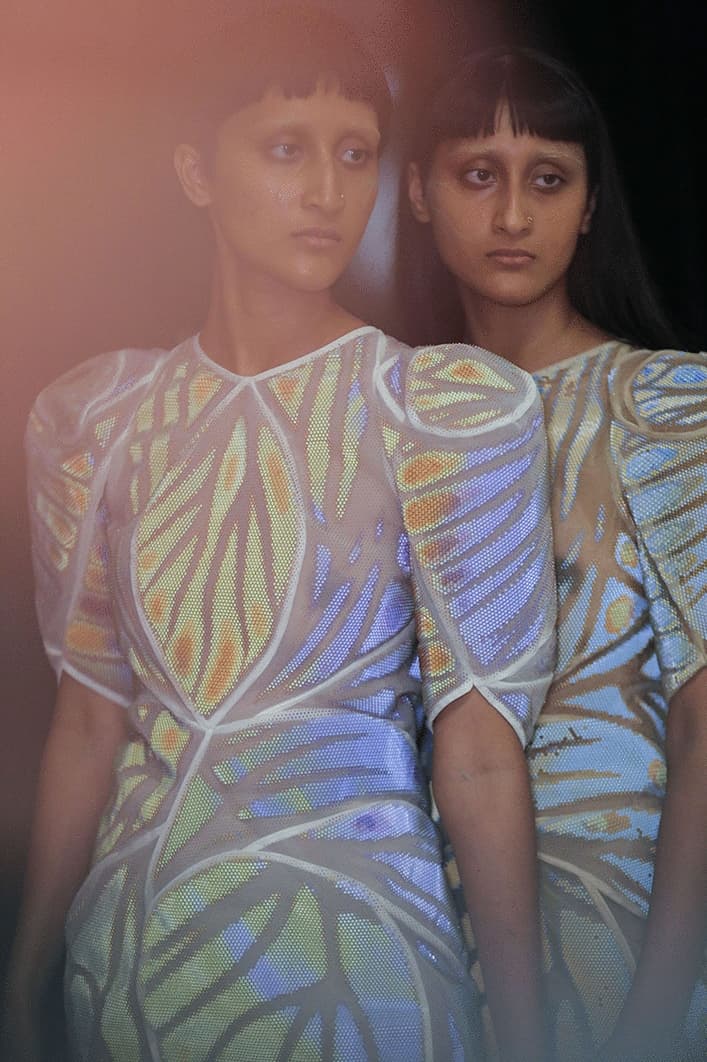
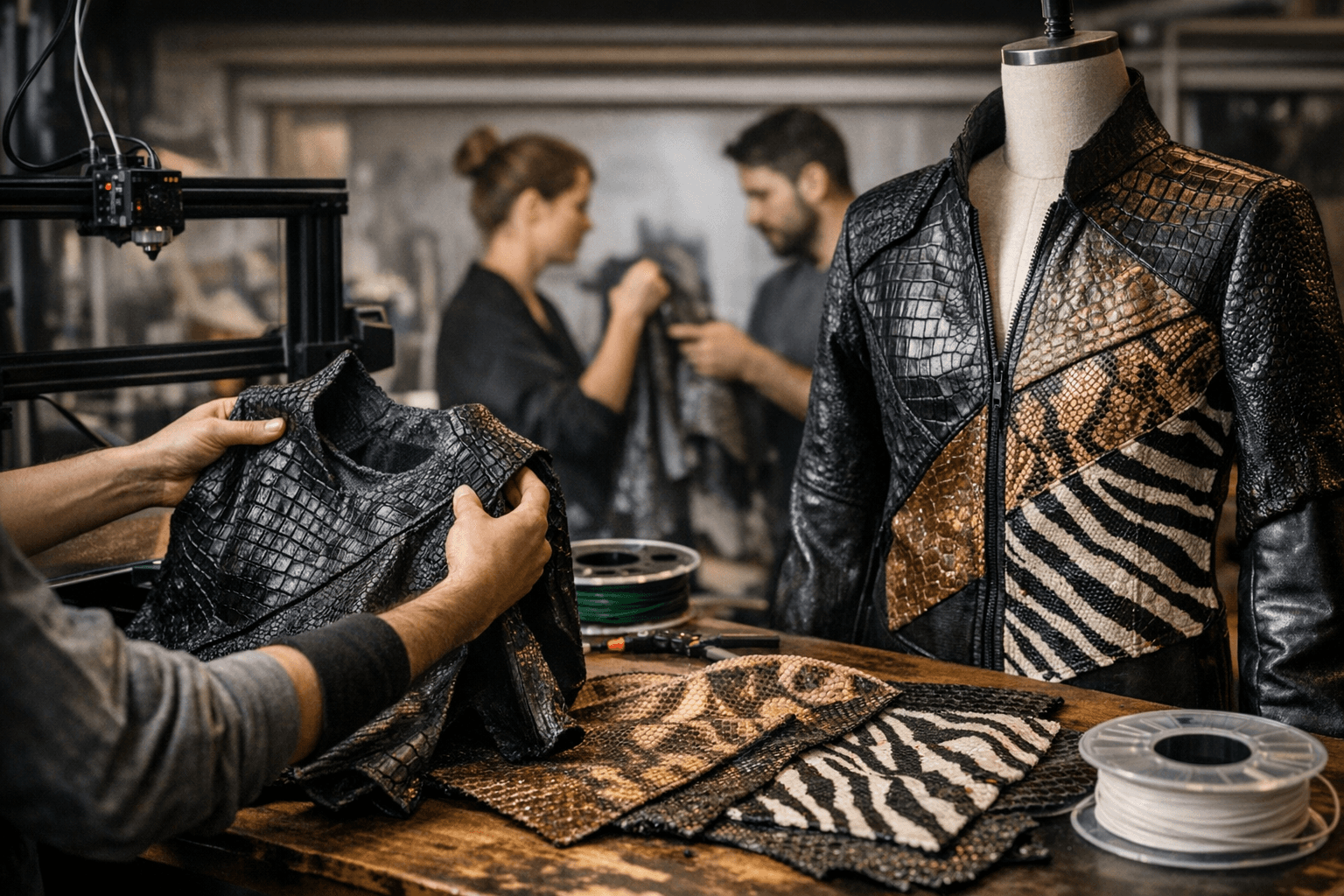
Researchers have translated the language of exotic skins into filament: an open‑access research article published 02 March 2026 documents the use of accessible FDM 3D‑printing with TPU, ABS and PLA to reproduce the visual and tactile attributes of crocodile, snake and zebra skins and to integrate those 3D‑printed skins into wearable garment prototypes. The paper positions the effort as practical prototyping rather than finished fashion goods, explicitly naming the thermoplastic filaments and the animal‑skin motifs it set out to mimic.
The study sits alongside established technical framing from Diva‑portal about how printing and textiles meet: "3D printed textiles are crafted by layering material directly onto the textile surface, guided by digital designs," the portal states in section 2.3, and it adds that "This method grants precise control over material utilisation, minimising waste and presenting a sustainable alternative to conventional techniques," citing Xiao and Kan, 2022. In practice this means designers and technicians can map scales, ridges and zebra striping as discrete topographical layers, depositing TPU for flex, PLA for crisp patterning, and ABS where structural rigidity is required.
Material overlap is notable: PLA appears in both the 02 March 2026 study and Diva‑portal commentary. Diva‑portal highlights an ecological pathway beyond virgin plastics, noting that "Biomaterials such as PLA biocomposites present eco‑friendly alternatives to conventional synthetic materials. These composites can be combined with natural fibres such as jute, cotton and hemp and are biodegradable," a point sourced to Polewka et al., 2023. That combination suggests a trajectory where printed skins could eventually incorporate renewable‑resource binders rather than relying solely on traditional thermoplastic filaments.
Practical trade‑offs remain explicit. Diva‑portal warns that "3D printed textiles often exhibit stiffness and reduced comfort levels, thereby limiting their applicability in textile manufacturing." The 02 March 2026 article reports wearable garment prototypes but supplies no published user‑comfort metrics, print settings or durability tests in the supplied text; missing details include nozzle sizes, layer heights, sample sizes and quantified tactile assessments. Those gaps make it impossible, from the supplied material, to judge whether the prototypes resolve the stiffness problem or simply demonstrate visual plausibility.
A parallel but technically distinct stream of research underscores the breadth of 3D printing in bio‑materials: teams at Graz University of Technology and Vellore Institute of Technology are developing hydrogel, cell‑laden 3D‑printed skin imitations to replace animal testing for cosmetics, work summarized by ScienceDaily under the headline "3‑D Printed skin to replace animal testing." Karin Stana Kleinschek of the Institute of Chemistry and Technology of Biobased Systems notes, "The hydrogels for our skin imitation from the 3D printer have to fulfil a number of requirements," and ScienceDaily records that these hydrogels enable "Hydrogels in which skin cells survive and grow," driven in part by Directive 2010/63/EU restrictions on animal testing for cosmetics in the EU.
Taken together, the 02 March 2026 FDM study and the Diva‑portal literature sketch a concrete but conditional future: layered, digitally guided printing can reduce material waste and permit striking reptile and zebra textures, yet the industry‑level hurdle of comfort remains. The next concrete steps are methodological: publish printing parameters, run quantified wear and durability tests, and compare standard TPU/ABS/PLA builds with PLA biocomposites combined with jute, cotton or hemp as described by Polewka et al., 2023. If those data arrive, 3D‑printed exotic skins could move from atelier experiments into lower‑waste prototype pipelines for designers who want the look of crocodile without the animal.
Know something we missed? Have a correction or additional information?
Submit a Tip