Acclaimed Wildlife Cameraman Doug Allan Dies While Trekking in Nepal at 74
Doug Allan, who spent 620 days filming polar bears and helped define Blue Planet, died 8 April while trekking in Nepal. He was 74.
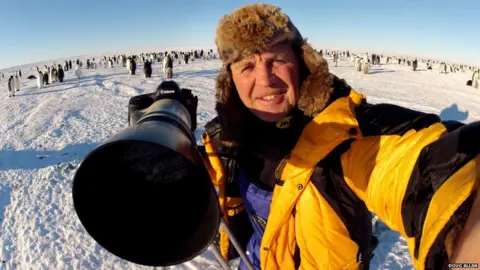
Doug Allan, the Scottish wildlife cameraman whose images of polar ice, deep oceans, and vanishing ecosystems shaped a generation's understanding of the natural world under threat, died on 8 April 2026 while trekking in Nepal. He was 74.
His management company, Jo Sarsby Management, confirmed the death, saying he had died "immersed in nature and surrounded by friends." In a statement, the company called him a "true pioneer of wildlife filmmaking" who had captured "some of the most breathtaking and intimate images" of the natural world, adding: "Doug leaves behind a visual legacy that few could ever match."
Born in Dunfermline, Fife, in 1951, Allan grew up in the shadow of his father's photography shop. As a child, Jacques Cousteau's 1956 documentary "The Silent World" fixed his attention on underwater cinematography. He graduated with an honours degree in marine biology from the University of Stirling and took his first job as a pearl diver with Bill Abernathy, described as the last pearl hunter in Scotland.
His defining professional arc began on the ice. Allan spent eight years with the British Antarctic Survey at Signy Island in the South Orkney Islands, working as a research diver, scientist, and photographer. A chance meeting with Sir David Attenborough in 1981, during a BAS filming visit, changed everything. Allan went on to work on "Living Planet" in 1984 before becoming a full-time cinematographer in 1985.
Over four decades, he served as principal cameraman on some of the BBC's most consequential wildlife programmes: The Blue Planet, Blue Planet II, Planet Earth, Frozen Planet, Life in the Freezer, Wildlife Special: Polar Bear, Human Planet, and Ocean Giants. The statistical record of his achievement is formidable: eight Emmy Awards, including Outstanding Cinematography for Nonfiction Programming for Blue Planet in 2002 and Planet Earth in 2007, plus five BAFTAs. He received the Outstanding Contribution to Craft prize at BAFTA Scotland in 2017, was made an Honorary Fellow of the Royal Photographic Society in 2012, and was awarded the Polar Medal twice for his polar region work. In 2024, the King's Birthday Honours List appointed him OBE for services to broadcast media and the promotion of environmental awareness.
What made Allan's work distinct was proximity. He told BBC Scotland in 2017 that he had spent roughly 620 days of his life searching for and recording polar bears. A polar bear once pressed its wet nose against his window so closely that, for a brief moment, he thought someone was cleaning the outside of the glass with a squeegee mop. On another occasion, filming underwater, a walrus grabbed his legs after mistaking him for a seal. He drove it away by hitting it on the head with his camera.
These were not incidental hazards. They were the product of a working method built entirely on closing the distance between viewer and animal, and between audience and consequence. The images Allan retrieved from permafrost and freezing water formed the visual vocabulary through which millions came to understand glacial retreat, sea ice loss, and the fragility of polar ecosystems. His footage did not lecture; it showed.
In the final months of his life, Allan moved from showing to arguing. Earlier in 2026, he urged the Scottish government to back an "ecocide" bill designed to hold companies legally accountable for severe or widespread environmental damage. The images he spent 40 years making had, by then, become inseparable from the case he was building.
This article was produced by Prism’s automated news system from verified source data, official records, and press releases, then run through automated quality and moderation checks before publishing. The system is built and supervised by the people who set the standards it runs under. Read our full AI policy.
Did this article answer your question?