Acting CDC director urges MMR shots as U.S. measles tops 1,100 cases
Jay Bhattacharya urged Americans to get MMR vaccination after CDC data showed 1,136 cases and growing outbreaks; officials say resources are being surged to states.
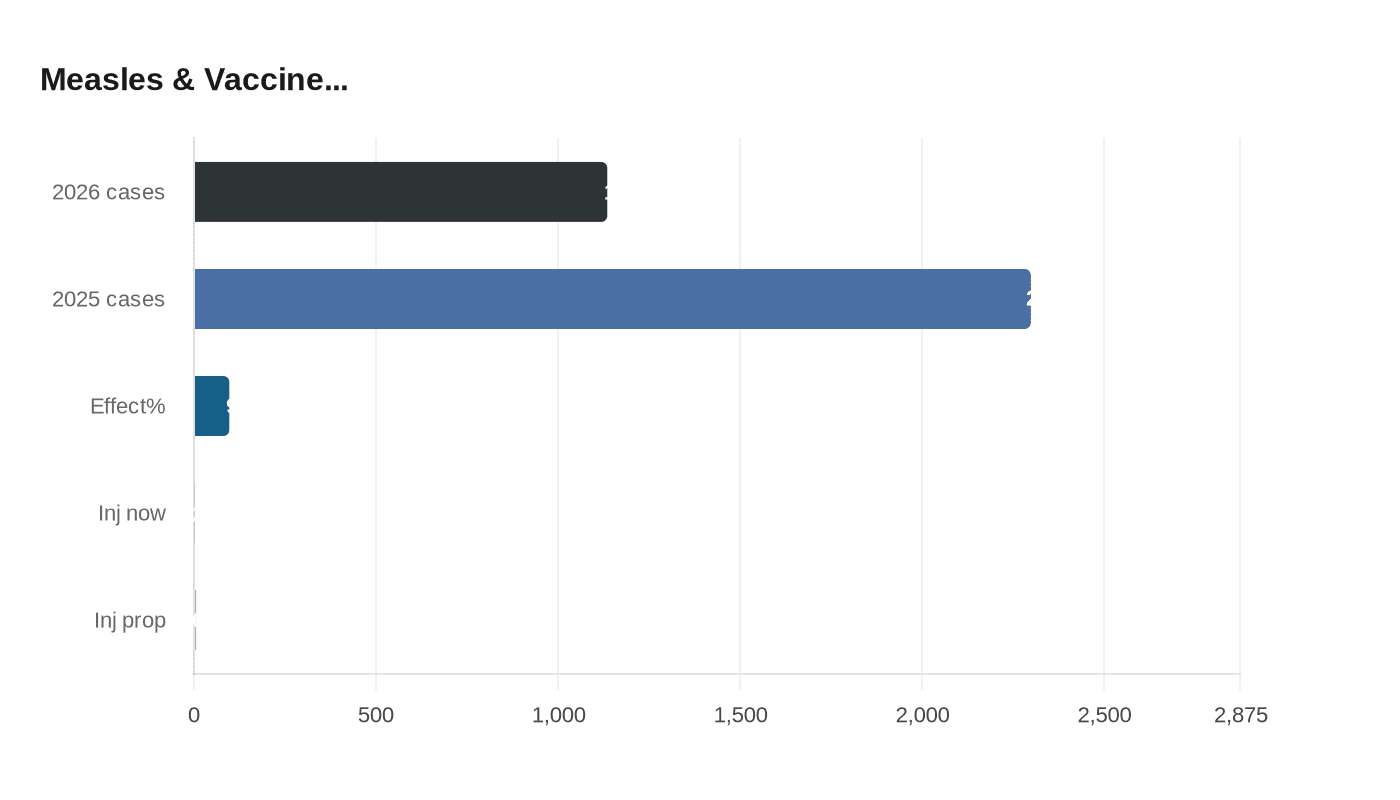
Jay Bhattacharya, the acting director of the Centers for Disease Control and Prevention and director of the U.S. National Institutes of Health, posted a video on X urging Americans to get the measles-mumps-rubella vaccine as the country confronts more than 1,100 confirmed infections and widening outbreaks. According to CDC data released Feb. 26, 2026, 1,136 confirmed measles cases have been reported in the U.S. so far this year, and health officials say new clusters are continuing to appear in multiple states.
“Measles is preventable, and vaccination remains the most effective way to protect yourself and those around you,” Bhattacharya said in the video. He added, “There is no cure for measles, which is why prevention is so critical. The MMR vaccine remains the most reliable and effective way to prevent it.” He also noted that “two doses are 97% effective at providing lifelong protection against measles and its complications,” and said the agency was “surging resources to support prevention and response efforts” while coordinating with state health departments. “We stand ready to provide CDC technical staff, laboratory support, vaccines and therapeutics upon request,” he said.
State health officials have already taken advantage of expanded federal assistance in at least one instance. A South Carolina public health official said the CDC allowed the state to temporarily expand its epidemiology workforce and that the state would seek additional analytical support from scientists and infectious-disease specialists to evaluate data and guide the response.

The appeal comes amid a fractious policy and messaging environment. Jim O’Neill, who has served as acting CDC director and deputy health secretary, has publicly called for manufacturers to develop “safe monovalent vaccines” and urged that the combined MMR be “broken up” into separate measles, mumps and rubella shots, posting about the idea on X. President Donald Trump has also advised on Truth Social to “break up the MMR shot into three totally separate shots.” Public-health experts have warned those proposals could undercut disease control efforts.
In a recent op-ed, Jake Scott, MD, argued sharply against separating the combined vaccine, writing, “O'Neill offers no evidence for his proposal, because none exists. No immunologic principle supports separation. No safety data justify abandoning a program that has protected millions of children for more than 50 years.” Critics note there are no licensed monovalent measles, mumps or rubella vaccines in the United States, and that breaking up the combined shot would double the number of injections a child receives for those antigens from two to six under the standard two-dose schedule.
The MMR has been administered as a combination vaccine since 1971 and the routine schedule calls for the first dose at 12 to 15 months and a second dose at 4 to 6 years. Public-health officials point to that long record of safety and to the World Health Organization’s elimination strategy, which relies on combined measles-rubella or MMR formulations, as reasons to maintain the current regimen.
Last year was the worst in decades for measles in the U.S., with nearly 2,300 confirmed cases across roughly 50 outbreaks, and officials warn that sustained declines in vaccine uptake would make elimination goals harder to achieve. For now, the CDC is pressing for immediate vaccination, ramping up technical support for states and urging clinicians to provide clear, evidence-based guidance to families.
This article was produced by Prism’s automated news system from verified source data, official records, and press releases, then run through automated quality and moderation checks before publishing. The system is built and supervised by the people who set the standards it runs under. Read our full AI policy.
Did this article answer your question?