Activist vessel collides with Norwegian krill trawler amid 'Operation Krill Wars' in Antarctic waters
An activist ship collided with a 132-meter Norwegian krill trawler in Antarctic waters, with the vessel owner calling it a "terroristic attack" that nearly ruptured a diesel tank.
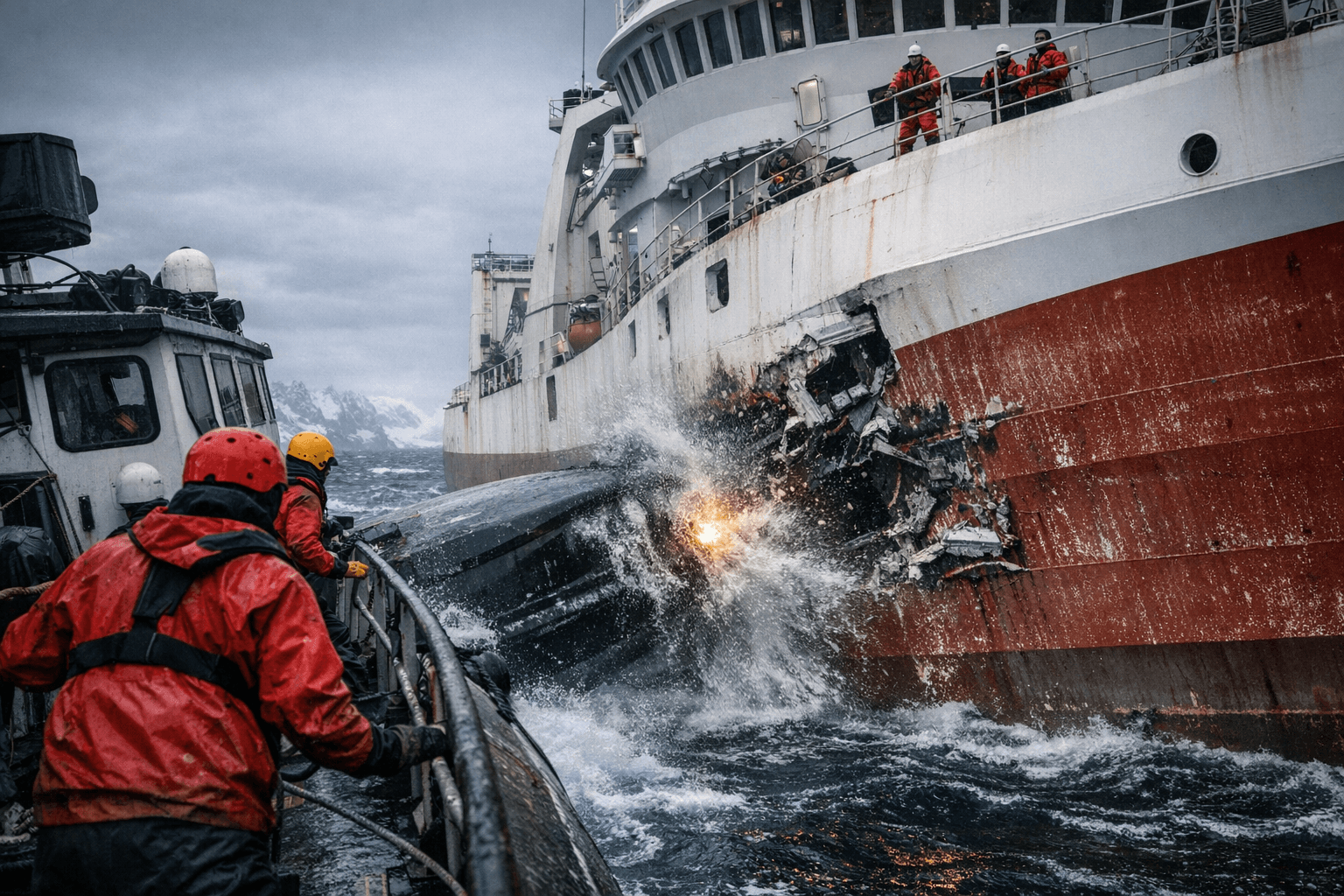
A 64-meter activist vessel operated by the Captain Paul Watson Foundation rammed into the stern of one of the largest krill trawlers in Antarctic waters on March 31, escalating a months-long campaign against industrial krill fishing into a direct physical confrontation with global regulatory consequences.
The M/V Bandero, crewed by approximately 19 people under the leadership of French activist Lamya Essemlali, collided with the Norwegian-flagged Antarctic Sea during what the foundation described as a five-hour direct intervention it called "Operation Krill Wars." A two-minute video provided to the Associated Press shows the Bandero steaming slowly into the trawler's stern, striking its port side at a slight angle. The Bandero's crew also intervened against a second Aker-owned vessel during the same operation, deploying giant metal net-shredding devices that the foundation said disabled krill nets and halted fishing for several hours.
Aker QRILL Co. CEO Webjørn Barstad condemned the action in stark terms, calling it a "deliberate attack" and, in some statements, a "terroristic attack." "Our crew were put at risk in some of the most remote waters on Earth, and only luck avoided potential environmental damage," Barstad said. The company said the Bandero came within centimeters of striking a diesel tank, and that the Antarctic Sea's multinational crew of approximately 60 was "shaken but unharmed." Aker said it would pursue all available legal action.
The size disparity between the two vessels underscores the audacity of the maneuver. The Antarctic Sea, built in 1999 and displacing 9,600 gross tons at 132 meters, is among the largest krill vessels of its type operating in the Southern Ocean; Aker contends it is the largest. The Bandero, acquired by the Captain Paul Watson Foundation in 2024 and formerly a Japanese fisheries patrol vessel, is less than half the trawler's length. The ship is named after the tequila brand owned by John Paul DeJoria, the American billionaire who co-founded Paul Mitchell hair care products and has long supported Watson's campaigns.
The Captain Paul Watson Foundation characterized the collision as "aggressive nonviolence," a tactic it traces through decades of direct actions against whaling, sealing, and dolphin hunting operations. Essemlali, president of Sea Shepherd France and the operation's campaign leader, framed the underlying issue in ecological terms: "Fishing for krill is an ecological time bomb. Nothing can justify targeting a keystone species on which the entire Antarctic ecosystem depends." Paul Watson himself was not aboard the Bandero; the vessel departed Australia in February 2026 as part of the joint campaign between the foundation and Sea Shepherd France.
The confrontation arrives at a moment of acute tension over Antarctic krill governance. Annual catches have grown nearly fivefold since 2006, reaching 518,000 tonnes in 2025 from roughly 106,000 tonnes two decades earlier. Last year was the first time in the fishery's history that the CCAMLR-set annual quota of 620,000 tonnes was fully exhausted, forcing an early closure of the fishery on August 1, 2025. That record catch was partly attributed to CCAMLR's failure at its October 2024 Hobart meeting to renew Conservation Measure 51-07, which had spatially distributed catches across the Southern Ocean; China and Russia both vetoed proposals to establish new marine protected areas and cut fishing levels in Zone 48.1, the Antarctic Peninsula's most heavily fished corridor. Approximately 13 large super-trawlers from Norway, China, Chile, Namibia, and South Korea currently operate in the fishery.
Krill's centrality to Southern Ocean ecology amplifies the stakes. The small crustaceans feed whales, seals, and hundreds of seabird species, and their role in carbon sequestration has drawn increasing scientific scrutiny. For Aker, the commercial argument runs in parallel with environmental credentials: the company has held Marine Stewardship Council certification, the only Antarctic krill fisheries to carry that distinction, and promotes its patented Eco-Harvesting technology as a no-bycatch method. In early 2025, Aker signed a contract to build a fourth krill vessel, scheduled to begin operating under a Norwegian fisheries license in late 2026.
The legal and jurisdictional fallout from the collision remains uncertain. Antarctic waters operate under the Antarctic Treaty System and CCAMLR, and any action by Aker would likely involve flag-state complaints given the Antarctic Sea's Norwegian registry. Watson's own recent legal history illustrates how politically charged maritime activism cases can become: arrested in Greenland on July 21, 2024, on a Japanese Interpol warrant tied to a 2010 clash with the whaling ship Shonan Maru 2, Watson was ultimately freed after Danish Justice Minister Peter Humlegaard declined extradition to Japan. Both sides have strong incentives to escalate in the public arena as CCAMLR negotiations over new spatial catch management measures remain unresolved heading into the 2026 fishing season, with experts warning the annual quota will likely be exhausted again unless new restrictions are agreed.
This article was produced by Prism’s automated news system from verified source data, official records, and press releases, then run through automated quality and moderation checks before publishing. The system is built and supervised by the people who set the standards it runs under. Read our full AI policy.
Did this article answer your question?