Aerospace Engineer Explains Why Crew Faces Communication Blackout During Flyby
During Artemis II's lunar flyby, Orion's passage behind the Moon cut all radio contact for 40 minutes - a geometry problem, not a glitch.

The moment the Orion spacecraft slipped behind the Moon on Monday evening, it took four astronauts and all radio contact with them with it. For aerospace engineer Elio Morillo, who explained the phenomenon for a national audience, the silence was entirely predictable: a straightforward consequence of physics, geometry, and the fact that the Moon is a very large rock.
The planned communications blackout for the Artemis II mission began at approximately 6:44 p.m. EDT and was expected to last 40 minutes. The cause is simple to state but easy to underestimate in scale. When Orion crossed onto the far side of the Moon, the lunar body itself sat directly between the spacecraft and Earth, physically blocking every radio signal the Deep Space Network relies on to maintain contact. No signal can bend around 2,000 miles of rock.
Morillo, a former systems engineer at NASA's Jet Propulsion Laboratory who worked on the Mars 2020 Perseverance rover and now leads avionics testing for Blue Origin's lunar landers, is one of the clearest voices translating this kind of orbital mechanics for general audiences. The blackout is not a failure mode. It is a predictable interval baked into the flight plan from the start, the same class of problem that engineers model out months before launch.
The crew of Reid Wiseman, Victor Glover, Christina Koch, and Canadian Space Agency astronaut Jeremy Hansen were not flying blind during those 40 minutes. They were simply unreachable. Orion reached its closest approach to the lunar surface at approximately 7:02 p.m. EDT, about 4,070 miles above the Moon, while ground controllers at Johnson Space Center had no choice but to wait. Mission control tracking the spacecraft's last known trajectory would have a precise window for when to expect the signal to resume as Orion emerged from the far side and line-of-sight with Earth's Deep Space Network stations was restored.
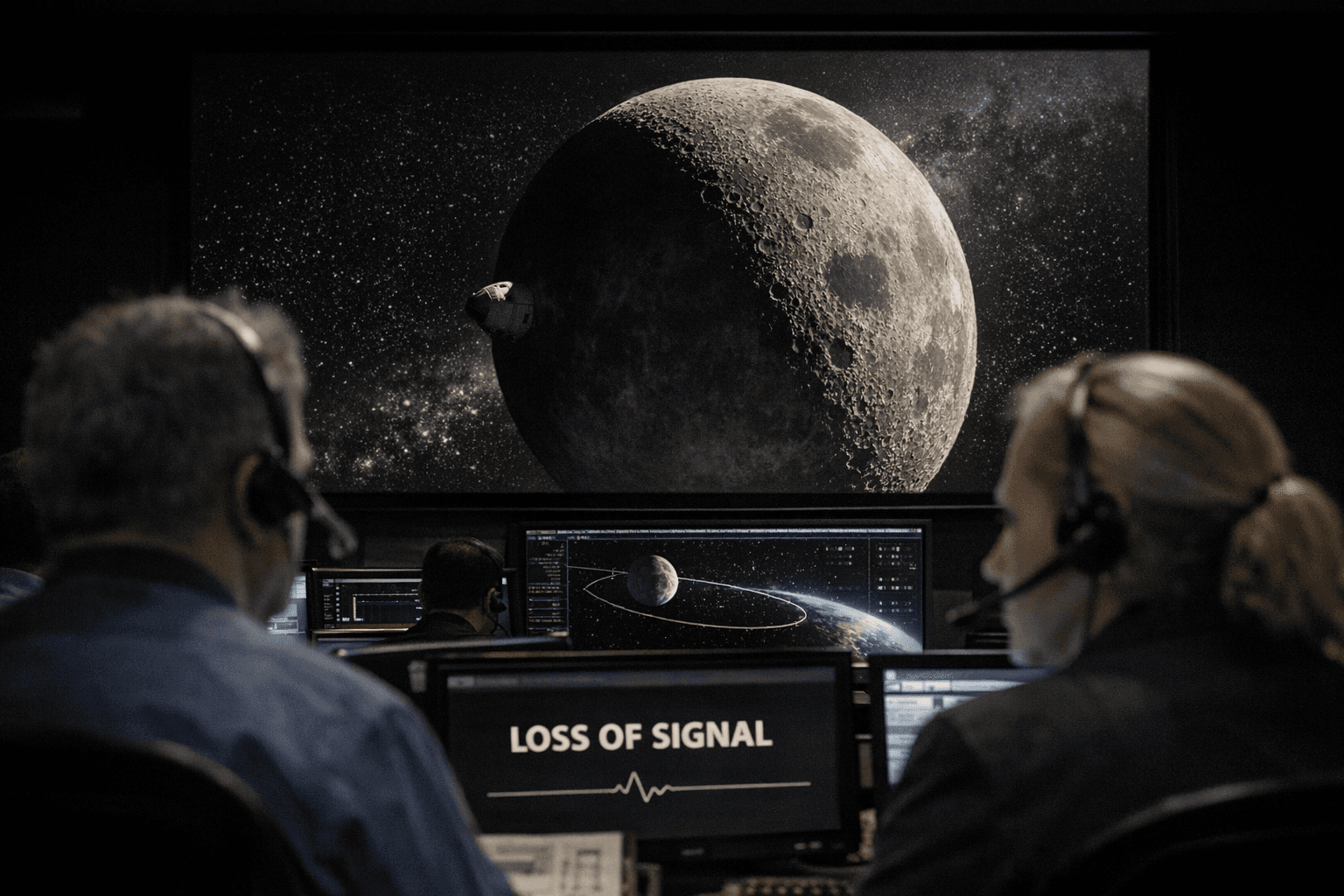
The blackout framed the most dramatic hour of the entire mission. The spacecraft had entered the lunar sphere of influence at 12:37 a.m. EDT the same morning, the point at which the Moon's gravity exerted a stronger pull on Orion than Earth's. Mission Specialist Koch marked the crossing with a note to ground controllers: "We are now falling to the Moon rather than rising away from Earth. It is an amazing milestone!"
By 7:05 p.m. EDT, Orion was expected to reach 252,757 miles from Earth, breaking the human spaceflight distance record set by Apollo 13 in April 1970, when that crew's emergency return trajectory carried them 248,655 miles out. The record had already technically fallen at 1:56 p.m., more than four hours before the blackout began.
The last time humans swung around the far side of the Moon and vanished from radio contact was Apollo 17 in December 1972. Artemis II made that experience routine again, which was precisely the point. Every 40-minute gap in the telemetry is a solved problem, not an unknown one, and the engineering behind that confidence is what makes crewed lunar missions manageable in public.
This article was produced by Prism’s automated news system from verified source data, official records, and press releases, then run through automated quality and moderation checks before publishing. The system is built and supervised by the people who set the standards it runs under. Read our full AI policy.
Did this article answer your question?