Robotaxi Companies Refuse to Disclose Remote Worker Intervention Data to Senator Markey
Seven robotaxi firms, including Waymo and Tesla, refused to tell Sen. Ed Markey how often remote human workers must intervene to rescue their self-driving cars.

Every autonomous vehicle company Senator Ed Markey asked refused to answer the most basic safety question about their fleets: how often does a human have to step in to save the ride?
The Massachusetts Democrat published a report titled "Remote Backseat Operators: Revealing the Autonomous Vehicle Industry's Reliance on Human Remote Assistance Operators" on March 31, finding that none of the seven companies he contacted, Aurora, May Mobility, Motional, Nuro, Tesla, Waymo, and Zoox, would disclose how frequently their Remote Assistance Operators, or RAOs, intervene when their self-driving systems encounter dangerous or uncertain conditions. Markey, a member of the Senate Commerce, Science, and Transportation Committee, launched the investigation on February 3 and set a response deadline of February 17.
The companies' responses exposed what Markey described as a patchwork of safety practices, with significant variations in operator qualifications, response times, and overseas staffing across the industry. Network delays varied across companies as well, indicating that operators are making their own determinations about the latency threshold that constitutes a safety risk.
"My investigation revealed a wide range of concerning practices, from employees assisting vehicles from overseas to wide variations in communication lag times between vehicles and human operators," Markey said.
The details that did emerge painted a fragmented picture. Waymo is the only AV company that uses overseas remote operators, according to the responses. The company said it has approximately 70 remote assistance agents on duty worldwide at any given time overseeing some 3,000 robotaxis, with staff based in the Philippines. Tesla disclosed a different model: its remote assistance operators, based in Austin, Texas, or Palo Alto, California, can temporarily take control of the vehicle at speeds up to 10 mph. Markey called Tesla's refusal to share more specific frequency data "especially concerning."
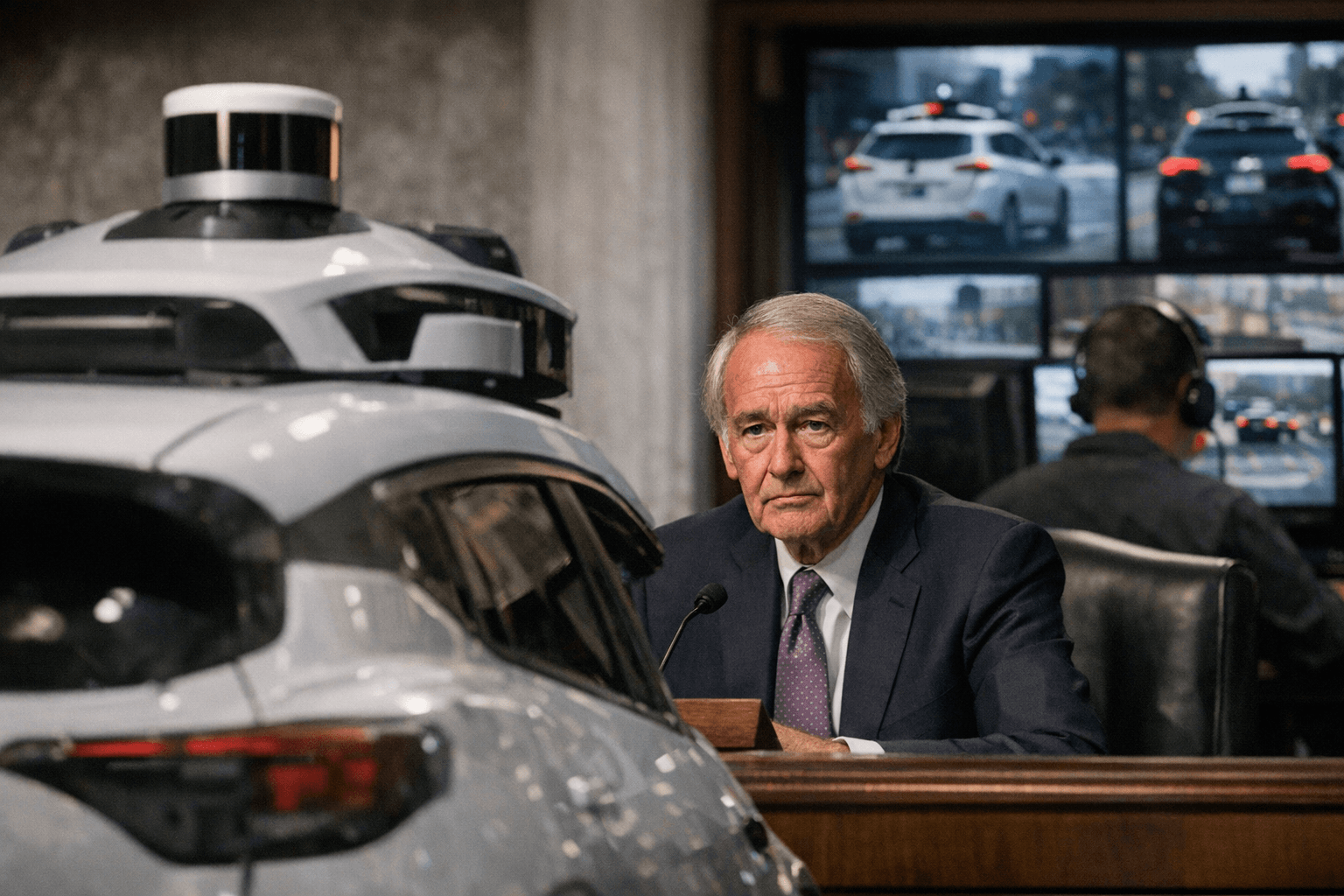
Waymo's remote operators, by contrast, intervene by making higher-level navigation decisions without assuming direct wheel control, as the company clarified in its responses to Markey.
The core transparency problem, Markey argued, is that millions of Americans have no idea this backstage workforce exists at all. In his original letters to the companies, Markey warned that without proper safeguards, the industry's reliance on Remote Assistance Operators could create serious safety, national security, and privacy risks.
Following the report's release, Markey sent a letter to Jonathan Morrison, Administrator of the National Highway Traffic Safety Administration, urging NHTSA to investigate the AV industry's RAO practices. He also announced he is working on legislation to impose strong, enforceable regulations around the industry's use of RAOs. That push builds on the AV Safety Data Act he introduced in January, which would require NHTSA to mandate the reporting of vehicle miles traveled, unplanned stoppages, and injuries involving drivers, pedestrians, and cyclists.
The intervention rate question is not academic. Without knowing how frequently human operators must take over, city permitting agencies, insurers, and the riding public have no baseline for evaluating whether these systems are genuinely safe to scale. What the industry markets as autonomy, Markey's investigation made clear, still runs on a network of human workers whose workload companies treat as a trade secret.
This article was produced by Prism’s automated news system from verified source data, official records, and press releases, then run through automated quality and moderation checks before publishing. The system is built and supervised by the people who set the standards it runs under. Read our full AI policy.
Did this article answer your question?