AfD hits record 28% in Germany poll, widening lead over CDU
AfD surged to a record 28% and moved four points ahead of the CDU, deepening pressure on Friedrich Merz's coalition.

Germany’s far-right Alternative for Germany climbed to a record 28% in the latest INSA voting-intention poll, taking a four-point lead over Friedrich Merz’s conservative bloc and underscoring how deeply the party has moved into the political mainstream.
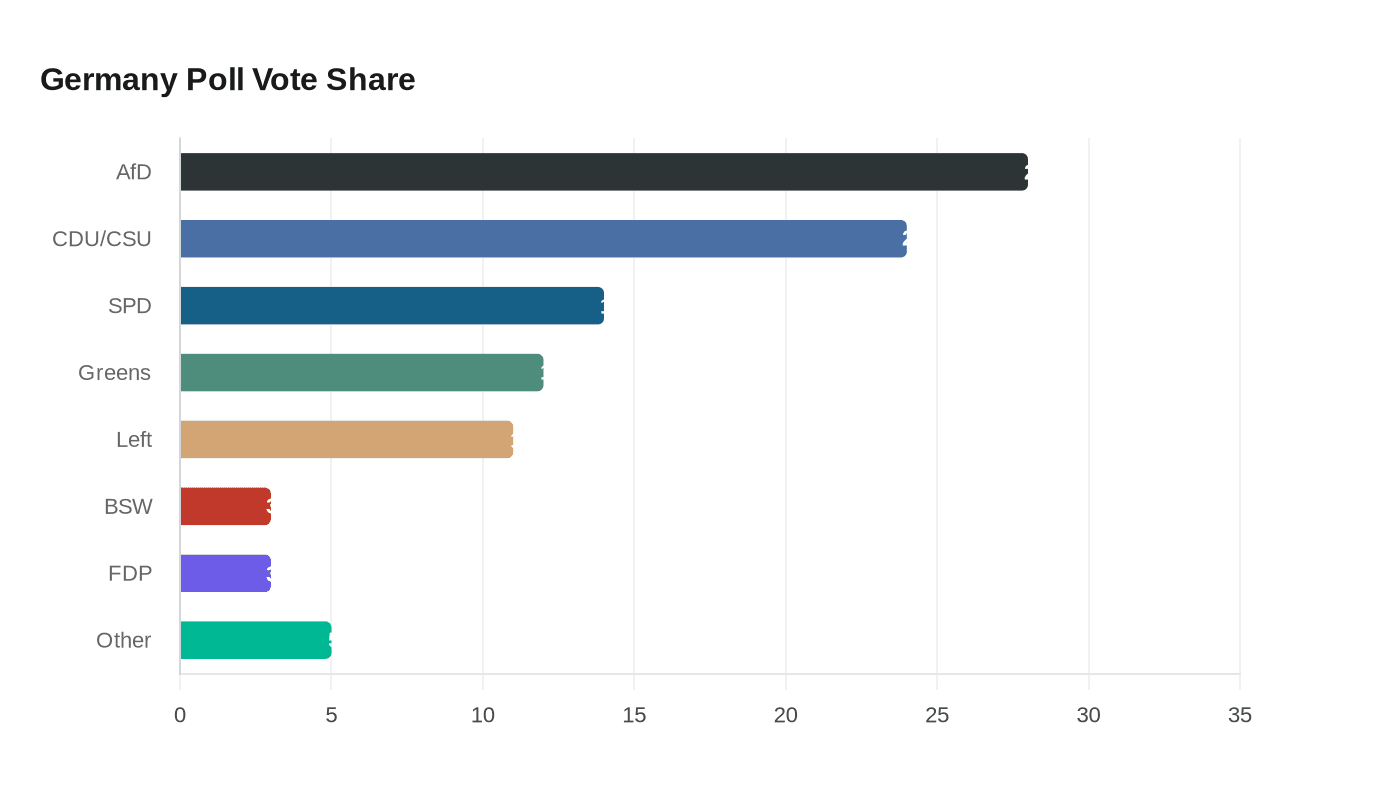
The weekly survey, conducted for BILD am Sonntag from April 20 to April 24 with a mixed telephone-and-online sample of 1,203 eligible voters, put the CDU/CSU unchanged at 24%. The Social Democratic Party held steady at 14%, the Greens slipped to 12%, and The Left stood at 11%. Bündnis Sahra Wagenknecht and the FDP were both on 3%, while 5% backed other parties.
The result was the highest level ever recorded for AfD by INSA and came after the party already finished second in Germany’s February 23, 2025 federal election. Earlier INSA polling in April 2025 had already shown AfD drawing level with the conservatives, suggesting the latest surge was part of a longer rise rather than a sharp one-off spike. For Merz, the numbers offered a stark warning: conservative voters were not consolidating behind the CDU/CSU fast enough to blunt the far right’s advance.
The poll also highlighted the arithmetic that makes German coalition-building so difficult. Politpro’s breakdown suggested the same numbers would translate into AfD 28%, CDU/CSU 24%, SPD 14%, Greens 12%, The Left 11%, BSW 3%, FDP 3% and others 5%. That would leave the incumbent governing parties short of a parliamentary majority, and the 11% supporting parties below the threshold showed how much of the vote can be stranded outside the Bundestag. Even so, viable three-party alliances would still be needed to reach the roughly 45% level that determines governing strength in practice.
Merz’s coalition has recently been shaken by internal squabbling over tax, pensions and health reforms, alongside concern over fuel prices. That backdrop has given AfD’s anti-immigration, anti-establishment message more room to resonate, even if the party’s 28% does not translate directly into power. With the next federal election expected in 2029, the poll was not a verdict on government survival, but it did show the far right consolidating its position at a time when Germany’s mainstream parties remain under strain.
This article was produced by Prism’s automated news system from verified source data, official records, and press releases, then run through automated quality and moderation checks before publishing. The system is built and supervised by the people who set the standards it runs under. Read our full AI policy.
Know something we missed? Have a correction or additional information?
Submit a Tip