Afghanistan Floods Kill 77, Earthquake Strikes as Disasters Mount Nationwide
Floods killed 77 in 10 days and a 5.8 quake wiped out a family of eight in Kabul province, sparing only a 2-year-old, as Afghanistan absorbs compounding catastrophes.
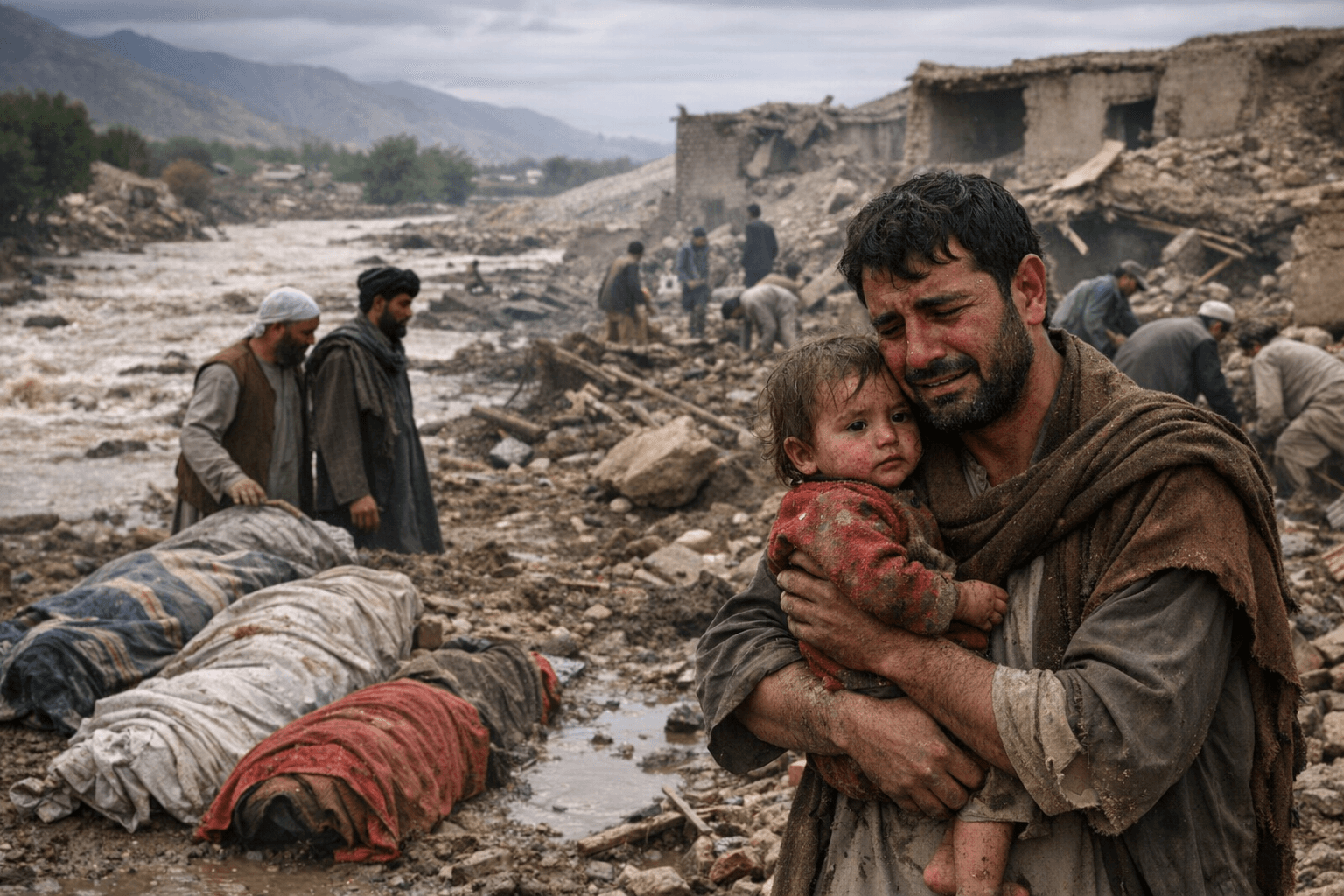
A Friday night earthquake killed an entire family sheltering in their home in Kabul province's Bagram district, while floodwaters were simultaneously tearing through at least 11 Afghan provinces, leaving a death toll of 77 people over just 10 days and exposing the staggering vulnerability of a country with almost no capacity to absorb cascading disasters.
The 5.8-magnitude quake struck at 8:42 p.m. local time on April 3, with its epicenter in the Hindu Kush mountain range roughly 150 kilometers east of Kunduz in northeastern Badakhshan province, at a depth of approximately 186 kilometers. Tremors radiated far beyond Afghanistan's borders, shaking parts of western Pakistan and registering as far away as New Delhi, India. The German Research Centre for Geosciences initially put the magnitude at 5.9 before it was revised.
In the Gosfand Dara area of Bagram district, about 60 kilometers from Kabul, a home collapsed under the force of the tremors, killing eight members of the same family. They were returnees from Iran. Health Ministry spokesman Sharafat Zaman confirmed the toll and noted the only survivor was a two-year-old child, pulled out injured from the rubble. Mohammad Yousuf Hammad, spokesman for the National Disaster Management Authority, separately confirmed the deaths.
The earthquake compounded what was already an unfolding catastrophe across the country. Flash flooding driven by heavy rains, landslides, and lightning strikes killed at least 77 people and injured 137 others over the 10 days leading up to Saturday, destroying or damaging more than 2,400 homes and wiping out thousands of acres of agricultural land. Taliban spokesman Zabihullah Mujahid put the flood death toll at 61 with 116 injured and four missing, and noted that blocked roads had severed access to multiple provinces. Jalalabad, the capital of Nangarhar province, was among the hardest-hit cities. More rain is forecast, and the National Disaster Management Authority has urged people to stay away from riverbanks and flood-prone areas.
The scale of this week's destruction fits a grim recent pattern. In August 2025, a 6.0-magnitude earthquake in eastern Afghanistan killed more than 2,200 people. Three months later, a 6.3 quake in Samangan province killed at least 27, injured more than 950, and damaged the historic Blue Mosque in Mazar-e-Sharif. In October 2023, a 6.3 earthquake and aftershocks in Herat province killed thousands. On the flood side, a single week of flash flooding in May 2024 killed more than 300 people across northern Afghanistan, with Baghlan province bearing the worst of that toll.
The disasters unfold against what humanitarian agencies describe as one of the world's most acute crises. OCHA estimates that 21.9 million people, roughly 45 percent of Afghanistan's population, require humanitarian assistance in 2026, prompting a $1.7 billion appeal. Of those, 17.4 million face acute food insecurity, with 4.7 million classified in IPC Phase 4 emergency conditions, more than double the figure from the prior year. Humanitarian funding, meanwhile, has collapsed from $3.8 billion in 2022 to $767 million, a consequence of international sanctions and frozen Afghan government assets following the Taliban's return to power in August 2021.
Climate science adds a structural dimension to the compounding crises. Afghanistan ranks among the ten countries globally most exposed to climate change, and average temperatures have climbed more than 1.5 degrees Celsius since 1900, accelerating glacial and snowmelt runoff and intensifying flood events. UNAMA noted that while the current rainfall has caused severe damage, it may also ease a prolonged drought gripping the country, an indication of the impossible trade-offs now defining life in Afghanistan. OCHA and the International Organization for Migration have deployed to affected areas to conduct rapid assessments and deliver urgent assistance, though the gap between need and available resources remains vast.
This article was produced by Prism’s automated news system from verified source data, official records, and press releases, then run through automated quality and moderation checks before publishing. The system is built and supervised by the people who set the standards it runs under. Read our full AI policy.
Did this article answer your question?


