Iran Shoots Down US Fighter Jet Amid Missile Strikes on Israel, Gulf States
Iran shot down a US F-15E Strike Eagle and an A-10 Warthog in a single day, as its missiles torched a Kuwaiti refinery and rained on Israel.
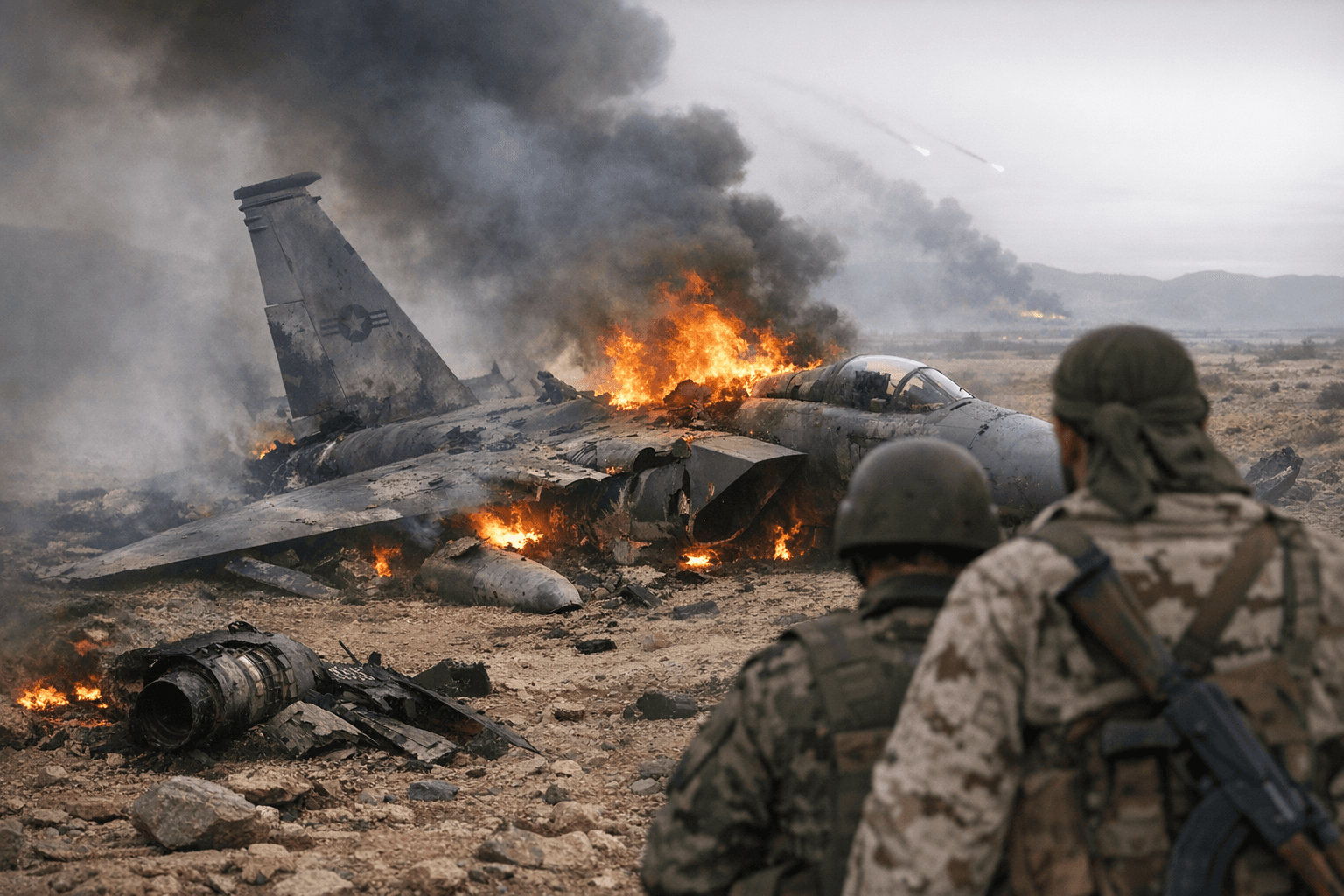
Iran delivered its most damaging strike against American air power since the 2003 invasion of Iraq on Friday, shooting down two U.S. military aircraft in the same day while continuing a relentless barrage of missiles and drones against Israel and Gulf states.
A U.S. F-15E Strike Eagle fighter jet was shot down over Iran on Friday, and one crew member from the plane was later rescued by American forces, U.S. officials confirmed. The F-15E is flown by a two-member crew, and the search for the second crew member, a weapons system officer, continued Friday, two U.S. officials said. Wreckage photos on Iranian state media showed a vertical stabilizer bearing the markings of the U.S. Air Force 494th Fighter Squadron out of RAF Lakenheath in Britain. An A-10 Warthog was part of the search and rescue mission when it too went down. An American A-10 Thunderbolt II fighter jet crashed into the waters of the Gulf near the Strait of Hormuz after being hit by Iranian fire on Friday night, and was the second U.S. fighter jet to be downed in one day. The A-10's pilot was rescued.
NBC reported that two U.S. helicopters taking part in the rescue effort were also hit by Iranian fire, though the service members were unharmed.
The last time a U.S. fighter jet was shot down in combat was an A-10 Thunderbolt II during the 2003 U.S. invasion of Iraq. The double loss in a single day directly contradicted recent public statements from senior U.S. officials. President Trump said during his prime time address on Wednesday that there was "not a thing" Iran could do to stop potential strikes on oil infrastructure.
As both rescue missions unfolded, Iran's missile campaign against neighboring countries intensified. Blasts and sirens rang out across Israel, Kuwait, the United Arab Emirates and Saudi Arabia on Friday as air defense systems tried to stave off Iranian attacks. Iran's missiles set alight a refinery and damaged a desalination plant in Kuwait on Friday. Kuwait's Mina Al-Ahmadi facility, the country's largest oil refinery, was among the sites ablaze. Tehran has been striking military bases, oil and gas sites, civilian airports, hotels and ports in a retaliatory campaign that has effectively shut the vital Strait of Hormuz.
Iranian strikes have also hit residential areas and civilian infrastructure in Israel and across the Middle East. A direct ballistic missile strike hit Petah Tikva, Israel, while separate strikes wounded civilians in Bnei Brak. Four people were killed in the occupied West Bank by an Iranian missile overnight.
The conflict, which Iranian state media dubbed the Ramadan War, began on February 28, 2026, when joint missile attacks coordinated by the United States and Israel hit multiple locations across Iran. At least 13 Americans have been killed during the campaign, and 365 U.S. troops have been wounded in action as of April 3.
The supply of jet fuel has also been interrupted by the conflict, with consequences for travel worldwide. A liquefied natural gas tanker co-owned by Japanese and Omani interests became the first Japan-affiliated vessel to cross the Strait of Hormuz since the start of the conflict, passing through on Friday and exiting the Persian Gulf, a development watched closely by energy markets.
The fate of the second F-15E crew member remained unknown Friday evening, with Iran's state-run Tasnim news agency reporting that the search had "so far been unsuccessful," and Iranian television broadcasting a reward offer for information on the missing airman's location.
This article was produced by Prism’s automated news system from verified source data, official records, and press releases, then run through automated quality and moderation checks before publishing. The system is built and supervised by the people who set the standards it runs under. Read our full AI policy.
Did this article answer your question?


