Agencies Must Prove Value Faster as Retainer Windows Shrink in 2026
Retainer windows now average just 12-24 months, and agencies that can't prove ROI fast are losing clients before the work compounds. Here's the framework that keeps them.

The average client relationship at a digital marketing agency now lasts somewhere between 12 and 24 months. That's not a runway; it's a deadline. A survey of 100 US agencies reveals a critical measurement gap: agencies that aren't using analytics to prove ROI to their clients are the ones with the shortest client lifespans. In a market where procurement teams increasingly treat agency relationships as renewable contracts rather than long-term partnerships, the question isn't whether you're doing good work. It's whether you can prove it fast enough to survive the first renewal conversation.
The Measurement Gap Is the Real Churn Driver
Most agency churn isn't caused by bad strategy or poor execution. It's caused by a failure to connect outputs to outcomes in a way clients can see and believe. Robust reporting and automation has become the new key to surviving the churn cycle and securing lasting client relationships, yet many agencies still rely on manually assembled decks that explain what happened last month rather than dashboards that demonstrate what's been built toward the client's revenue goals.
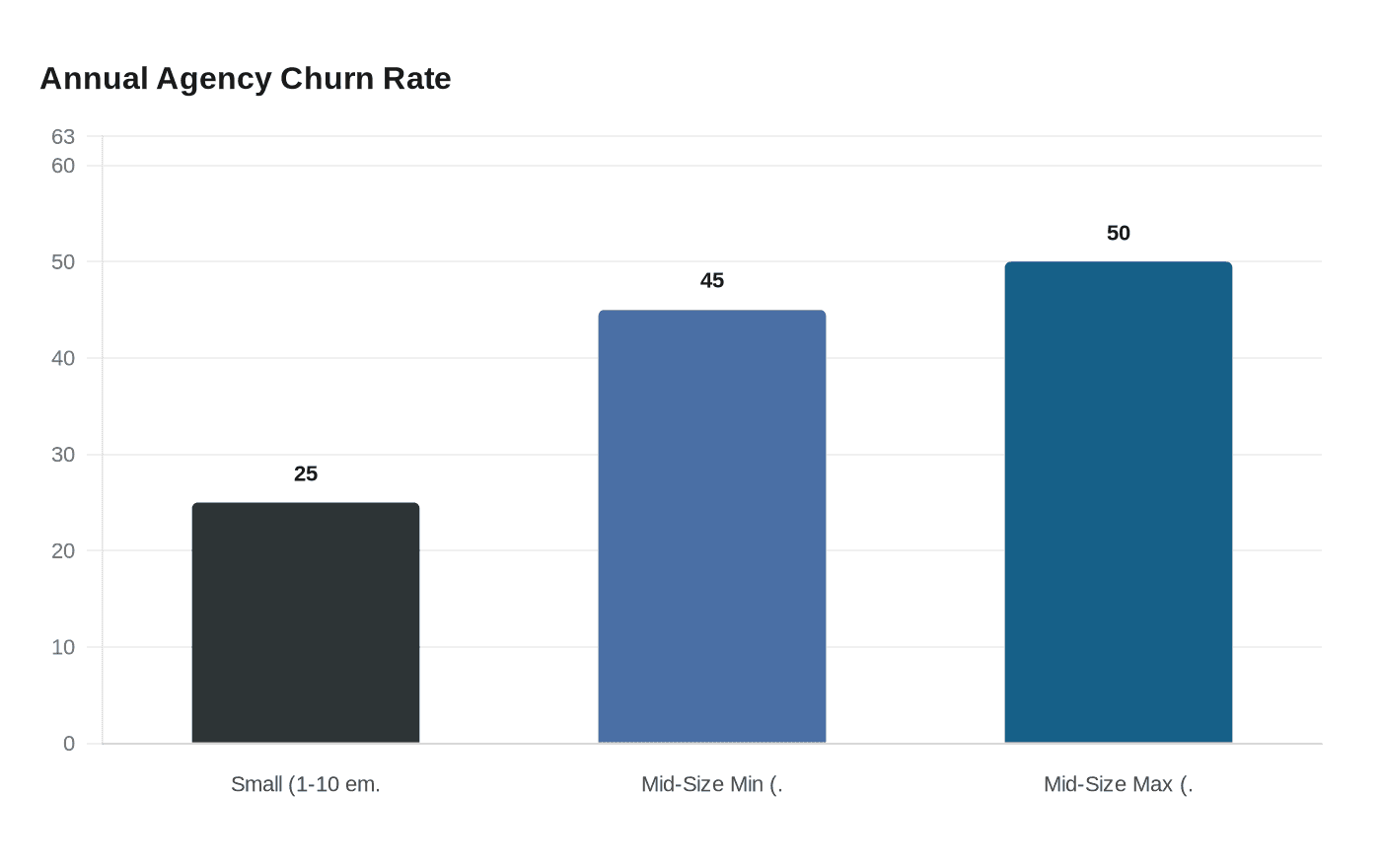
Small retainer agencies with 1-10 employees experience approximately 25% annual churn, while mid-sized project-based agencies of 11-25 employees face 45-50% annual churn. Those numbers don't improve on their own. They improve when agencies close the gap between delivery and demonstrated value, and they worsen when reporting is an afterthought bolted onto the end of a busy month.
The SEJ 2026 agency outlook makes this operational: standardize win stories, add conversion-linked dashboards, and automate executive summaries for client success managers so that every renewal conversation is anchored in documented, revenue-adjacent outcomes.
Prove Value Before the Honeymoon Ends
The first 90 days of a retainer are now the highest-stakes stretch of the entire client relationship. Agencies that treat onboarding as a slow ramp to "real work" are burning their best window. The smarter play is a structured 30/60/90-day value demonstration plan where early milestones are defined, agreed upon, and reported against from day one.
This means deciding in advance what proof looks like at day 30 (technical audit completed, baseline benchmarks set, quick-win opportunities identified), day 60 (initial optimizations live, early conversion data flowing), and day 90 (first performance narrative delivered showing movement against agreed KPIs). Those milestones need to be baked into the Statement of Work, not improvised during the first quarterly review.
The agencies building this structure systematically are shifting from a posture of "trust us, it takes time" to "here's what we said we'd do, and here's exactly what happened." That shift reframes renewal from a negotiation to a natural continuation.
Shift Investment From Acquisition to Retention Mechanics
Agencies that build repeatable growth systems can charge higher retainers, retain clients longer, and scale more efficiently compared to those delivering task-based services, which face increasing price compression as AI commoditizes execution. The implication for how agencies allocate internal resources is significant: time spent designing a replicable reporting cadence, outcome framing process, and early-win playbook pays dividends across every client account, while time spent winning new logos doesn't address the leaking bucket underneath.
Retention mechanics worth systematizing include:
- A standardized reporting cadence tied to client business cycles, not just marketing metrics
- Outcome framing that connects call volume, form fills, and chat conversations directly to pipeline and revenue
- Pre-built "win story" templates that CSMs can populate weekly without starting from scratch
- Renewal prep decks that lead with forward-looking growth opportunities rather than backward-looking campaign recaps
The goal is to make demonstrating value a process, not a heroic act performed under deadline pressure every 90 days.
Conversion Tracking as Infrastructure, Not a Setup Task
Conversion tracking isn't a technical checkbox completed during client onboarding; it's the infrastructure that determines whether an agency can prove value, optimize with confidence, and retain clients who might otherwise churn after a few mediocre months. The agencies winning in 2026 have moved beyond browser-based pixels to server-side tracking that captures conversions regardless of privacy settings, and have implemented multi-touch attribution that reveals the true value of every campaign.
This is the mechanical foundation underneath every reporting and retention strategy. If calls, forms, and chat conversions aren't mapped back to specific campaigns and channels, every client conversation becomes an argument about credit rather than a discussion about growth. Agencies that treat tracking infrastructure as a first-week deliverable rather than a long-term technical debt item are the ones whose monthly reports actually land.
Packaging AI Without Commoditizing Your Fees
AI is simultaneously the biggest operational opportunity and the most dangerous positioning trap for agencies in 2026. The trap is this: if you lead with AI as a speed benefit, you've just told clients they should expect cheaper fees as the tools get faster. The correct framing is AI as a quality and consistency multiplier that accelerates demonstrable client outcomes.
Task-based services will likely face increasing competition and price compression as AI continues to evolve, while agencies that build repeatable growth systems will be able to charge higher retainers. The distinction matters when scoping: AI that automates the generation of executive reporting summaries or flags anomalies in conversion data is defensible because it improves the client-facing deliverable. AI that just makes internal execution faster without improving what the client sees is a margin improvement you can't monetize.
When packaging AI in retainer proposals, be specific about what it enables at the client level: faster anomaly detection, consistent weekly performance narratives, automated alert systems when KPIs move outside agreed thresholds. These are outcomes clients can evaluate. "We use AI tools internally" is not.
The White-Label Trap and How to Avoid It
Agencies that resell white-label SEO, PPC, or development services face a specific version of this problem. The partner does the work. The agency owns the relationship. But if the reporting, milestone structure, and client narrative aren't integrated across both parties, the agency is flying blind at renewal time, unable to tell a coherent story about value delivered.
The fix requires three things working together: clear SLAs with white-label partners that map to your 30/60/90 day client milestones; unified reporting that pulls partner work into your client-facing dashboards without visible seams; and joint acceptance criteria so that early deliverables from partners are evaluated against ROI relevance, not just technical completion. The language shift from selling deliverables to selling outcomes framed around ROI can fundamentally change effective rates, but only if the underlying measurement infrastructure actually supports that framing. A white-label partner delivering work that can't be tied to a business outcome gives you nothing to sell at renewal.
Running the Playbook This Quarter
The 2026 retainer environment rewards agencies that operate with precision at the start of every client relationship and discipline throughout it. The frameworks that separate agencies with strong retention from those caught in a constant new-business treadmill are not particularly complex; they're just not yet standard practice for most shops.
Start with a single audit question: if your most important client's retainer came up for renewal tomorrow, could you walk them through a clear, revenue-connected narrative of value delivered in the last 90 days without pulling an all-nighter? If the answer is anything other than an unqualified yes, the measurement and reporting infrastructure isn't where it needs to be. Fix that first. Every other growth strategy depends on it.
Sources:
Know something we missed? Have a correction or additional information?
Submit a Tip