Aging Prison Design Leaves Facilities Vulnerable to Aerial Smuggling Operations
The Federal Bureau of Prisons logged 479 drone incidents in 2024, up from just 23 in 2018, as aging prison designs offer no defense above the fence line.
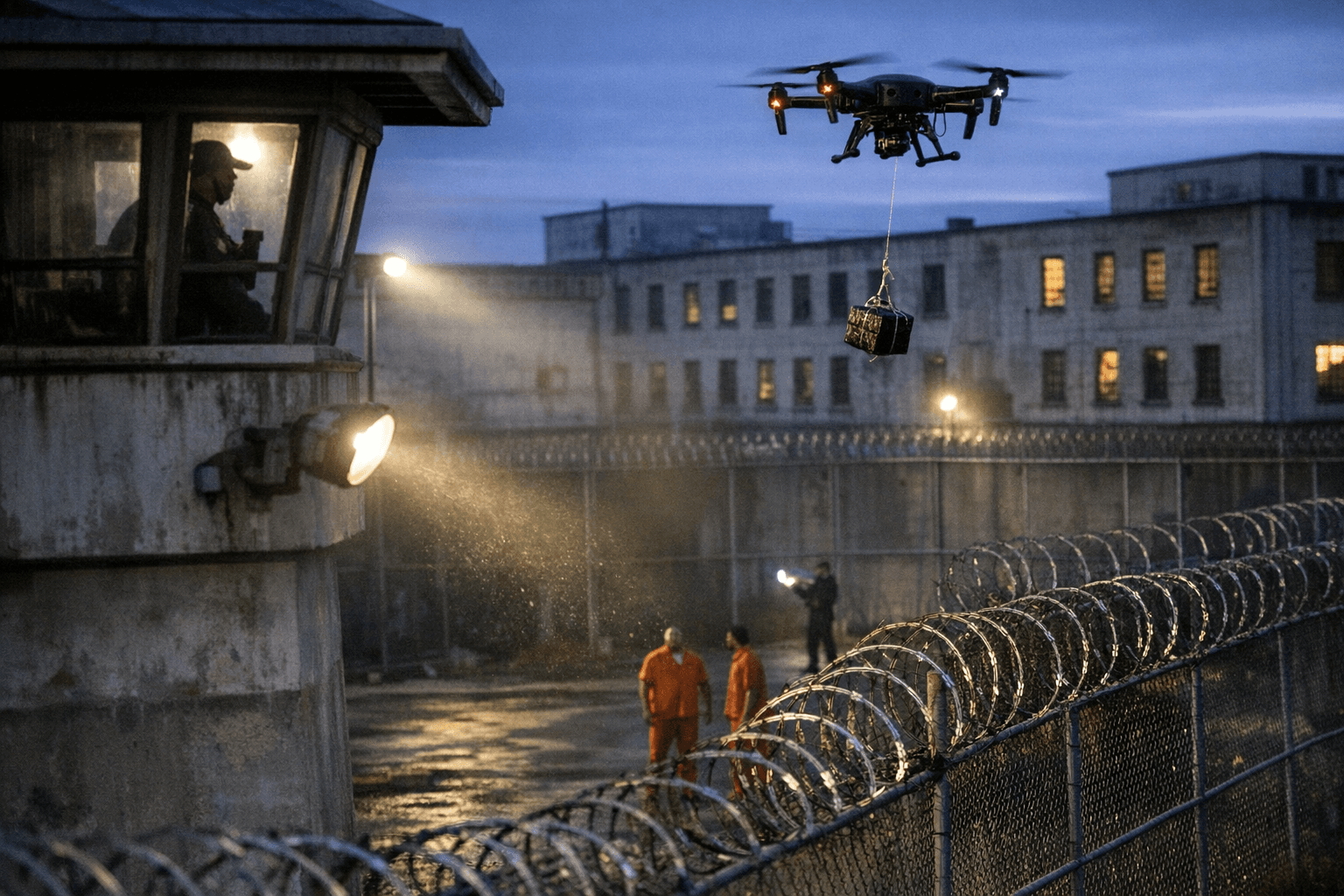
The Federal Bureau of Prisons logged 479 drone incidents at federal facilities in 2024, a figure that stood at just 23 six years earlier. The exponential rise reflects a security gap that no amount of razor wire or guard towers was ever built to close: the airspace above correctional facilities was simply never part of the original threat model.
Most American prisons were designed and constructed decades before commercial drones existed. Perimeter fences, motion sensors, and controlled access points address threats arriving on foot or by vehicle. They do nothing to stop a small unmanned aircraft crossing the fence line at altitude, in the dark, in seconds. As security experts note, by the time a drone is spotted by a corrections officer, its mission may already be complete.
The consequences of that architectural blind spot are mounting. On March 14, 2026, staff at Marcy Correctional Facility in upstate New York detected a drone flying over the compound at approximately 1 a.m. The aircraft released a package between dormitory buildings before staff could intervene. The package, which had wires protruding from it, prompted a response from the New York State Police bomb squad; investigators ultimately determined it contained contraband rather than an explosive device. The drone itself was recovered outside the facility perimeter.
In South Carolina, the scale of the problem is even more stark. Joel Anderson, director of the state's Department of Corrections, says his facilities absorb drone intrusions night after night. South Carolina recorded 69 drone incursions in 2019; by 2022, that number had climbed to 262. "We get assaulted nightly," Anderson said. "We get assaulted at multiple institutions at night." His staff, he added, would rather be monitoring inmates inside housing units than chasing packages in the dark.
The drones themselves have grown more capable. Early smuggling attempts relied on aircraft carrying roughly four pounds of contraband at top speeds around 45 miles per hour. Heavy-lift models now haul 25-pound duffel bags at more than 75 miles per hour, and operators, sometimes former inmates with knowledge of prison layouts, can conduct multiple drops in a single night. Packages are occasionally disguised, with fentanyl-laced paper wrapped to resemble synthetic grass.
State corrections departments have scrambled to respond, but they face a significant legal constraint: under federal law, only a narrow set of federal agencies hold authority to track, jam, or disable unauthorized drones. State prison officials largely can only watch and recover. That regulatory gap prompted Alabama Attorney General Steve Marshall to join 20 other attorneys general in a letter dated March 31, 2026, asking the Trump administration to extend interdiction authority to state and local law enforcement. "Criminals have found a way to turn the skies above our prisons into a smuggling route," Marshall said in the letter.
Congress took a partial step with the Safer Skies Act, passed in December 2025 as part of the FY2026 National Defense Authorization Act, which created a legal framework for designated state and local agencies to disable drones at certain facilities. Tennessee is now seeking $1.7 million to build out drone detection infrastructure under that authority. Commissioner Frank Strada told state lawmakers the funding request was non-negotiable: "I want to be clear, this is not a discretionary enhancement."
Georgia's Operation Skyhawk, which combined detection with active interdiction, resulted in more than 150 arrests and $7 million in seized contraband. The lesson from that operation, and from Canada's Kingston task force, which cut drone drops by 50 percent over nine months through a coordinated multi-agency approach, is that detection alone is insufficient. Until prison infrastructure and legal frameworks catch up with the technology exploiting them, the airspace above American correctional facilities will remain the easiest point of entry on the grounds.
This article was produced by Prism’s automated news system from verified source data, official records, and press releases, then run through automated quality and moderation checks before publishing. The system is built and supervised by the people who set the standards it runs under. Read our full AI policy.
Did this article answer your question?