AI deciphers first complete reading of sealed Herculaneum scroll
AI has read a sealed Herculaneum scroll from start to finish, exposing a Stoic ethics text that had stayed blackened and closed since Vesuvius buried it.

Researchers using artificial intelligence and advanced imaging have read a sealed Herculaneum scroll from beginning to end for the first time, reconstructing PHerc. 1667, also known as Scroll 4, without physically opening it. The scroll had survived as a carbonized roll from the Villa of the Papyri, the only known library to survive from Greco-Roman antiquity, after Mount Vesuvius buried Herculaneum and Pompeii in AD 79 under about 60 feet of ash and rock.
The breakthrough matters because the surviving papyri are too brittle and blackened to unroll by hand without destroying them. PHerc. 1667 is about 1.4 metres long and contains roughly twenty-two columns of Greek text, but earlier opening attempts in the 19th century, in 1969 and again in the 1980s, damaged the scroll further and left scholars with only fragments. Virtual unwrapping, by contrast, let researchers recover the text noninvasively, turning a sealed object into a readable continuous work.
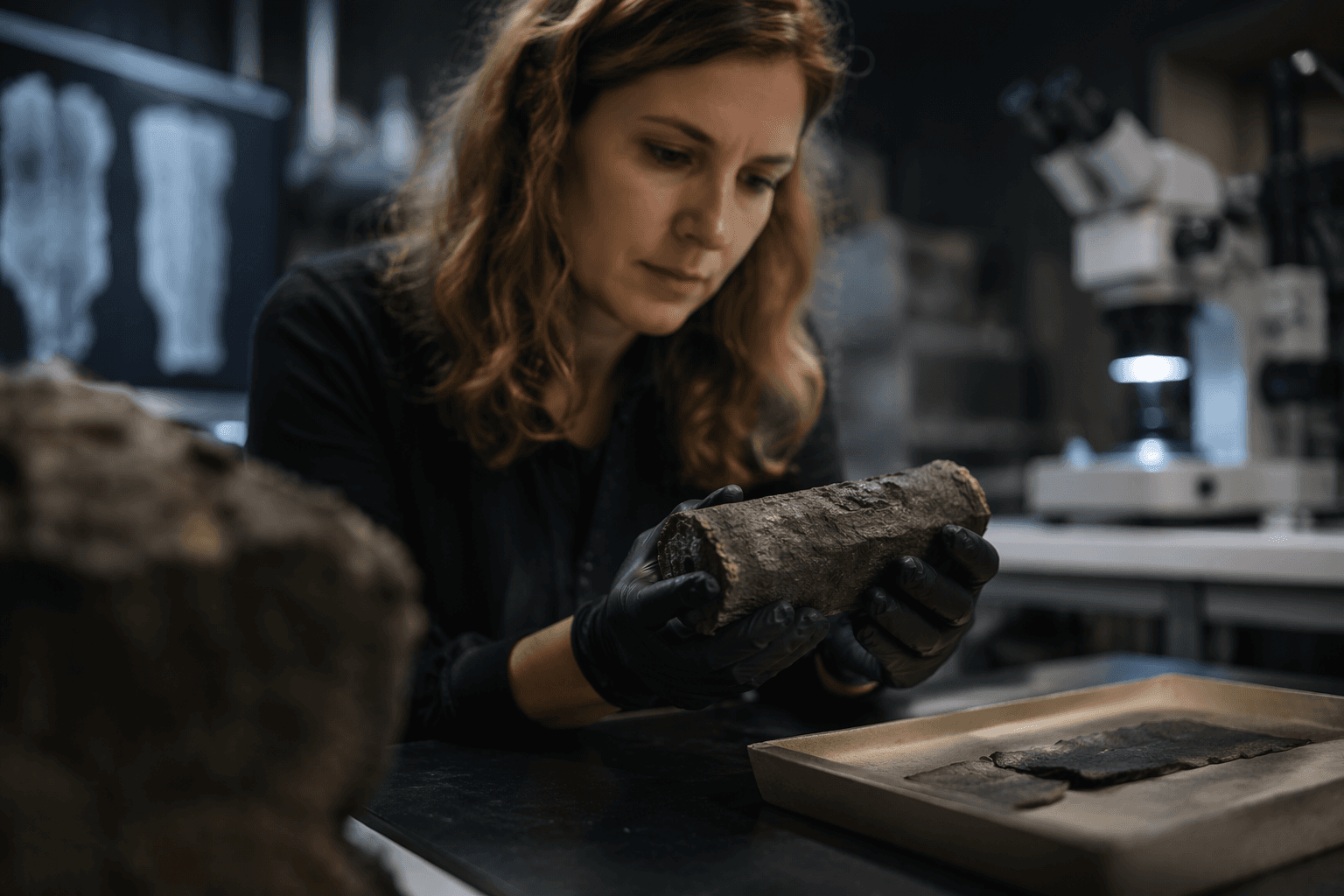
The recovered writing is a philosophical treatise on ethics that appears to be Stoic and is dated by the project to the 2nd century BC. Its final preserved column names Aristocreon, described as the nephew and disciple of Chrysippus, one of Stoicism’s foundational thinkers. That gives scholars a rare point of contact with a school of thought that shaped later ideas about reason, virtue and public life, while also showing how much of antiquity still sits hidden inside the archive.
The method combined high-resolution X-ray scanning, digital reconstruction of the wound sheet inside the roll and machine learning to detect faint traces of ink. Diamond Light Source said the work used synchrotron-generated X-rays at Diamond in the United Kingdom and at the European Synchrotron Radiation Facility in France. The same project has also identified PHerc. 172, held at Oxford’s Bodleian Libraries, as a copy of Philodemus’ On Vices, and PHerc. 139 as Philodemus’ On Gods, Book 8.
The Vesuvius Challenge says it has now awarded more than $1,800,500 in prizes overall and will make its data, code and models public. It has also put up a $1 million prize for the first person or team to fully read any other scroll. That openness is part of what separates a scientific advance from hype: the result is not a claim that the whole Herculaneum archive is suddenly legible, but a documented milestone showing that continuous texts, titles and authors once thought lost can now be recovered in full.
This article was produced by Prism’s automated news system from verified source data, official records, and press releases, then run through automated quality and moderation checks before publishing. The system is built and supervised by the people who set the standards it runs under. Read our full AI policy.
Know something we missed? Have a correction or additional information?
Submit a Tip