AI turns India tech hubs into patent-making innovation engines
India’s tech hubs are moving from code factories to patent shops, as AI pushes engineers toward products, trade secrets and company-owned IP.

Artificial intelligence is pushing India’s biggest technology hubs beyond support work and into the business of patents. Executives from Publicis Groupe’s Epsilon, Kimberly-Clark and Daimler Truck said in Bengaluru on May 27 that automation is already shifting employees in global capability centers away from repetitive coding and operations toward product design, experimentation and new intellectual property.
At Daimler Truck Innovation Center India, that change is already visible. Radhakrishnan Kodakkal, who heads the unit, said: “The number of IPs, the patents and the trade secrets created by (GCCs in India) is already increasing.” His point goes to the heart of the AI shift. If machines absorb more routine production, Indian teams can spend more time on work that multinationals are more likely to protect, monetize and keep in-house.
That is a bigger structural change than a simple efficiency story. India’s technology centers are no longer just low-cost back-office operations. They are becoming places where global firms want to generate ideas, file patents and build proprietary products. The question underneath the optimism is who ultimately owns the upside. In most cases, the intellectual property still belongs to the multinational, not the local workforce or the Indian ecosystem that helped create it. AI may deepen that imbalance even as it raises the strategic value of India-based engineers and product teams.
The scale of the bet is enormous. NASSCOM and Zinnov said India had more than 1,700 global capability centers and more than 2,975 GCC units in FY2024, employing about 1.9 million people. Those centers generated $64.6 billion in revenue, with engineering, research and development revenue at $36.4 billion. The report said nearly one-third of global engineering activity is now based in India, underscoring why multinational companies see the country as central to product development and innovation rather than just delivery.
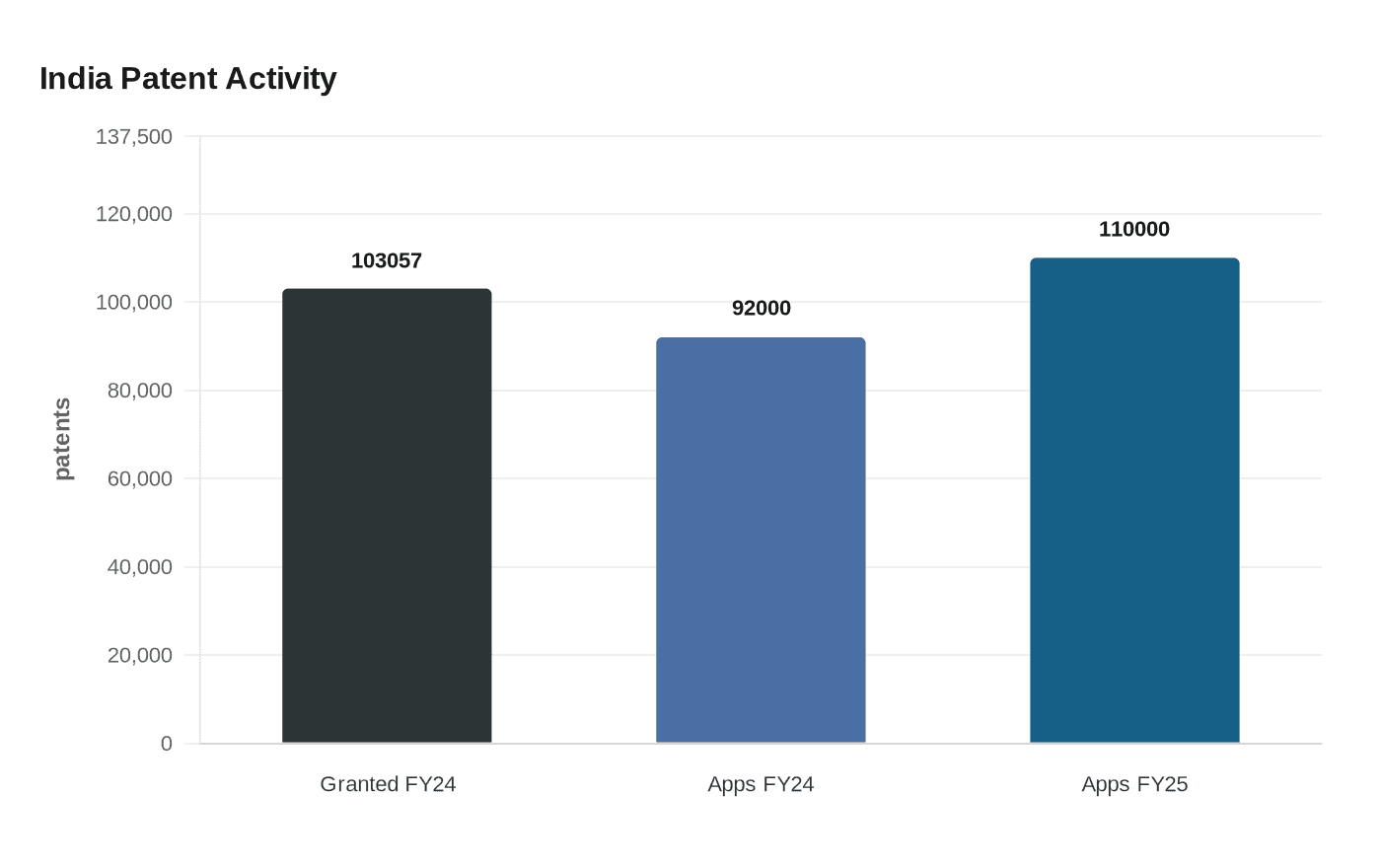
India’s domestic patent pipeline is expanding too. The Indian Patent Office granted 103,057 patents in FY2023-24, while government data showed about 92,000 patent applications were filed that year. A later annual report for 2024-25 said applications crossed 110,000, a sign that the country’s innovation ecosystem is broadening even as global companies use Indian hubs to deepen their own R&D footprint.
The roots of that shift go back decades. Texas Instruments set up an R&D center in Bengaluru in 1985, an early marker of India’s move from offshore support to serious engineering work. AI is now accelerating the next stage of that evolution. For multinationals, the prize is faster innovation, more in-house expertise and a stronger return on large offshore investments. For India, the test is whether rising patent counts translate into durable strategic power, or mainly into more value created locally and owned elsewhere.
This article was produced by Prism’s automated news system from verified source data, official records, and press releases, then run through automated quality and moderation checks before publishing. The system is built and supervised by the people who set the standards it runs under. Read our full AI policy.
Did this article answer your question?