Airbrushing setup checklist and basing and display guide for miniature painters
Two pillars matter: nail your airbrush workspace first using the practical checklist from Harder & Steenbeck, then lock a repeatable basing and display workflow, source the missing tactical steps.
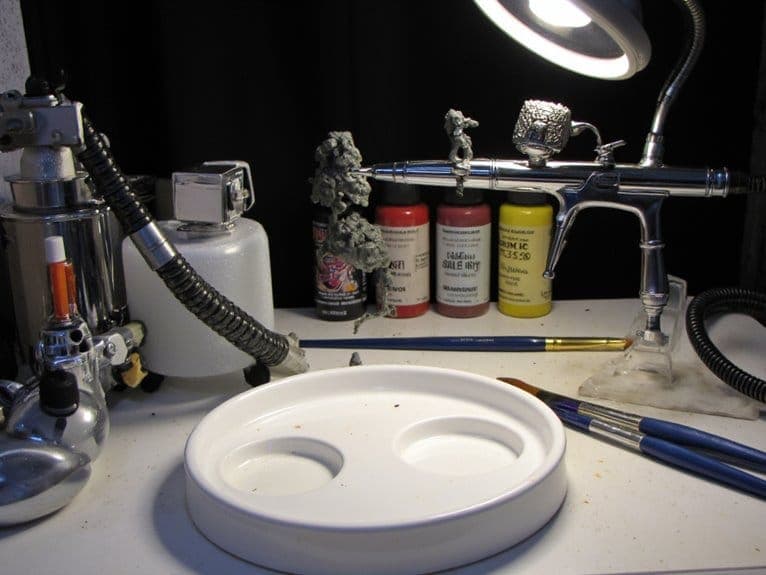
When a commission hits a snag because your airbrush or base presentation fails, it’s usually a setup problem, not your skill. "Why these evergreen guides matter: miniature painting workflows are heavily influenced by fundamental setups, a reliable airbrush rig and a repeatable basing/display workflow are two pillars that determine long‑term productivity and presentation quality. Both topics are perennial: painters constant", treat that line as the framework for the checklist below.
1. Compressor and airbrush positioning
Warrick from Harder & Steenbeck explicitly lists "How to position your compressor and airbrush safely" as a core learning point in the video "Everything You Need in Your Airbrush Setup." Put the compressor on a stable, low-vibration surface and route hoses so they don’t pull the airbrush mid-stroke; the video frames this as a safety and efficiency step. The channel (Harder & Steenbeck) has the credibility to make this a priority, note the video has 19,172 views and 1,159 likes, so treat positioning as a non-negotiable part of the rig.
2. Lighting and layout
The description promises "Why lighting and layout affect your results", don’t skip this. Your layout should place task lighting, workspace, and storage in a flow that keeps paint, air, and tools separate; the video positions lighting and layout as core to getting consistent results. Because the video is the third in the Airbrushing Essentials series, treat its advice as part of a sequence: you’ll want the full playlist for layout context ("Don’t forget to check out the full Airbrushing Essentials playlist to learn everything you need to get started with confidence.").
3. What tools help speed up your workflow
Harder & Steenbeck lists "What tools help speed up your workflow" as a discrete lesson; interpret that as both airbrush-specific tools (needle caps, quick-clean cups) and workspace helpers (holders, quick-change fittings). The presenter Warrick frames tools within workflow efficiency, so inventory what you reach for during a session and compare it to the tools shown in the video to cut minutes off repetitive steps. Given the channel’s focus and the video’s place in a series, use it as a checklist to upgrade one tool at a time.
4. Tips to stay organized and avoid workspace clutter
The description promises "Tips to stay organized and avoid workspace clutter." Treat organization as a productivity lever: label drawers, use modular trays for nozzles and needles, and keep common consumables within arm’s reach. The video frames organization alongside health and safety, implying clutter increases risk; with 76 comments on the video, expect community-tested ideas in the comment thread if you need real-world tweaks.
5. Health and safety
The video summary says Warrick "shares everything you need to know to build a creative space that supports your painting, from efficiency and organization to health and safety." That means ventilation, solvent handling, and safe positioning of compressors belong on the checklist. The description doesn’t list specific PPE or filter types, so you should treat the video as the primary source to confirm exact recommendations before changing your practice.
6. Use the Airbrushing Essentials series as a structured learning path
This video is explicitly "In this third video of our Airbrushing Essentials series," so don’t treat it as a one-off. Follow the series for continuity: the channel (Harder & Steenbeck, 39,700 subscribers) structures lessons across multiple short videos, and the playlist CTA is explicit, "Don’t forget to check out the full Airbrushing Essentials playlist to learn everything you need to get started with confidence." If you’re setting up your first station or upgrading, consume the series in order.
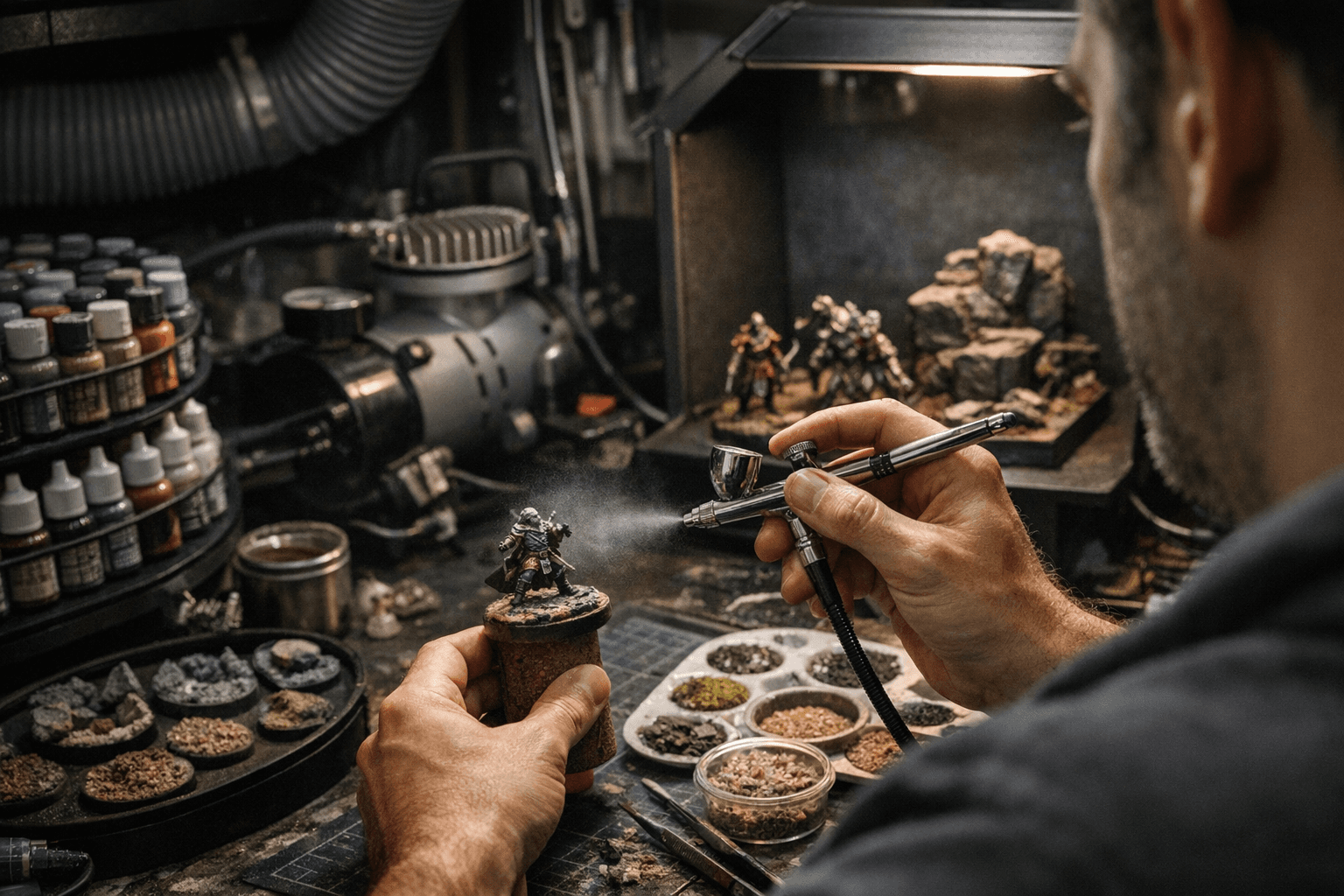
7. Metadata and community context to validate advice
If you want quick credibility checks, the video metadata is handy: "Everything You Need in Your Airbrush Setup," uploaded 4 Jul 2025, shows 19,172 views, 1,159 likes, and 76 comments at the time captured. The presenter is identified as Warrick from Harder & Steenbeck. The description also includes social hooks, hashtags such as #airbrushsetup and #miniaturepainting, and a music credit: "Music from epidemicsound.com." Use these facts when cross-referencing the video or looking up related content.
8. Why the basing and display workflow is the other pillar, and what’s missing
The Original Report frames a second pillar: a "repeatable basing/display workflow." That phrase is explicit in the dossier and ties directly to presentation quality, but the supplied sources contain no tactical basing steps. The research notes list this as a clear gap: there are no materials lists, adhesives, flocking techniques, sealant recommendations, magnet or display-case tips, or display lighting specs included in the provided material. Treat the basing/display pillar as conceptually critical but operationally under-documented in the sources you have.
9. Concrete follow-ups you must do to fill the basing/display gap
The dossier’s Final Notes/Action Items are explicit: you should "source at least one practical, step-by-step basing/display guide or interview an experienced miniature baser/presenter" and "request clarification or the remainder of the fragment from the Original Report author." Use those directions exactly: watch the Harder & Steenbeck video for airbrush specifics, then pull up specialist basing tutorials or reach out to recognized basing creators for materials lists and step sequences. The research product explicitly recommends confirming Warrick’s full name and the video’s spoken recommendations if you plan to quote him beyond the description.
10. How to combine both pillars into a durable workflow
Start by locking the airbrush workspace using the checklist items Warrick highlights, compressor placement, lighting, tools, organization, and safety, then treat basing and displays as a separate runbook you must source. The dossier’s opening line frames the payoff: the two pillars "determine long‑term productivity and presentation quality." In practice, that means make the airbrush rig repeatable first, then codify a basing/display workflow from sourced tutorials and interviews so your presentation is as consistent as your paint application.
11. Practical next steps and resources to collect now
Follow the explicit action items in the research notes: watch "Everything You Need in Your Airbrush Setup" (Harder & Steenbeck, 4 Jul 2025), collect other videos in the "Airbrushing Essentials" playlist, and gather basing/display resources through interviews or dedicated how-to guides. The research flags specific questions to fill, lighting specs, compressor pressure ranges, PPE, adhesives, flocking materials, magnets, and display-case recommendations, so assemble that list and check each item off with a named source before standardizing your workflow.
Final point: treat the airbrush rig and basing/display process as two halves of delivery, one keeps your paint application fast and repeatable, the other makes your miniatures communicate scale and story. The Harder & Steenbeck video gives you the airbrush-side checklist to get started; the basing/display pillar is vital but under-documented in the supplied material, so prioritize sourcing those tactics next and lock them into a repeatable runbook.
Know something we missed? Have a correction or additional information?
Submit a Tip