Airline Passengers Capture Rare Aerial View of Artemis II Launch
Airline passengers flying over Florida's eastern seaboard filmed Artemis II's ascent, capturing a rare aerial view of NASA's 8.8-million-pound-thrust rocket carrying humans toward the Moon for the first time since 1972.
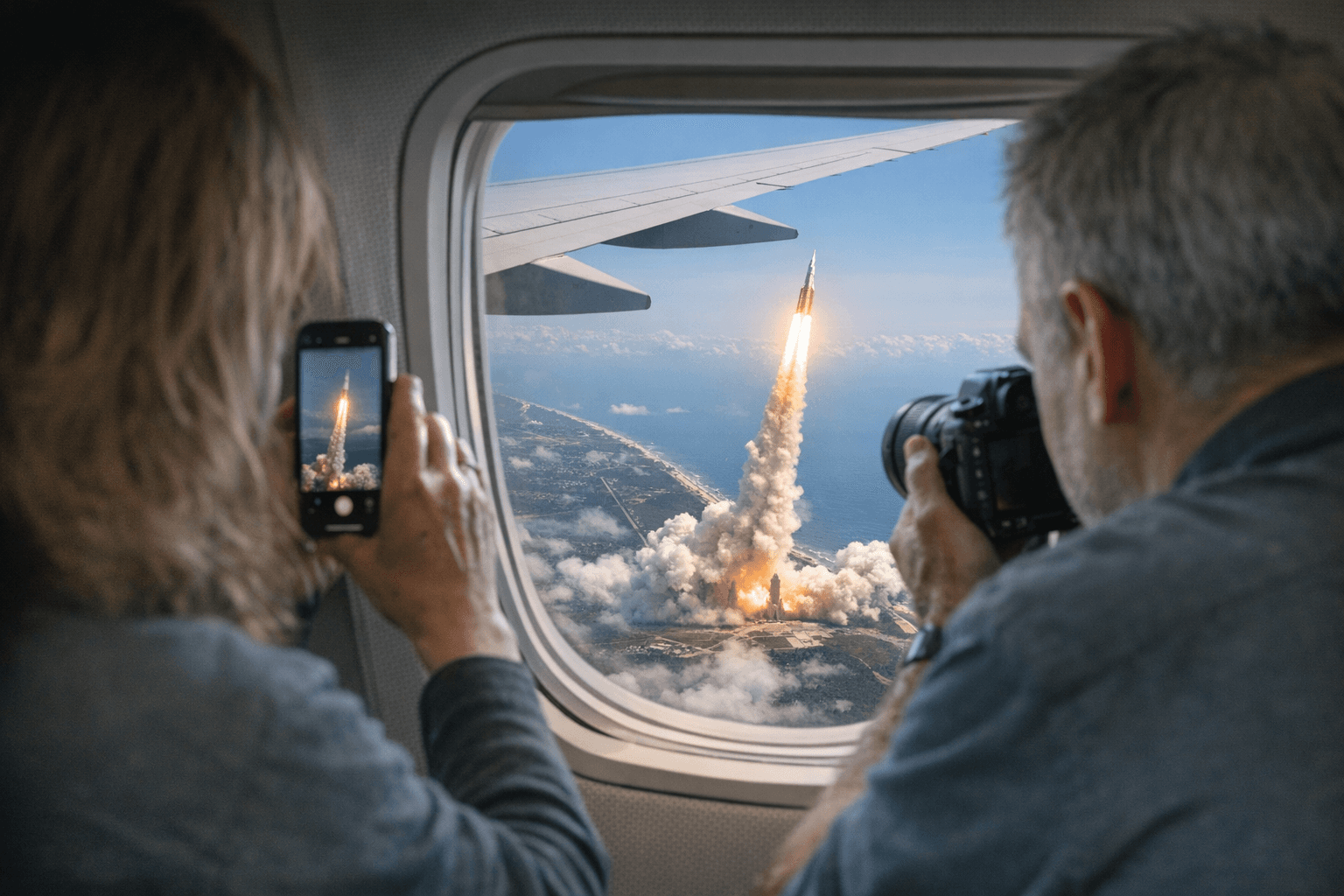
Passengers aboard commercial flights over Florida's eastern seaboard captured an extraordinary aerial vantage point as NASA's Artemis II rocket tore through the atmosphere at 6:35 p.m. EDT on April 1, powering the first humans toward the Moon in more than 53 years.
The scale of the Space Launch System made it nearly impossible to miss from cruising altitude. Producing approximately 8.8 million pounds of thrust at liftoff from Launch Complex 39B at Kennedy Space Center, the SLS Block 1 cleared the launch tower in just 10 seconds before accelerating past 767 miles per hour, supersonic speed, within its first minute of flight. By booster separation, the vehicle was traveling at roughly 3,100 miles per hour at an altitude of 30 miles. Even at ground level, spectators at the Kennedy Space Center Visitor Complex could not see the rocket until it had already cleared the nearby tree line; at cruising altitude, there was no such obstruction.
Those aircraft were carefully positioned outside the launch corridor. Under FAA protocols, Notices to Air Missions go out to pilots 48 to 72 hours before major launches, establishing Temporary Flight Restrictions and Aircraft Hazard Areas around Kennedy Space Center. The FAA's Space Data Integrator tracks rockets in near real-time using telemetry data including position, altitude, and speed, allowing controllers to reopen restricted airspace as quickly as three minutes after a vehicle safely clears a designated hazard zone. Rather than issuing blanket holds, the agency identifies and reroutes only the aircraft directly in the affected corridor, a precision that will matter more as launch frequency increases.
The agency flagged those stakes in January 2026 when it issued SAFO 26001, a safety alert focused specifically on airspace management challenges from the rapid growth of commercial space launches, warning operators of potential debris fields capable of endangering aircraft and urging airlines to factor launch schedules into preflight route planning.
The mission those passengers watched ascend overhead is unlike any since the Apollo era. Artemis II is the first crewed mission beyond low Earth orbit since Apollo 17 in December 1972, carrying Commander Reid Wiseman, Pilot Victor Glover, and Mission Specialist Christina Koch of NASA, alongside Canadian Space Agency Mission Specialist Jeremy Hansen, on a 10-day free-return trajectory around the Moon. The Orion spacecraft, named Integrity, had never before carried human passengers. Glover is the first person of color to travel beyond low Earth orbit; Koch is the first woman; Hansen is the first non-U.S. citizen. Before the crew boarded, Wiseman offered a spare assessment of where things stood: "The four of us, we are ready to go. The team is ready to go. The vehicle is ready to go."
The crew could travel approximately 4,700 miles beyond the Moon, potentially surpassing the Apollo 13 distance record of 248,655 miles from Earth set in 1970. Atmospheric reentry is expected to reach approximately 25,000 miles per hour. There is no lunar landing on this mission; Artemis II is a deep-space systems verification flight, building on the uncrewed Artemis I test in 2022 and setting the stage for Artemis III, which is targeting the first crewed lunar landing since 1972 in 2028.
What those passengers filmed was a preview of a new normal. With commercial launch cadence rising across multiple providers operating spaceports from Florida to California to Texas, the FAA's task of threading rocket trajectories through some of the nation's busiest commercial flight corridors is growing more complex with every launch window.
Know something we missed? Have a correction or additional information?
Submit a Tip