Albertsons warns of flat sales growth as grocery price war intensifies
Albertsons cut 2026 sales expectations to flat to 1%, signaling shoppers still chase discounts as Walmart and Amazon intensify grocery competition.
Albertsons warned that the grocery price fight is still biting into growth, telling investors it expects fiscal 2026 identical sales to come in flat to 1%, below the 1.58% increase Wall Street had been looking for. For one of the country’s biggest supermarket operators, the message was clear: consumers remain highly sensitive to promotions, and the chain is being forced to defend traffic in a market where heavier discounts can win share quickly but strain margins.
The caution came even after Albertsons posted a solid fiscal 2025. Identical sales rose 2.0% for the year and 0.7% in the fourth quarter, while digital sales increased 21% over the full year and 16% in the quarter. Loyalty membership climbed 12% in the fourth quarter to 51.2 million, a sign that Albertsons is still drawing shoppers into its ecosystem even as the average basket faces more pressure. Fiscal 2025 ended Feb. 28, 2026, with a 13-week fourth quarter and a 53-week full year.
Profitability was mixed. Albertsons reported a fourth-quarter net loss of $481 million, largely because of a $600 million charge tied to its opioid settlement framework. Adjusted net income came in at $252 million, or 48 cents per share, and adjusted EBITDA reached $903 million in the quarter. For the full year, adjusted EBITDA totaled $3.902 billion. The company guided fiscal 2026 adjusted EBITDA to a range of $3.85 billion to $3.925 billion, while also forecasting identical sales growth of 0% to 1% overall, or 1.5% to 2.5% excluding pharmacy headwinds.
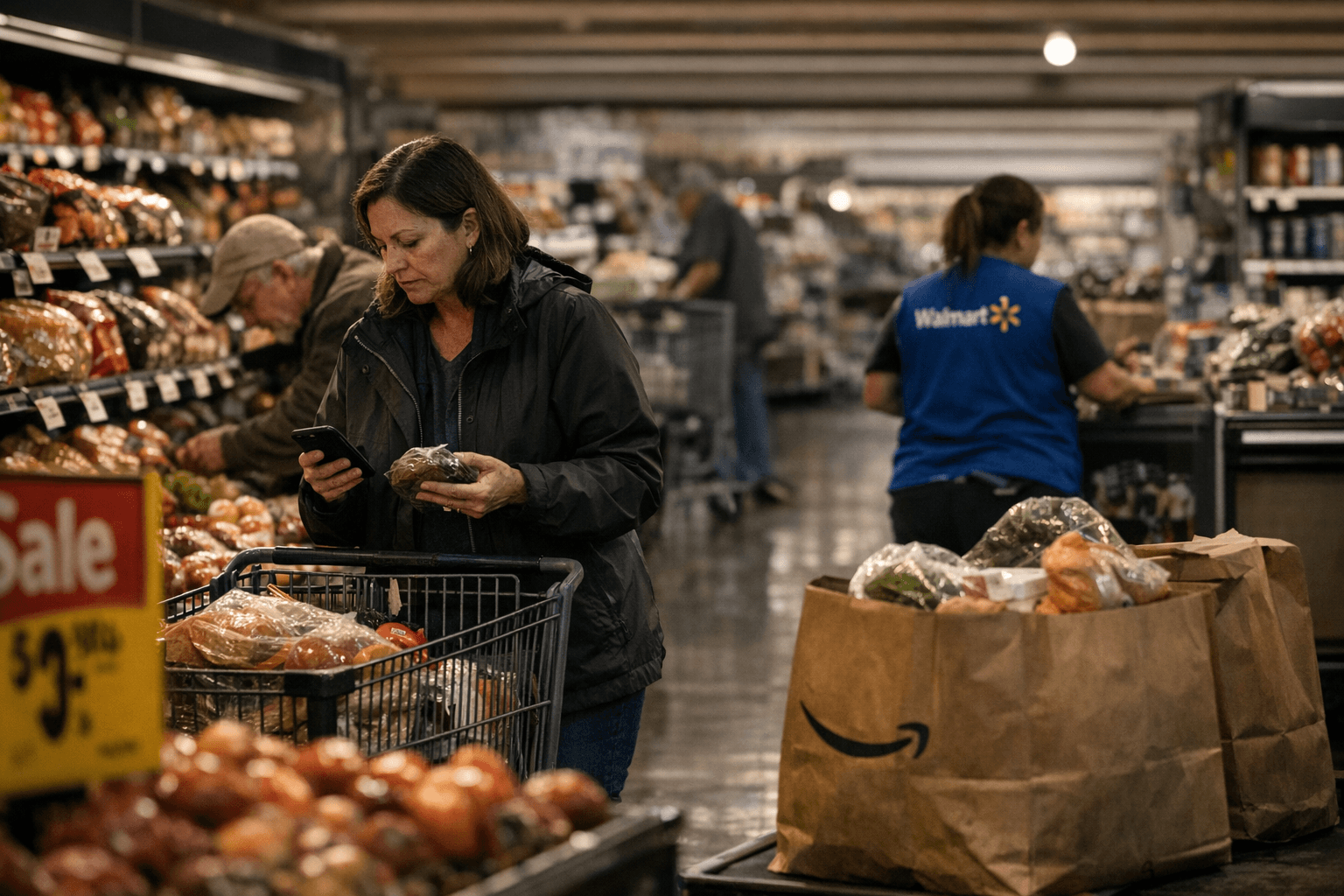
The outlook underscores how the supermarket business has become a high-stakes contest over price and value. Reuters said the pressure is coming from bigger rivals, including Walmart and Amazon.com, both of which have leaned hard into lower prices and promotions. That competition matters because groceries are usually considered defensive, but food retailers can still lose share fast when shoppers compare prices more closely and trade down to cheaper items or private-label alternatives.
Albertsons’ warning also lands against the backdrop of its broken $24.6 billion merger with Kroger, the largest supermarket deal ever proposed in the United States. Federal and state courts blocked the transaction in December 2024 after antitrust challenges from the Federal Trade Commission and state enforcers in Oregon and Washington. Susan Morris, who became chief executive on May 1, 2025, has now delivered her first full-year update, and the numbers suggest the path ahead will depend on tighter execution, more disciplined pricing and a grocery market that is still rewarding value over volume.
This article was produced by Prism’s automated news system from verified source data, official records, and press releases, then run through automated quality and moderation checks before publishing. The system is built and supervised by the people who set the standards it runs under. Read our full AI policy.
Did this article answer your question?

