Amazon overtakes Walmart as world's largest company by sales
Amazon posted roughly $717 billion in sales, edging out Walmart's about $713 billion; the shift ends a 13-year run and raises stakes for jobs, access and local economies.
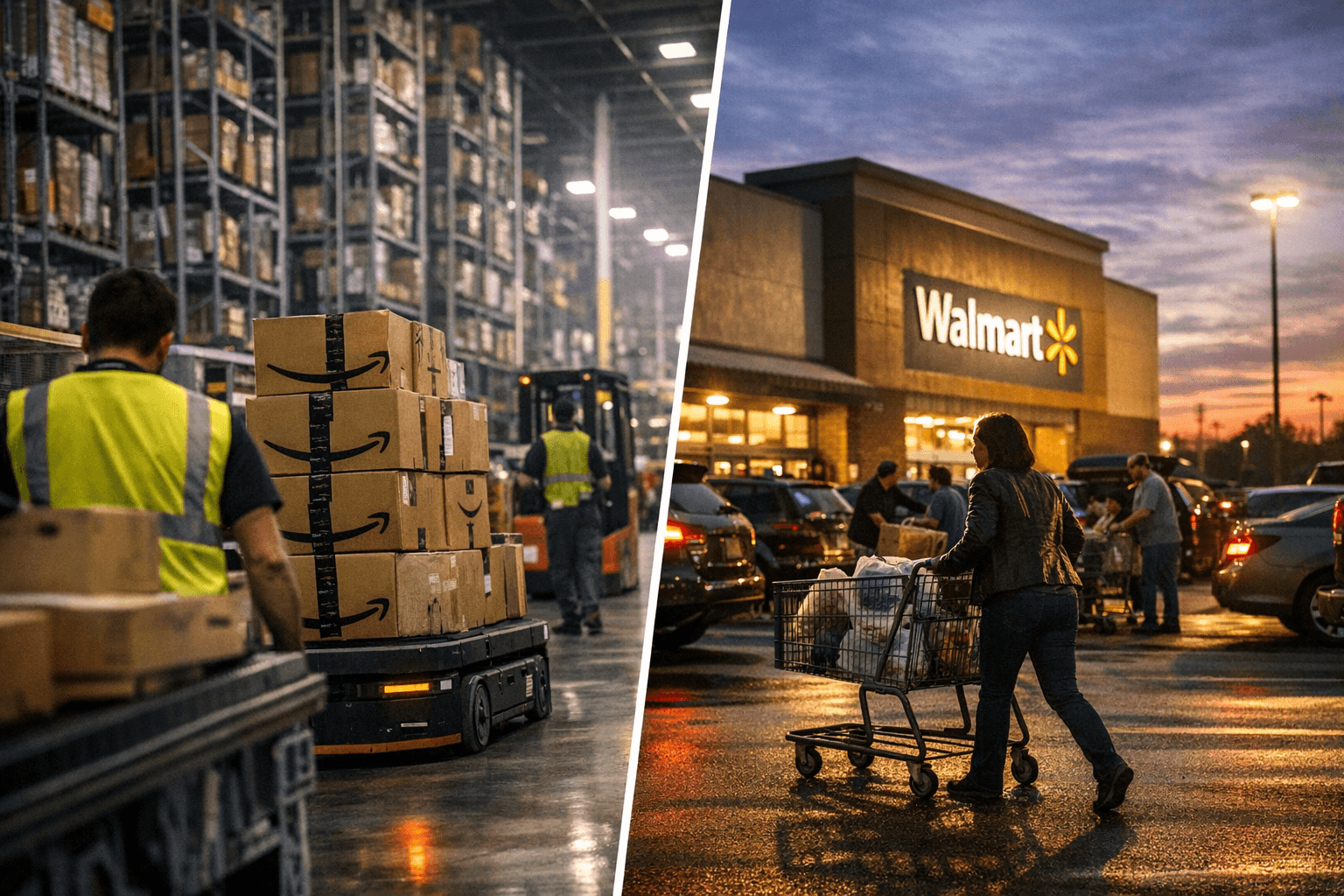
Amazon has surpassed Walmart as the largest company in the world by annual sales, posting roughly $716.9–$717.0 billion for the year while Walmart recorded about $713.0–$713.2 billion for its fiscal year. The change ends Walmart’s roughly 13-year stretch atop the revenue rankings and reflects Amazon’s expanding mix of cloud computing, advertising, subscriptions and seller services that now rival its core retail business.
The narrow margin partly reflects timing: Amazon’s total is for the year ending in December, while Walmart’s figure covers a fiscal year that runs through Jan. 31. Amazon’s fourth-quarter revenue reached $187.8 billion, slightly above Walmart’s $180.5 billion for the same quarter. Those quarterly gains helped push Amazon ahead for the full year.
Amazon’s revenue mix shows why. About $464 billion came from its online and physical stores and third-party sellers, while Amazon Web Services generated nearly $129 billion. Advertising and Prime subscription revenue together exceeded $100 billion. Third-party seller services made up roughly 24.5 percent of Amazon’s total sales, and AWS accounted for nearly 17 percent, illustrating how platform services and cloud computing have become central profit drivers.
Walmart remains a dominant force in bricks-and-mortar retail, with nearly 11,000 stores employing more than 2 million people and more than 90 percent of its sales coming from physical stores and its websites. Walmart’s U.S. business showed momentum last quarter, with U.S. sales growth of 4.6 percent and online sales expanding at a faster clip, driven in part by faster delivery options. John Furner, Walmart’s chief executive, said in a statement, “The pace of change in retail is accelerating. Our financial results show that we’re not only embracing this change, we’re leading it.”
The shift in revenue leadership is about more than corporate bragging rights. The balance of scale between a cloud-and-platform giant and a largely store-based employer has tangible consequences for communities, workers and public services. Walmart’s footprint anchors many small towns and provides local access to groceries, prescriptions and basic goods. Amazon’s growth has concentrated economic power in digital infrastructure and logistics networks that reshape where and how people shop, work and receive essential goods.
For workers, the contrast matters. Walmart’s millions of store employees depend on hourly jobs that are often the primary local employer in rural counties, while Amazon’s 1.6 million workers are split across warehouses, corporate roles and delivery networks that use different labor models, including more gig-style and automated work. Changes in corporate scale can influence local tax revenue, employer-provided benefits, and the bargaining power of workers - all of which bear on health, housing and social services in affected regions.
Investors have taken note: Walmart recently surpassed $1 trillion in market value, and Amazon’s market cap topped $2 trillion last year. Analysts caution that revenue rankings are a single metric; profitability, cash flow and regulatory scrutiny will shape both companies’ futures.
Jeff Bezos founded Amazon in 1994 as an online bookstore; three decades later the company’s diversification has converted that origin story into a platform whose size now alters the economic landscape for retailers, employees and communities. Policymakers and public-health advocates will be watching how that shift affects access to essentials, labor standards and the local institutions that sustain health and economic equity.
This article was produced by Prism’s automated news system from verified source data, official records, and press releases, then run through automated quality and moderation checks before publishing. The system is built and supervised by the people who set the standards it runs under. Read our full AI policy.
Did this article answer your question?