Americans Wait Days in Cars for Free Care at RAM Clinics
Dave Burge slept in his truck overnight for a shot at free dentures. Half the patients who waited days in Knoxville had insurance they simply couldn't afford to use.
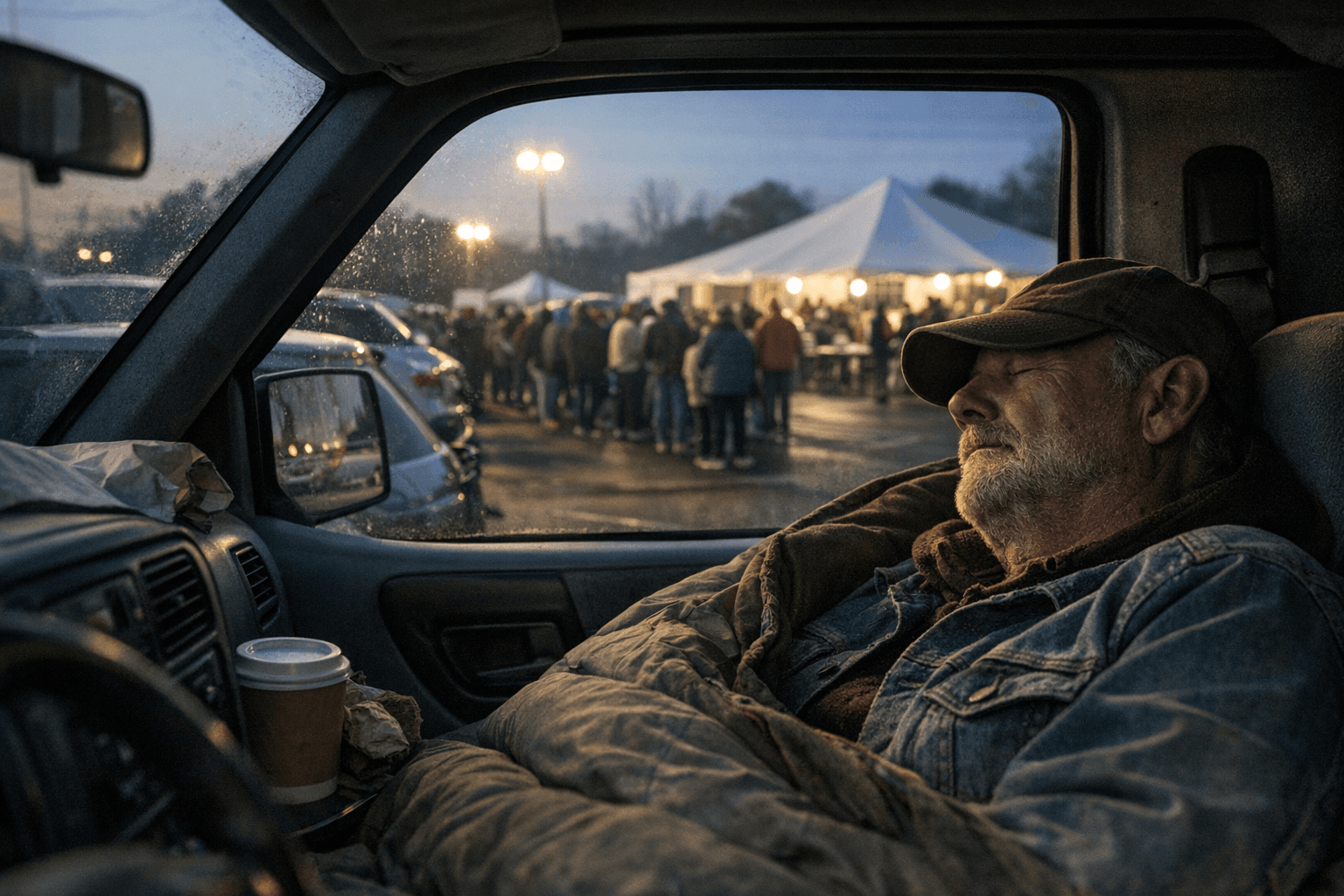
Dave Burge drove to a parking lot in Knoxville, Tennessee, parked his truck, and waited. He needed dentures and could not afford them. So he slept there overnight, holding his place in a line that had been forming for days in frigid February temperatures, joining hundreds of Americans willing to endure a parking lot to see a dentist.
Burge was one of more than 1,200 patients served at that Knoxville pop-up clinic run by Remote Area Medical, a nonprofit that has spent four decades deploying volunteer doctors, dentists, and optometrists to Americans who have no other realistic path to care. Some of those patients drove hundreds of miles to get there. Because RAM can only accommodate a fixed number of patients over a weekend, people begin queuing days in advance, sleeping in their vehicles to hold a spot.
The economics driving those lines are stark. About half of RAM's patients carry no health insurance at all. The other half have coverage they cannot afford to use, a category that has grown as premiums and deductibles have outpaced wages. The average annual family health insurance premium reached $25,572 in 2024, a 7% increase from the prior year, while workers paid an average of $6,575 out of pocket toward that premium before a single claim was filed. Nationally, 26.2 million Americans, representing 7.9% of the population, lacked insurance entirely as of 2024, and 46% of uninsured adults skipped treatment they needed because of cost.
The problem extends well beyond the uninsured. About one-third of all U.S. adults, including many with coverage, said they had skipped or postponed needed health care in the past year due to cost. The share of Americans who say they can afford and access quality healthcare fell to a historic low of 55% in July 2024.
RAM's own data illustrate the scale of unmet need. An earlier Knoxville clinic served 920 patients, produced 500 pairs of glasses made on-site, conducted 94 mammograms, extracted 1,066 teeth, and performed 567 fillings. It still turned away 400 people.
RAM was founded in 1985 by Stan Brock, a British philanthropist who had co-hosted NBC's Emmy-winning Mutual of Omaha's Wild Kingdom alongside Marlin Perkins, drawing more than 32 million weekly viewers. The organization originally parachuted doctors into remote regions of South America, including areas reachable only after a 26-day journey from the nearest ranch. In the 1990s, Brock pivoted the focus to Americans cut off from care by cost rather than geography. He served without compensation as the organization's volunteer, founder, and president until his death on August 29, 2018, at age 81.
In 2024 alone, RAM served nearly 36,000 patients through more than 16,000 volunteers, providing care valued at nearly $15 million. The organization reached its one-millionth patient in 2025, its 40th anniversary year, having hosted more than 1,400 clinics and delivered more than $215.4 million in free care since its founding.
A key legislative milestone came in 1995, when Brock helped secure passage of the Tennessee Volunteer Health Care Services Act, which allows health professionals licensed in other states to volunteer at RAM clinics, removing one of the bureaucratic barriers that had historically limited the organization's ability to staff events at scale.
With more than 150 pop-up and telehealth clinics scheduled across the country in 2026, RAM's calendar reflects both the organization's growing reach and the persistence of the conditions that fill parking lots before dawn.
This article was produced by Prism’s automated news system from verified source data, official records, and press releases, then run through automated quality and moderation checks before publishing. The system is built and supervised by the people who set the standards it runs under. Read our full AI policy.
Did this article answer your question?