AMPERA Opens Palm Beach Gardens Nuclear Reactor Campus, Eyes NRC Licensing
AMPERA opened its Palm Beach Gardens HQ Tuesday, backed by a $10M Scorpio Tankers deal, targeting NRC licensing for a container-sized thorium reactor by 2030.

Nuclear startup AMPERA cut the ribbon Tuesday on its world headquarters in Palm Beach Gardens, gathering more than 150 local officials and business leaders to preview a containerized thorium reactor it says can deliver clean power to data centers, industrial sites, and ocean-going vessels by 2030. Whether the company can actually hit that target is the harder question.
The campus spans two buildings totaling nearly 100,000 square feet at 354 and 358 Hiatt Drive inside the Gardens Innovation Center at PGA National Commerce Park, and will house R&D, engineering, additive manufacturing, assembly, and administrative functions. AMPERA Founder and CEO Brian Matthews framed the company's mission around the accelerating power demands of artificial intelligence: "With the growth of AI and continued constraints on power supply, we are developing a reliable, safe, low-cost solution that can effectively change the energy landscape."
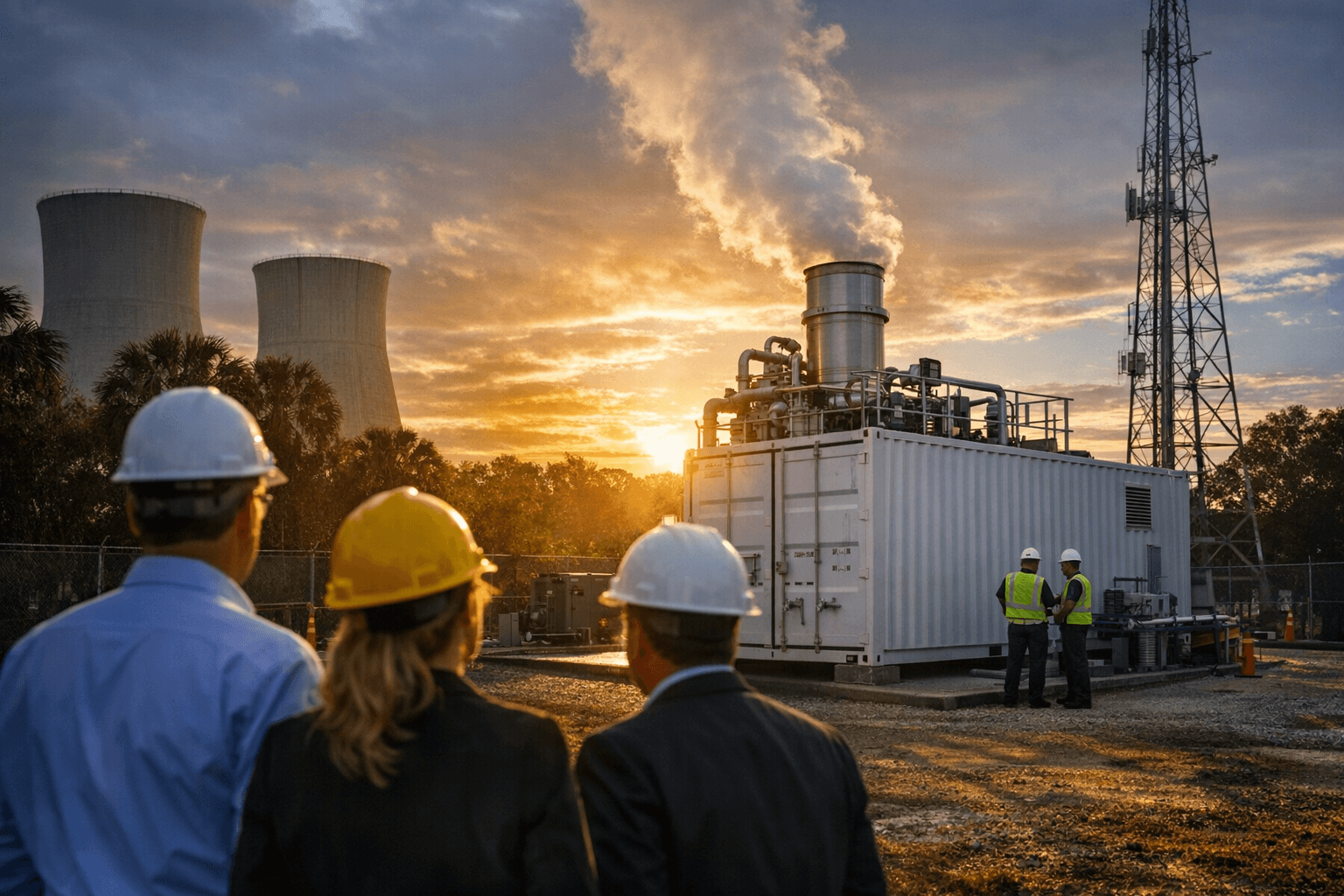
The reactor design is unconventional across nearly every dimension. AMPERA's units are engineered to produce between 15 and 30 megawatts of electricity, use TRISO fuel derived from thorium rather than enriched uranium, and replace conventional water cooling with supercritical CO2 as the working fluid, enabling fully water-free operation. The reactors fit inside standard 28-foot or 40-foot shipping container platforms. The company's subcritical design, it says, cannot sustain a runaway chain reaction independently, a safety claim that, if validated through licensing, would distinguish it sharply from conventional nuclear plants.
That licensing process is where ambition meets institutional reality. AMPERA submitted a formal pre-application letter to the Nuclear Regulatory Commission on February 23, 2026, just weeks after the NRC finalized 10 CFR Part 53, a new risk-informed, technology-inclusive regulatory framework mandated by the Nuclear Energy Innovation and Modernization Act of 2019. Under Part 53, advanced reactor developers are evaluated on their own safety merits rather than benchmarked point-by-point against conventional light-water reactor designs. Matthews called the new rule a turning point: "With the NRC implementing Part 53, innovative, advanced nuclear concepts like ours can focus on licensing new technology rather than explaining how it is different from traditional nuclear systems."
Even under this streamlined framework, pre-application engagement, design review, and safety analysis typically span several years, making AMPERA's 2030 commercial deployment target aggressive for a startup pursuing first-of-kind reactor licensing. The Trump administration signed four executive orders in May 2025 to expedite nuclear permitting, adding tailwinds, but regulatory timelines for novel concepts have historically resisted compression.
The headquarters opening also spotlighted a $10 million investment from Scorpio Tankers, a Monaco-based shipping company with 89 product tankers and an average fleet age of 10.1 years. The strategic collaboration, announced April 2, envisions floating nuclear power barges in the near term and nuclear-powered vessels over the longer horizon, with Scorpio serving as the maritime market lead. Chairman and CEO Emanuele Lauro confirmed the investment "reflects both our conviction in nuclear and our confidence in the team."
The backdrop driving private nuclear interest is electricity demand from AI infrastructure. The International Energy Agency estimated data centers, AI, and cryptocurrency collectively consumed roughly 2 percent of global electricity in 2022, a figure projected to double by 2026. Microsoft is backing small modular reactor development targeting at least 5 gigawatts by 2039; Google holds a 500-megawatt nuclear agreement with Kairos Power.
AMPERA plans to hire 100 people in Palm Beach County by the end of 2026, scaling to more than 2,000 by the decade's end and approximately 2,500 once a larger manufacturing facility, expected within five years, reaches full production. Kelly Smallridge, President and CEO of the Business Development Board of Palm Beach County, called AMPERA "exactly the kind of forward-thinking, high-impact company that is shaping the future of our region."
The $10 million from Scorpio Tankers validates the maritime application case, but capital requirements for manufacturing reactors at scale will run far higher. The real test begins not with ribbon-cuttings but with whether a thorium-fueled, subcritical reactor in a shipping container can satisfy the safety standards that define commercial nuclear power in the United States.
This article was produced by Prism’s automated news system from verified source data, official records, and press releases, then run through automated quality and moderation checks before publishing. The system is built and supervised by the people who set the standards it runs under. Read our full AI policy.
Did this article answer your question?

