Andy Burnham leads 14-candidate contest in Greater Manchester by-election
Burnham’s 49-37 lead came in a 14-candidate race that tested whether Labour could hold Makerfield against Reform pressure and protest voting.
Andy Burnham went into the Makerfield by-election with Labour still ahead, but not unchallenged. The 14-candidate contest, which opened and closed polling between 7:00 am and 10:00 pm, was shaped less by a routine vacancy than by a wider verdict on Labour’s post-2024 standing, Reform UK’s local momentum and the fatigue that has pushed voters toward smaller parties and independents.
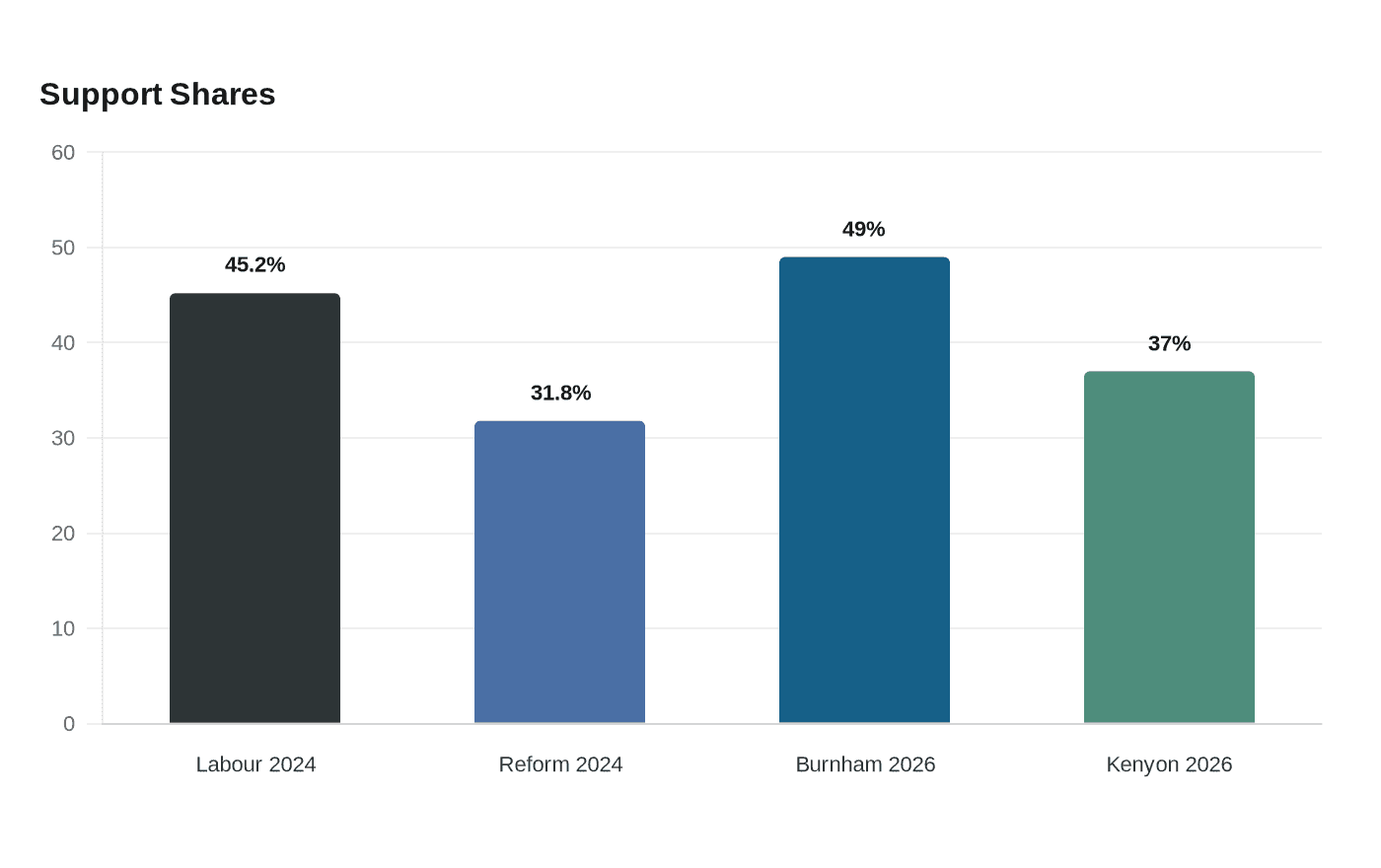
The seat had been Labour-held since its creation in 1983, and the 2024 general election showed why it mattered. Labour won 18,202 votes, or 45.2%, and held off Reform UK, which took 12,803 votes, 31.8%, leaving a majority of 5,399. Turnout reached 52.5% in an electorate of 76,641, a reminder that the constituency can still mobilise when the stakes are clear.
That arithmetic was under pressure from several directions. A June 2026 Convergent poll put Burnham on 49% and Reform’s Robert Kenyon on 37%, leaving a gap large enough to favour Labour but narrow enough to keep the contest highly competitive. Reform’s showing in the May 2026 borough elections sharpened that warning, after the party won 24 of the 25 Wigan council seats available. In Makerfield, that result underlined a local protest mood that no longer sat neatly on one issue or one party label.
Burnham’s candidacy brought an added institutional wrinkle. Josh Simons resigned the seat on 14 May 2026 to make way for Burnham, who was confirmed as Labour’s candidate on 19 May. If elected, Burnham would become an MP immediately, but under current rules he would also be disqualified as Greater Manchester mayor because that office carries police and crime commissioner powers. A victory in Makerfield would therefore open a mayoral vacancy as well as a Commons seat, turning a local by-election into a wider test of Labour’s succession machinery.
The ballot paper itself reflected the fragmentation of the moment. Alongside Burnham and Kenyon stood Michael William Winstanley for the Conservatives, Sarah Elizabeth Wakefield for the Greens, Jake Austin for the Liberal Democrats, Rebecca Lee Shepherd for Restore Britain, Peter Mark Ward for Rejoin EU Bring In PR, Ed Gemmell for the Climate Party, Dan Clarke for the Libertarian Party, Count Binface, Howling Laud Hope of the Official Monster Raving Loony Party, and independents John Alfred Dyer, Paul Richard Gould and Robert Neil Pownall.
For Labour, the result was always going to be read beyond Wigan. Makerfield offered a sharper test of whether the party could still anchor working-class voters, or whether Reform could turn local frustration into something more durable.
This article was produced by Prism’s automated news system from verified source data, official records, and press releases, then run through automated quality and moderation checks before publishing. The system is built and supervised by the people who set the standards it runs under. Read our full AI policy.
Know something we missed? Have a correction or additional information?
Submit a Tip