ANSTO Porous Reusable Targets Increase Mo-99 Yield While Lowering U-235 Enrichment
ANSTO is testing porous cylindrical reusable uranium targets in OPAL to boost Mo‑99 output while lowering U‑235 enrichment and cutting waste.
.png&w=1920&q=75)
ANSTO researchers say a new porous, reusable target design is being tested in the OPAL reactor to increase production of molybdenum‑99 while requiring less enrichment of uranium‑235 and generating less waste. The organisation announced the work on 25 February 2026 and framed the effort as a step toward more cost‑effective domestic supply of the medical isotope that feeds technetium‑99m diagnostics.
The tests are taking place in the 20‑MWt OPAL research reactor, which produces about 1,750 6‑day curies of Mo‑99 per week and represents roughly 8 percent of global Mo‑99 capacity. ANSTO said its nuclear materials research and technology group scientists, working with teams across the organisation, are irradiating porous cylindrical targets in OPAL as part of a sequence that moved from computer modelling to proof‑of‑concept irradiation and prototype fabrication.
Modelling work compared three target geometries - flat (rectangular), spherical, and cylindrical - and ran simulations of different sizes made from the same uranium material and density under typical operating conditions for several days. The simulations tracked neutron yields and fission production of Mo‑99, heat buildup, long‑term usability and radiochemical impurity formation. ANSTO followed modelling with proof‑of‑concept experiments that irradiated simulated targets using neutron activation analysis in OPAL to confirm predicted yields and stability.
A spherical prototype was fabricated to test the fission‑recoil mechanism that ejects Mo‑99 into pores of a porous matrix; ANSTO researchers then adapted the concept to porous cylindrical targets now under reactor testing. ANSTO says the design lets fission recoil place Mo‑99 into pores where it can be removed by a liquid compatible with ANSTO’s existing molybdenum extraction processing system, enabling target reuse until the uranium is exhausted.
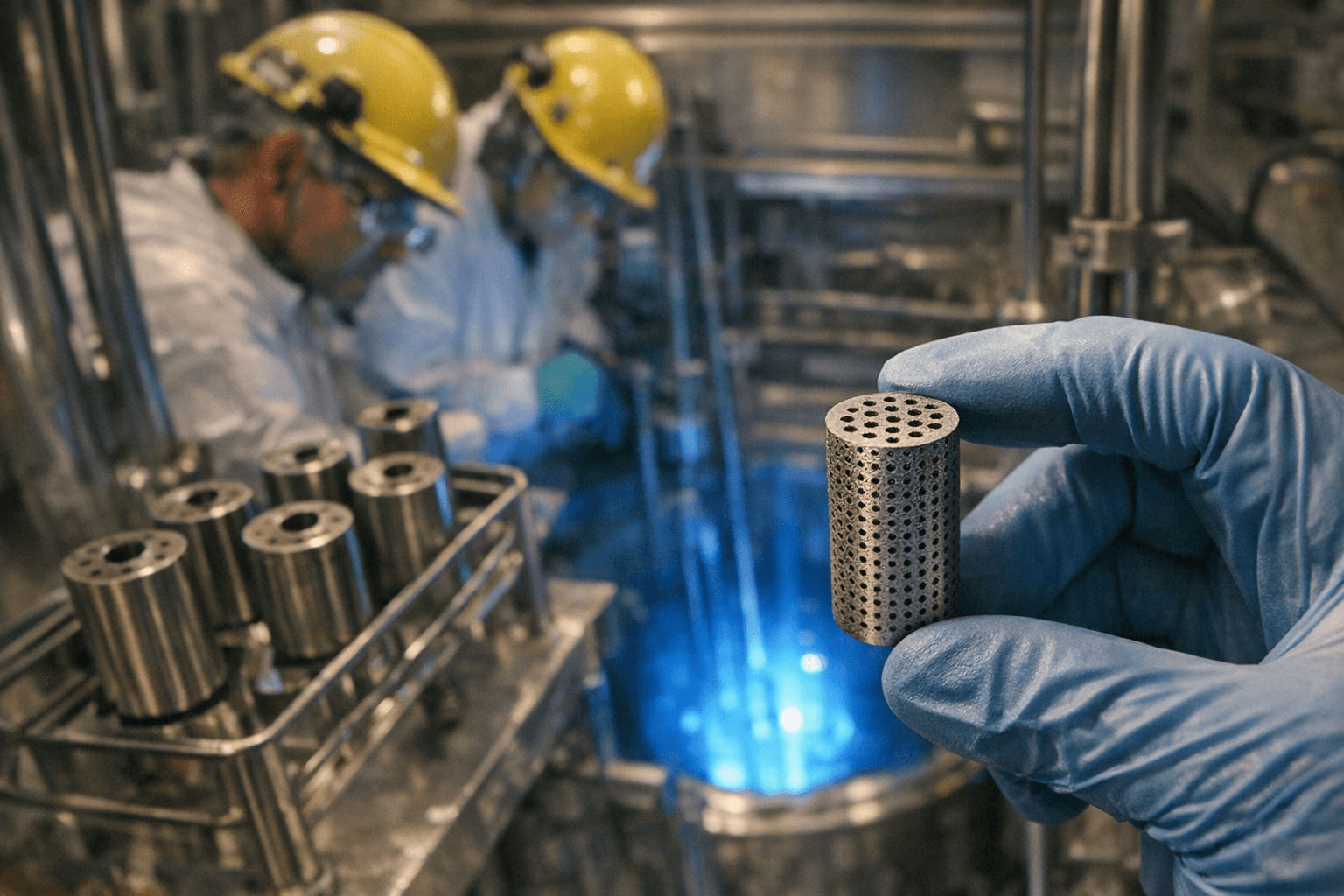
Prof Gordon Thorogood, ANSTO senior principal research scientist and a lead on the project, framed the objective in process terms: “The goal is to produce as much Mo‑99, while consuming as much of the target U‑235 as possible. The more effectively this is done, the larger the sustainability index.” ANSTO materials add that the approach offers “a more cost‑effective way to produce the medical radioisotope molybdenum‑99, with less enrichment of uranium‑235 and less waste produced,” calling out benefits for ANSTO and Australia.
ANSTO reported tangible research outputs: four research papers, three patents and a PhD awarded to Dr Robert Raposio of the University of Wollongong, whose doctoral work was supervised by Distinguished Professor Anatoly Rosenfeld and Prof Thorogood and published in Frontiers in Nuclear Engineering. The organisation also noted waste handling for exhausted targets: “Once the uranium‑235 is exhausted, it can be disposed of using ANSTO’s Synroc® waste encapsulation technology,” Prof Thorogood said.
The sources stress that the project remains in simulation, proof‑of‑concept and reactor testing stages; ANSTO did not publish a percentage increase in Mo‑99 yield or specific uranium enrichment levels for the porous targets. If the OPAL tests confirm the simulations, the combination of porous target geometry, compatible extraction chemistry, and Synroc® end‑of‑life encapsulation could change how ANSTO supplies Mo‑99 to Australia’s medical sector and influence broader fission‑product production practices.
Know something we missed? Have a correction or additional information?
Submit a Tip
_82415.jpg&w=1920&q=75)