Appeals court lets Trump East Wing ballroom construction continue temporarily
The D.C. Circuit extended a pause on Judge Richard Leon’s injunction and allowed crews to work on the East Wing site through April 17 while remanding security questions back to the district court.
A three-judge panel of the U.S. Court of Appeals for the D.C. Circuit on April 11, 2026 temporarily stayed parts of a district court injunction and permitted construction at the White House East Wing site to continue through April 17, 2026 while it sent the case back to U.S. District Judge Richard Leon for further clarification. The order, filed as No. 26-5101 consolidated with 26-5108, listed Circuit Judges Patricia Millett, Neomi Rao, and Garcia on the panel and arose from D.D.C. case No. 1:25-cv-04316-RJL.
Judge Leon had previously blocked the privately funded ballroom project, estimated at $300 to $400 million, concluding the President likely lacked unilateral authority to demolish and rebuild the East Wing without congressional authorization. Leon’s injunction preserved a narrow exemption for actions the court found “strictly necessary” to ensure safety and security on the White House grounds, but otherwise paused the $300–$400 million program pending resolution of threshold questions about presidential and agency authority.
The appellate order recounts the administration’s timeline and security assertions, noting that President Donald Trump posted on social media on October 20, 2025 that “ground ha[d] been broken,” and that within three days the East Wing was demolished. The order paraphrases the government’s factual submission that the excavation now contains or was prepared for “bomb shelters,” a “hospital and medical area,” “protective partitioning,” and “Top Secret Military installations.” In December filings, Secret Service Deputy Director Matthew Quinn warned that stopping work would create “security concerns,” that improvements were needed before the Secret Service’s safety and security requirements could be met, and that a pause would “hamper the Secret Service’s ability to meet its statutory obligations and protective mission.”
The appeals panel’s majority said the record lacked sufficient information to determine whether pausing construction would jeopardize national security and ordered Judge Leon to reexamine whether his injunction adequately accounted for the government’s classified and sensitive submissions. Judge Neomi Rao dissented, writing that the government had presented “credible evidence of ongoing security vulnerabilities at the White House that would be prolonged by halting construction,” and describing the administration’s showing of irreparable harm as persuasive.
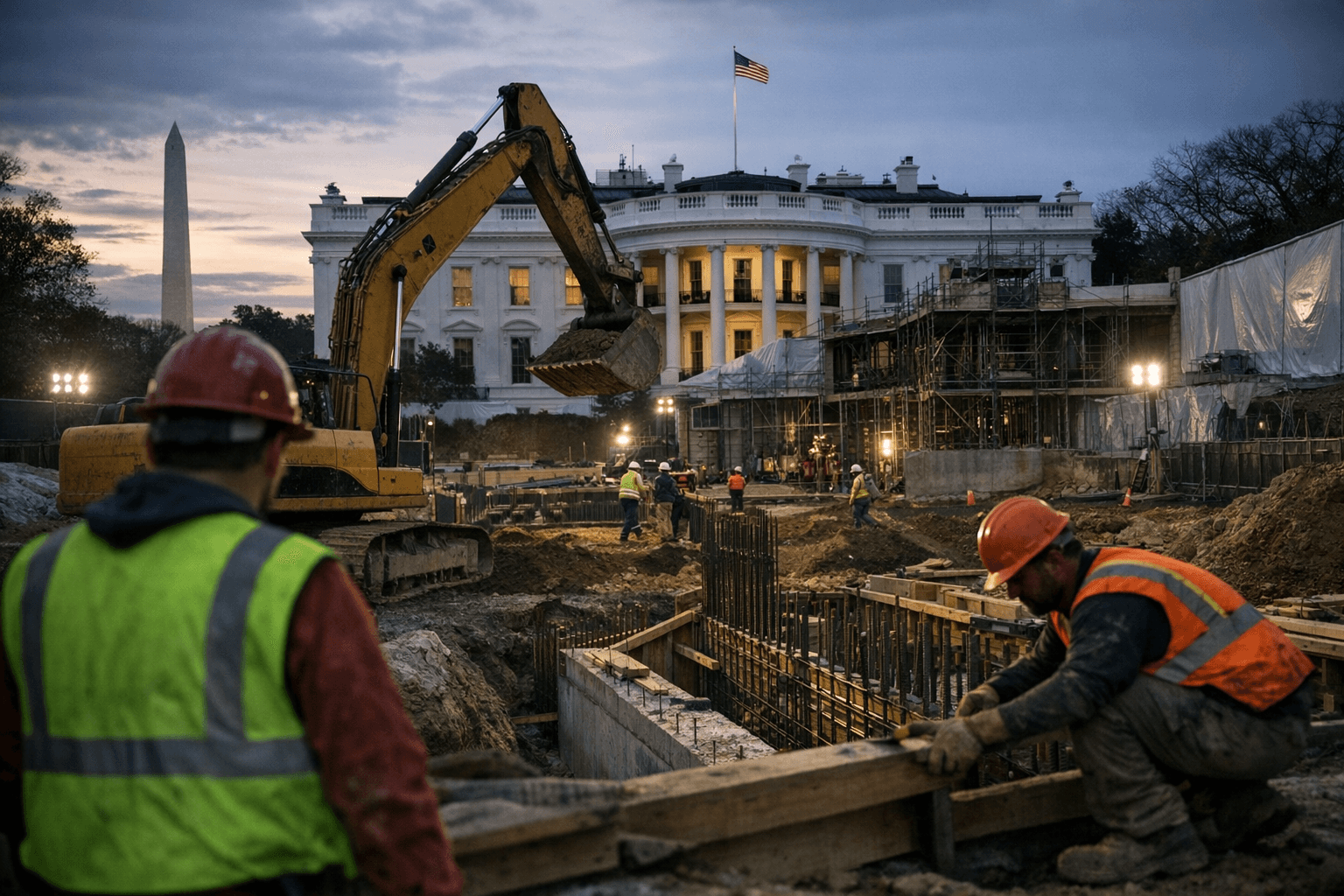
Preservation and planning objections remain central to the dispute. The National Trust for Historic Preservation sued on December 12, 2025, alleging the project bypassed required review by the National Capital Planning Commission, omitted legally required NEPA review, and proceeded without authorization for work in President’s Park. Carol Quillen, president and CEO of the National Trust, said, “We appreciate the court of appeals acting quickly and await further clarification from the district court.” Bloomberg Law has described the planned facility as a 90,000-square-foot ballroom on the East Wing site, underscoring the scale at issue for campus planning and preservation bodies, including the Commission of Fine Arts.
Practical next steps are compressed: the appellate stay runs through April 17, 2026, during which the Trump administration may seek emergency review from the Supreme Court; absent such relief, Judge Leon must revisit his injunction with additional attention to the executive’s classified security materials. If the district court narrows or reimposes a stop-work order, the $300–$400 million project faces delay and potential contract disputes, while the National Trust’s NEPA and National Capital Planning Commission claims leave the project exposed to sustained legal and ethics scrutiny about bypassing federal planning and public-comment processes. The remand ensures that separation-of-powers questions and asserted security needs will be litigated further, likely through multiple levels of the federal courts.
This article was produced by Prism’s automated news system from verified source data, official records, and press releases, then run through automated quality and moderation checks before publishing. The system is built and supervised by the people who set the standards it runs under. Read our full AI policy.
Did this article answer your question?

