Arcata Poll: Residents Prioritize Streets, Livability and Local Economy
Arcata residents told a Feb. 23–25 FlashVote poll that crumbling sidewalks and failing streets are urgent, with streets and sidewalks the top service priority at 69 percent.
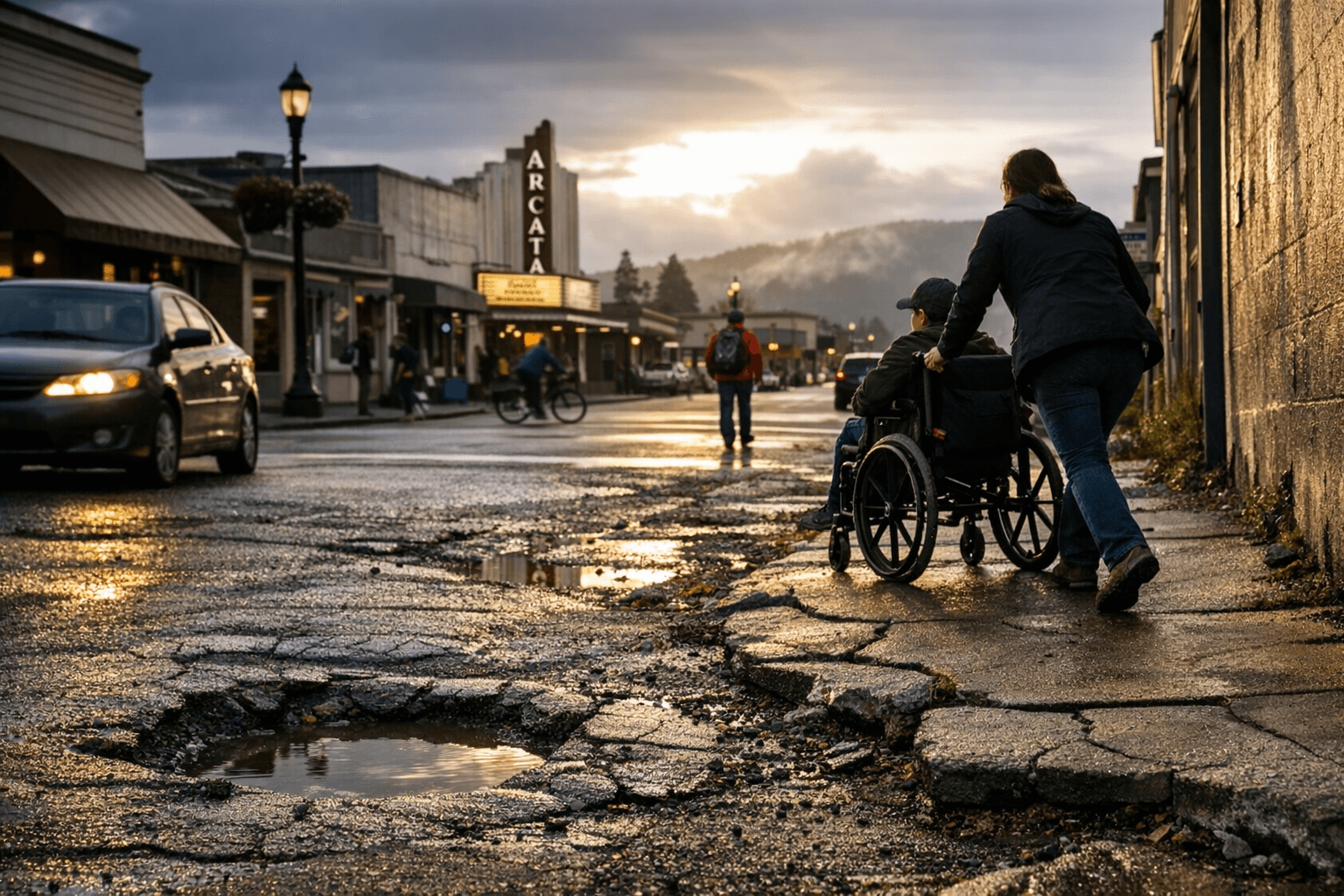
Elderly and mobility-challenged Arcata residents described narrow, cracked and missing sidewalks as daily hazards, and a City of Arcata FlashVote survey conducted Feb. 23–25, 2026 shows streets and sidewalks are the single highest service priority, selected by 69 percent of respondents, according to Mad River Union. One FlashVote respondent wrote, "The condition of many sidewalks makes it difficult for elderly and others with mobility challenges to safely navigate. They are very narrow (poor design and because of overgrowth), cracked and crumbling, and too often non-existent," a verbatim comment captured in the FlashVote assets.
The survey also ranks broad city goals: Mad River Union reported 73 percent of respondents selected "improving the local economy and quality of life for residents" and 71 percent selected "enhancing Arcata's appearance, safety and overall livability." Mad River Union framed the results this way: "For all the searing rhetoric about international politics at City Council meetings, the latest City of Arcata FlashVote survey ... reports that residents' top budget priorities center around everyday basics: the local economy, livability, roads, sidewalks and public safety."
Service priorities beyond streets included parks and city facilities at 62 percent and both public safety and economic development at 49 percent, Mad River Union reported. Lost Coast Outpost emphasized the transportation focus in its headline, "Arcata Residents Sure Do Like Their Roads," and summarized that "Almost 70% of them said they'd prioritize city funding for streets and roads."
The poll included budget-allocation exercises tied to recent ballot measures. Lost Coast Outpost reported that "Out of a hypothetical $100 earned from Measure H, Arcata’s latest sales tax hike, the average respondent said they’d spend $25 on the homeless, the most out of any category," while the same Lost Coast story also stated elsewhere that open-ended feedback implied a $22 average allocation to homelessness, a discrepancy that the published accounts do not resolve. FlashVote asset fragments show related item-level responses, including "Reduce impacts from homelessness 61% (116)," "Enforce codes (rundown buildings, litter, overgrowth, junk cars, etc.) 52% (100)," and "Clean up graffiti 12% (22)."
Measure G renewal surfaced as a conditional test of voter support: Lost Coast Outpost reported that "Another 57 people said they'd only support renewing the Measure G 0.75% sales tax if the revenue was spent exclusively on streets and transportation policies." Mad River Union noted that the FlashVote platform lets users sort results by neighborhood, indicating the potential for geographic differences in priorities that the city could use for targeted policy responses.
Methodological details and respondent counts warrant clarification before city leaders use the poll as a definitive mandate. Multiple sources describe the online survey as drawing about 240 participants; Mad River Union additionally reports 229 of 551 invited respondents, a 42 percent response rate, and a margin of error of plus or minus 6 percent. FlashVote interface fragments reference "Primary Residents (191)," and raw item counts appear in screenshots, suggesting different denominators for different questions. Those discrepancies indicate a need for the City of Arcata or FlashVote to confirm the final valid sample size and the full Measure H allocation table.
Council members and budget officials in Arcata face concrete voter signals on streets, livability and the local economy: the poll data point to priorities that could affect decisions on Measure G renewal, Measure H spending, code enforcement, sidewalk repairs and water rates in the months ahead.
Know something we missed? Have a correction or additional information?
Submit a Tip