Archaeologists uncover 1,700 years of history beneath Notre Dame square
Four meters below Notre Dame square, archaeologists have found a Constantine coin, medieval shards and hundreds of artifacts spanning 1,700 years of Paris.

Four meters below Notre Dame square, archaeologists are peeling back a living cross-section of Paris, where a 4th-century coin stamped with Emperor Constantine has surfaced beside medieval pottery shards with markings experts have not yet deciphered.
The excavation sits just outside Notre-Dame Cathedral on the Parvis Notre-Dame, where barriers and a wooden walkway now separate tourists above ground from the pit below. What began as preparation for a redesigned forecourt has become an unusually rich probe into the city’s layers, with hundreds of finds already recovered from the ground beneath one of France’s most watched landmarks.
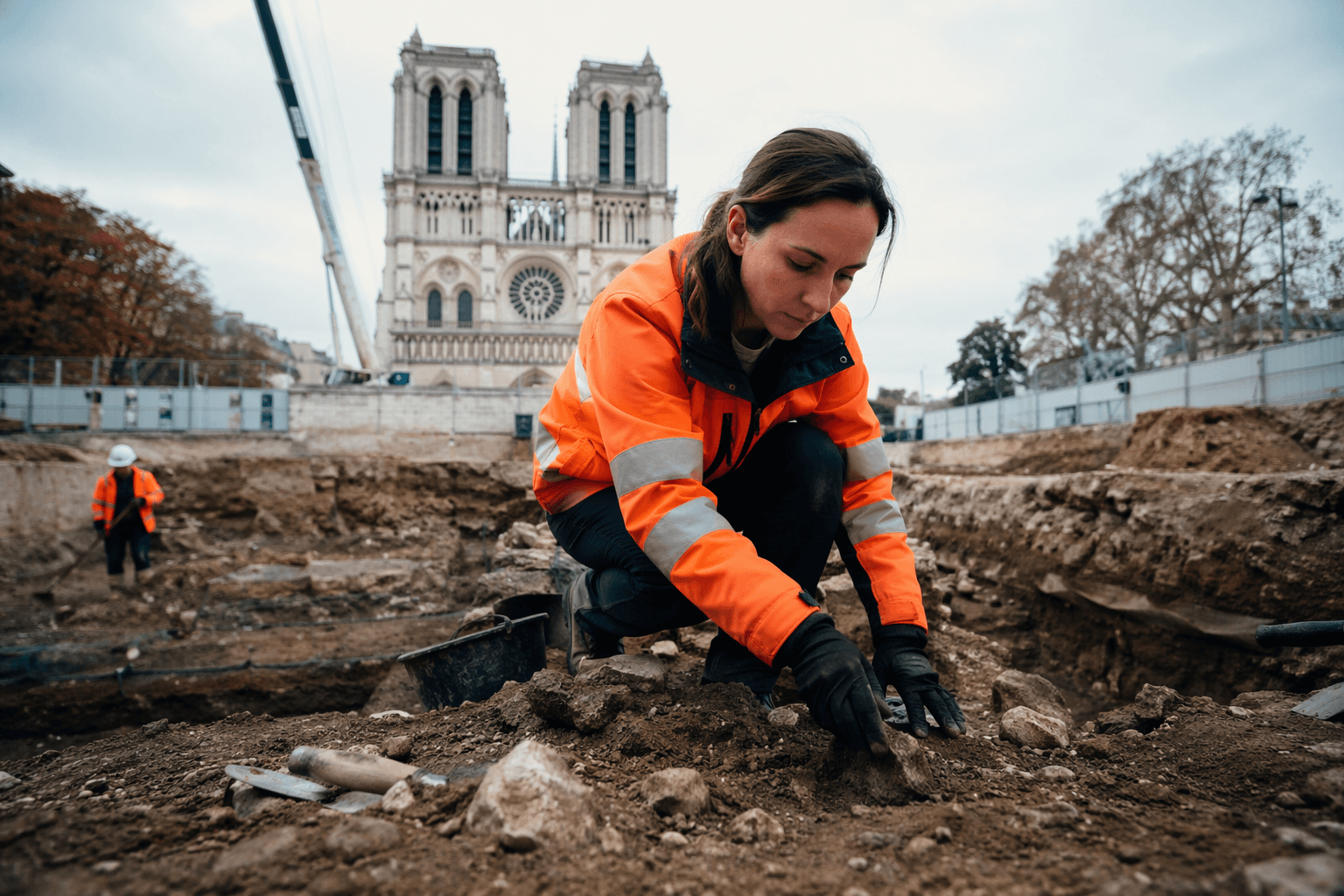
The work is tied to the wider rebuilding of Notre-Dame after the April 15, 2019 fire that gutted the cathedral and triggered five years of restoration. Notre-Dame reopened to the public on December 8, 2024, but the space around it is still being reimagined. Paris announced the winning design for the surroundings project in June 2022, and city officials say the broader overhaul should be mostly complete by 2028. The plan calls for a more vegetated, cooler public square and the conversion of the former underground parking area into a visitor reception space with services and amenities.
That push to soften the cathedral’s setting has had an unexpected effect: before the plaza can be reshaped, archaeologists have had to excavate what lies beneath it. French authorities assigned Inrap to preventive archaeology linked to the restoration after the fire, and the institute said in 2024 that it had spent five years working both inside the cathedral and in its immediate surroundings under state prescription.
The result is a timeline of Paris itself. Earlier digs at Notre-Dame uncovered major medieval remains, including elements of the 13th-century rood screen destroyed in the early 18th century. The current forecourt excavation adds the Roman period to that record, showing how the city was built upward over centuries, each layer compressing the one beneath it. For Paris, the dig is doing more than rescuing artifacts. It is forcing a debate, in real time, over what the city chooses to preserve, study and reveal about itself before the next layer of stone and landscaping goes down.
This article was produced by Prism’s automated news system from verified source data, official records, and press releases, then run through automated quality and moderation checks before publishing. The system is built and supervised by the people who set the standards it runs under. Read our full AI policy.
Did this article answer your question?


