Argentina posts $3.5 billion May trade surplus, topping forecasts
Argentina’s May trade surplus hit $3.5 billion, far above forecasts, as exports surged and imports fell. The beat tests whether Milei’s overhaul is durable.
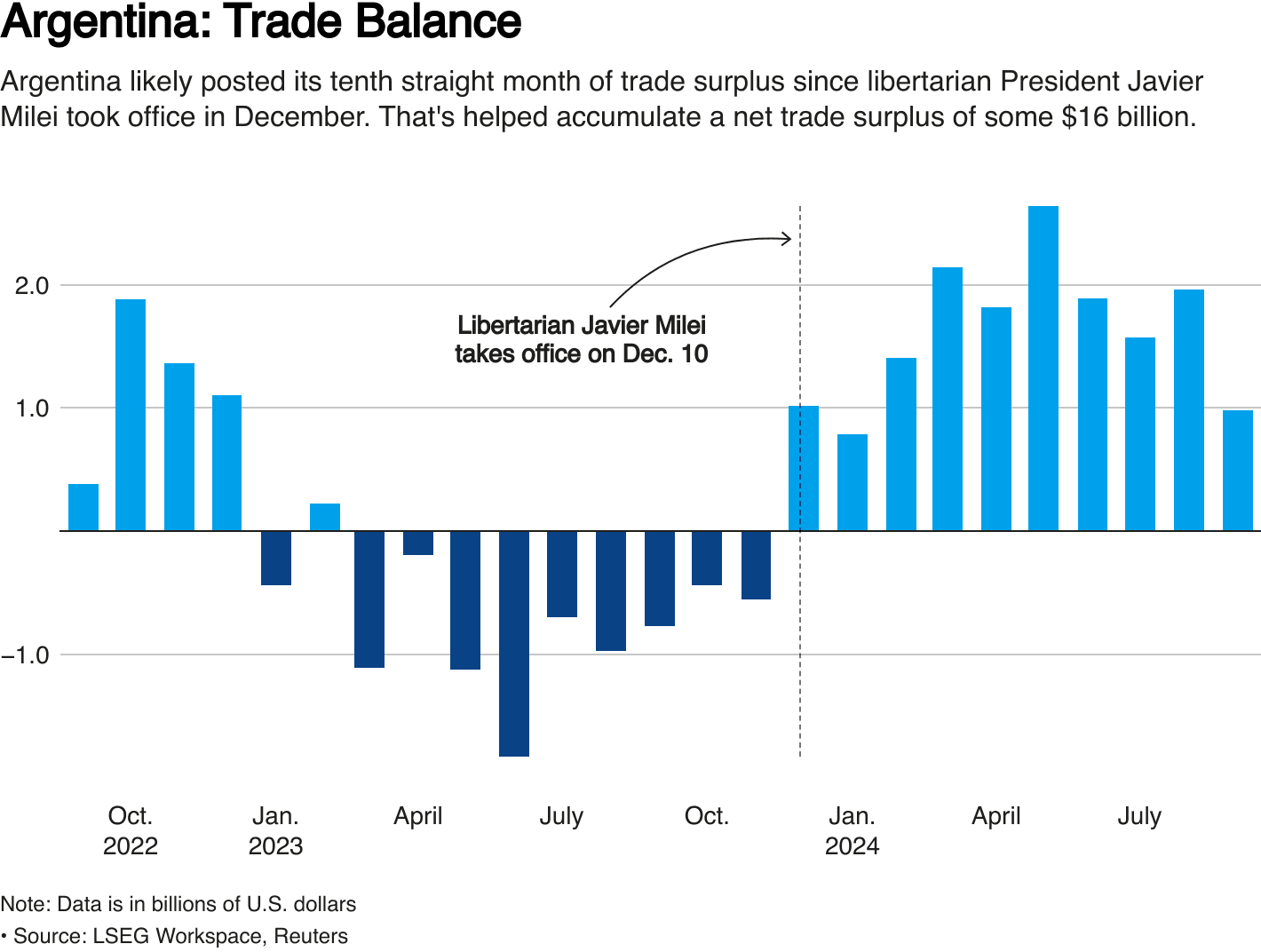
Argentina’s trade surplus widened to $3.50 billion in May, a result that landed well above economist expectations and gave Javier Milei’s government another boost in a closely watched source of hard currency. Exports totaled $9.54 billion, while imports came in at $6.03 billion, leaving a balance that underscored how much the economy still depends on foreign earnings to steady markets and rebuild reserves.
The number easily topped the $2 billion median forecast from a survey of 13 local and foreign analysts, whose estimates ranged from $1.3 billion to $2.7 billion. The latest figures suggest Argentina’s external accounts continue to outperform expectations even as domestic activity remains under pressure, a mix that has become central to the story of Milei’s economic reset.

The May surplus also pointed to a stronger first five months of 2026. On that basis, Argentina logged about $9.5 billion in cumulative trade surplus, sharply higher than the $1.9 billion recorded in the same period a year earlier. One analyst projected a full-year surplus of $15.8 billion, a sign that some economists see the current pace as more than a one-month outlier.
Energy was a major driver. One economist said the energy sector generated about half of the May surplus, while high international crude prices and continued agricultural shipments helped lift exports. Trading Economics said exports jumped 34.4% from a year earlier to a record $9.5 billion, with fuels and energy up 167.1%. Imports, meanwhile, fell 7.0% to $6.0 billion, with declines in fuels and lubricants, parts and accessories, passenger vehicles, capital goods and consumer goods.
That split is what makes the surplus such a useful stress test for Milei’s program. More export dollars can ease pressure on the peso, reduce external financing needs and support investor confidence in the government’s austerity drive and looser currency controls. But the same data also raise a harder question: how much of the improvement reflects durable export strength, and how much reflects recession-like weakness in imports and domestic demand.
The new reading came after April’s $2.711 billion surplus, the 29th consecutive month of positive trade balances, with exports of $8.914 billion and imports of $6.204 billion. INDEC also said first-quarter export prices rose 3.6% year on year and import prices 3.7%, evidence that prices, not just volumes, have been helping shape the trade picture. For Argentina, the latest surplus is both a relief and a test of whether the recovery is being built on a firmer base.
This article was produced by Prism’s automated news system from verified source data, official records, and press releases, then run through automated quality and moderation checks before publishing. The system is built and supervised by the people who set the standards it runs under. Read our full AI policy.
Did this article answer your question?