Armani 15% Stake Sale Advances amid Complex Will and Foundation Veto
armani’s will requires sale of 15% within 12–18 months to LVMH, L’Oréal or EssilorLuxottica; bidders are in due diligence but no firm bid six months after his death.
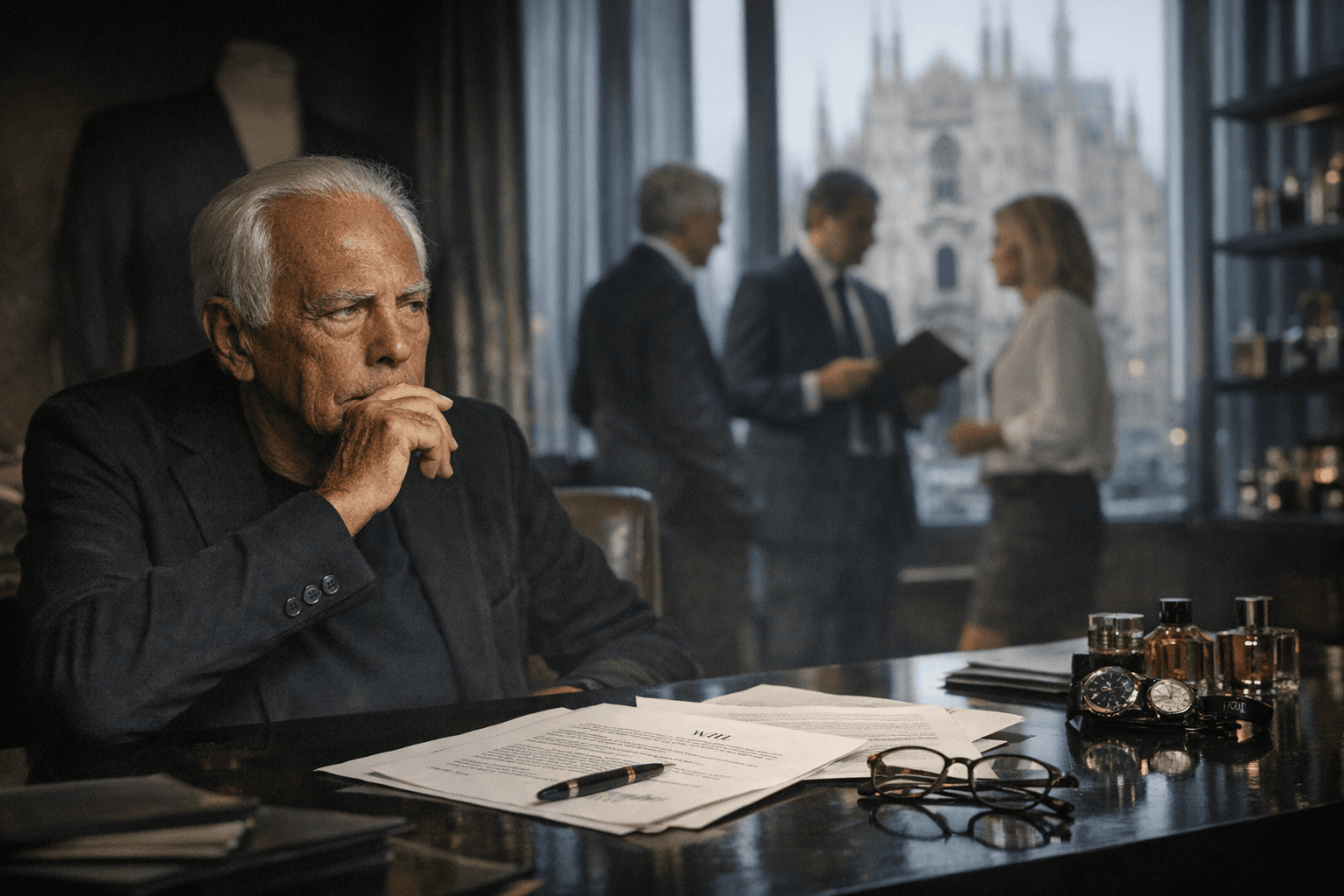
Giorgio Armani’s testament has activated a legally tight divestment: the first 15 percent of Armani Group must be sold within 12–18 months to LVMH, L’Oréal, EssilorLuxottica or a similarly ranked buyer, and potential acquirers are now in the data room though no firm bid has been reported six months after Mr. Armani’s death. The will gives the initial buyer 15 percent of voting rights and the ability to appoint a board member, and it expressly allows an IPO if no buyer is found.
The will does more than mandate a 15 percent sale; it stages control shifts. A further stake of between 30 percent and 54.9 percent is to be sold to the initial buyer between three and five years after Mr. Armani’s death, while the Armani Foundation is written to retain a significant block of power. The testament sets a clear hierarchy of priority bidders and preserves an option structure that could hand a single strategic partner a controlling economic interest over time.
Family and governance mechanics complicate any takeover. The estate’s structure includes six different share classes, and pantaleo dell'Orco is shown retaining 40 percent of voting rights despite a smaller capital holding. Sources present conflicting figures for the foundation’s retained share - one line shows the foundation will retain at least 30.1 percent, while an ownership table in circulation lists the foundation at 10 percent capital with 30 percent of voting rights - a discrepancy that will require the full will text and shareholder-class documents to reconcile.
Strategic logic points squarely at license partners. L’Oréal’s long-term partnership with Armani generates roughly €1.5 billion in revenue, while EssilorLuxottica’s tie to the label is likely around €300 million, and about 10 percent of those amounts are paid to Armani as royalties. Charles-Louis Scotti of Kepler Cheuvreux said, "L’Oréal’s licence with Armani runs to 2050 so there is no risk of non-renewal or breakup in the short term; however, it would make a lot of sense to secure the assurance that the licence is infinite [by buying a stake in Armani]." Scotti added, "For L’Oréal, the licence is probably the third-biggest luxury beauty brand of their portfolio after Lancôme and Yves Saint Laurent."
Market timing turns the sale into a strategic puzzle. The will’s 12–18 month window collides with "two and a half years into a luxury downturn" that has weakened aspirational labels such as Emporio Armani, and that context is explicitly cited as a complicating factor. Industry conversations remain active in Milan as bidders "are diving into the company’s books," yet reports say "half a year on the conversation around a sale or other transaction remains active but without a firm bid," and LinkedIn commentary notes that at this point the named companies have not publicly surfaced as interested parties.
What to watch next are formal offers before the 12–18 month deadline, clarity on share-class voting mechanics that lock Pantaleo Dell'Orco with 40 percent voting power, and whether the foundation exercises its veto rights on statute changes, capital increases and M&A. The will’s combination of staged sale windows, priority bidders and preserved veto power guarantees that the outcome will determine not only ownership percentages but the future of licensing income streams and board control for decades to come.
Know something we missed? Have a correction or additional information?
Submit a Tip

